




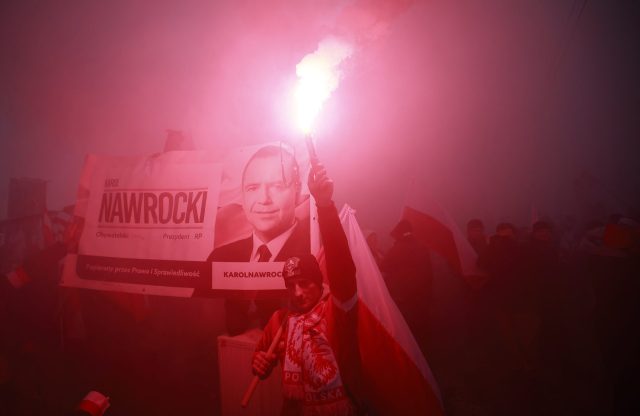
Protesters from both sides gathered outside the tribunal. (Woktek Radwanski/Getty)





In Poland, what started as a constitutional crisis, is quickly evolving into an all-out institutional civil war. It all began on 30 October, when Anna Korwin-Piotrowska — a judge elected to the Constitutional Tribunal earlier this year by Donald Tusk’s pro-EU parliamentary majority, but whom President Karol Nawrocki, elected by popular vote last year with the backing of the national-conservative Law and Justice party (PiS), had refused to swear in — declared herself in charge of the court and suspended its president and vice-president, appointed under Nawrocki’s PiS-aligned predecessor, Andrzej Duda. From there, riot police were sent to surround the building: officially to protect judges and staff, but in practice to make sure the Tribunal’s leadership couldn’t get back in.
While all this was happening, Nawrocki himself was flying to Senegal for an official state visit. Once he heard the news, though, he ordered his plane to fly back to Warsaw. In the early hours of the following morning, he forced his way into the Tribunal amid crowds of protesters. Since then the two camps — Tusk’s government on one side, Nawrocki and the PiS-led opposition on the other — have been locked in a bitter standoff, each accusing the other of violating Polish law and the constitution. The opposition has called it a coup d’état — or, at least, given that the situation is still unfolding, an attempted one. Tusk, for his part, insists purging the court is necessary to “restore the rule of law”. Which rule of law, though? As we shall see, behind the domestic power struggle lies a much larger battle over sovereignty in the EU — and over who, ultimately, gets to decide what the “rule of law” means.
The standoff has since escalated even further. On 10 November, the Supreme Court overturned the suspension of the Tribunal’s president and vice-president. Two days later, when they both arrived at the Tribunal with the ruling in hand, the police refused to open the gates. Korwin-Piotrowska declared that the Supreme Court’s decision had “no bearing” on the suspensions, while the justice minister argued that the chamber that issued it was itself illegitimate. In other words, the government isn’t just overriding the Tribunal’s decisions but the Supreme Court’s as well. Meanwhile, on Monday, the central bank — headed by Adam Glapiński, who has longstanding ties to PiS — suspended payment orders involving the Tribunal’s accounts, citing doubts about who was legally authorised to represent the institution. The decision has drawn strong criticism from the government.
The latest chapter in the country’s long-running constitutional crisis began in March, when the Sejm (Polish parliament) elected six new judges to fill vacancies on the 15-member Tribunal — seats Tusk’s coalition had refused to fill since taking office. It argued that the Tribunal had been “captured” by PiS — every sitting judge had been appointed during the party’s eight-year tenure, which ended with Tusk’s victory in 2023 — and was no longer a proper court, and that electing its own judges would have meant recognising a court it considered illegitimate. Moreover, a seat can only be filled once its holder’s nine-year term expires, and in the coalition’s first years in office that meant just a handful of vacancies: not nearly enough to tip the balance. The coalition’s preferred plan was to reform the Tribunal through legislation and reset it wholesale, but that plan ran into Duda — and then into Nawrocki. At that point, Tusk switched to plan B — judicial appointments — especially since by this year the number of vacant seats had risen to eight, enough to shift the balance.
Nawrocki, however, refused to accept the oaths of five of the eight new judges, citing irregularities in their election, as well as the political nature of some of the nominations. The government accuses Nawrocki of acting on political grounds: if all the new judges took their seats, the PiS-era members would become a minority, losing control of a court that can strike down government legislation. Tusk also argues that Nawrocki’s refusal is unconstitutional, since the constitution gives the president no role in vetoing judges elected by parliament.
On this point, the government can count on some heavyweight backing. The Venice Commission, the Council of Europe’s advisory body on constitutional matters, has said that the president’s role in the swearing-in is purely ceremonial; in May, the European Court of Human Rights ordered Poland to remove the obstacles preventing the new judges from taking up their seats. The Tribunal itself, however, reached the opposite conclusion: in a ruling issued that same month, it found that the president is under no absolute obligation to swear in judges elected by parliament. The point here is that Poland’s judicial question is legally contested — and that the government chose to settle it not through political mediation but with riot police.
Throughout its time in power, PiS was accused — both by the Tusk-led opposition and the EU — of politicising the court and undermining its impartiality and independence. Indeed, most accounts trace the origins of the current crisis to PiS’s decision, in 2015, to appoint judges to three seats that had already been filled by the outgoing majority — a coalition led, then as now, by Tusk’s Civic Platform (before winning in 2023, Tusk had previously been prime minister from 2007 to 2014). What these accounts usually leave out is that PiS was itself responding to a move by the outgoing Civic Platform-controlled Sejm, which had elected five judges to the Tribunal just weeks before the parliamentary election. The Tribunal later ruled that three of those appointments were valid, but that two were unlawful, as they filled seats falling within the incoming parliament’s term; the new PiS majority, however, declared all five void and elected five replacement judges of its own.
In many ways, then, what is happening now is a replay of those events, with the roles reversed. For all the accusations levelled at PiS of “politicising” the court, it is hard to see how the current government’s conduct is any different. Coming from a PiS-backed president, Nawrocki’s complaints about the political nature of the new appointments may be hypocritical, but they are hard to dismiss when one of the new judges served in Tusk’s cabinet until this summer and is described by Tusk himself as his “right-hand man”. The hypocrisy, it would seem, runs both ways.
Indeed, Tusk’s pro-EU government may well be right that Nawrocki is bending the rules by refusing to swear in the judges, but its own appeals to the rule of law ring hollow, given its own evident willingness to bend the rules. Even legal scholars who have spent years denouncing PiS’s judicial policies, and who have no sympathy for Nawrocki, have argued that Korwin-Piotrowska’s decision to suspend the Tribunal’s president and vice-president has “no legal basis” and “violates at least five provisions of the Polish Constitution”. One thing is clear: this is not a battle over the rule of law, but over replacing one form of political control with another — by any means necessary. Courts, prosecutors, the police, the presidency, even the central bank: every arm of the state has been drawn into the fray — a reminder of how quickly democratic norms can unravel once politics becomes an existential fight for power.
Yet this is also about much more than a showdown between government and opposition. To see why, one needs to understand why the Tribunal matters so much. It is not just the arbiter of whether the government’s laws are constitutional; it is also the body that decides, in the last instance, how the Polish constitution relates to EU law — and therefore whether Poland’s legal order can be overridden from Brussels. At its core, then, this is a battle over sovereignty in its most fundamental form: when the two collide, which legal order should prevail — the Polish constitution or EU law?
In the past, the Tribunal has ruled that the final word lies with the Polish constitution, something Brussels has never forgiven it for. The supremacy of EU law over national law is not enshrined in any of the treaties; it was created by the European Court of Justice (ECJ) itself, in its 1964 Costa v ENEL ruling. From there, it has become the engine of EU “integration through law”: by constantly creating new “laws” through its rulings, almost always in favour of “more Europe”, the ECJ has effectively become the bloc’s most important constitution-writing body, hollowing out national constitutional and legal systems from above.
A national constitutional court that rejects this principle poses an existential threat to Brussels. This is the real reason the EU was so implacably hostile to Poland under its previous government (and to Viktor Orbán’s Hungary, for the same reason). The landmark moment came in October 2021, when the Tribunal ruled that key provisions of the EU treaties, as interpreted by the ECJ, were incompatible with the Polish constitution, insofar as they allowed EU law to override it and EU judges to rule on how Poland organises its own judiciary. In effect, the court declared that, in matters reserved to the constitution, the final word lay in Warsaw, not Luxembourg. Brussels responded with infringement proceedings against Poland and financial blackmail, freezing tens of billions in EU funds, officially over the PiS government’s judicial reforms. It later took the case to the ECJ, which, unsurprisingly, ruled in December 2025 that the Tribunal had violated EU law by rejecting the primacy of the latter — and, for good measure, that it was not even a valid court. In other words, a national constitutional court was declared illegitimate by a supranational one for daring to defend its own constitution.
This, ultimately, is what Brussels and Tusk mean when they accuse the previous government, and the Tribunal itself, of violating the rule of law: that they dared to challenge the rule of Brussels’s law. This is the law Tusk wants to restore. It also explains why Brussels has thrown its weight behind Tusk. The Commission has insisted that parliament must be free to appoint new judges: effectively demanding Nawrocki validate them. The Tribunal, said Justice Commissioner Michael McGrath, must operate “in accordance with the Polish constitution and the case law of the Court of Justice of the EU”. Meaning: the latter must take precedence over the former. Unsurprisingly, McGrath had nothing to say about a government sending riot police to take control of the country’s highest court.
In broader terms, what is happening in Poland is part of a wider trend that one may call “liberal authoritarianism”: pro-EU governments using every means at their disposal, including blatant violations of the rule of law, to entrench their grip on power and keep the opposition out of it. Since coming to power in late 2023, Tusk’s coalition has shown scant regard for constitutional norms and institutional independence: it has seized control of the public broadcasters by ministerial fiat, bypassing the media regulator, and ignored the Tribunal’s rulings, refusing even to publish them in the official journal as the law requires.
Tusk’s move against the Tribunal should also be seen as a way of pre-emptively tying the hands of a future national-conservative government. Polls suggest the Right could return to power in the autumn 2027 election; backed by a sovereigntist president and Tribunal, it could resist further EU centralisation. Taking control of the Tribunal now is one way of making sure that doesn’t happen. In the shadow of Poland’s constitutional crisis, meanwhile, the Sejm has just passed a bill that would allow it to sanction anyone deemed to support “foreign interference and manipulation in the information environment” — with breaches of sanctions punishable by up to 12 years in prison.
All this has been met with silence in Brussels, when not openly applauded. As a former president of the European Council and staunch pro-integrationist, Tusk, it seems, enjoys a near-total exemption from the scrutiny Brussels reserves for its critics. Nor is Poland an isolated case. From Hungary to Romania, appeals to an abstract and hypocritical “rule of law” have barred candidates and overturned elections, even as the AfD in Germany lives under the constant threat of a ban. Across Europe, the pattern is the same: the rule of law is invoked to suspend the rule of law, while democracy is dismantled by the very EU establishment that claims to defend it.
Thomas Fazi is an UnHerd columnist and translator. His latest book is The Covid Consensus, co-authored with Toby Green.
 battleforeurope