




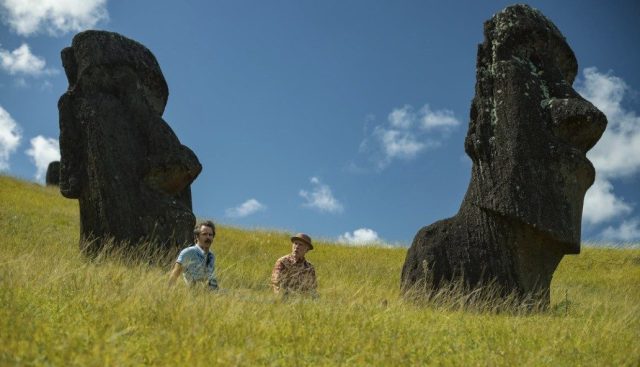
‘Do you ever get paranoid that you’re not being paranoid enough?’ (Wild Horse Nine/IMBD)





“Do you ever get paranoid that you’re not being paranoid enough?” asks John Malkovich in Martin McDonagh’s new black comedy, Wild Horse Nine. It is 1973 and Malkovich’s character Chris, an ageing, morphine-addicted CIA agent, is fresh from plotting a coup in Chile along with his colleague Lee (Sam Rockwell). The pair have decamped to Easter Island where Chris, high on opiates, starts blabbing the agency’s secrets to whoever will listen: his part in the Kennedy assassination, and his more recent work plotting to topple President Allende. “Enjoy him while you can, ladies,” he tells two Chilean students he comes across at the airport. “Your country is gonna get fucked.”
Some early viewers have been offended by the movie’s “cool, jokey complacency”. The jokes come mostly “at the expense of the myriad political victims of America’s relentless interventionist politics”. Certainly, for those used to the paranoid thrillers from the Seventies like The Parallax View (1974) or The Domino Principle (1977), which sought to lay bare America’s secret history, McDonagh’s flip, caustic tone seems a deliberate affront. In place of Deep Throat’s gravelly sotto voce in an underground garage, we have a spook laughing about messing up other people’s countries while on a mini-break.
McDonagh, in having Chris spill secrets from his bar stool, deliberately upends the conventions of the great conspiracy thrillers of the Seventies, which depended on the scarcity of disclosure. Their climaxes usually came with a congressional inquiry or a newspaper scoop: Sydney Pollack’s Three Days of the Condor (1975) ends with Robert Redford’s CIA bookworm on the pavement outside the New York Times, having handed over the story. All the President’s Men (1974) ends with a fusillade of teletyping. To adapt the old Watergate maxim, crimes require a cover-up to register as crimes — and a heroic press to unmask them.
Fifty years on, the secrets are out. Or rather, the secrets are content. Conspiracy theories are the raw material of some of the most popular podcasts and YouTube channels in the world, and they are regularly spouted from the presidential podium. Meanwhile the actual record has never been more available: WikiLeaks cables, Edward Snowden’s slides, and tens of thousands of pages of JFK files declassified by presidential order. There is, if anything, too much of it. Revelation no longer registers, in the same way that Trump’s malfeasance barely registers, because he is so open about it. Asked in January why he was allowing so much conflict of interest, he said plainly: “because I found out that nobody cared.” Why bother with the cover-up?
The flourishing of American paranoia in the Seventies took its cue from Richard Hofstadter’s seminal essay The Paranoid Style in American Politics, first published in November 1964. For Hofstadter, this political approach was used by everyone from John Robison to Joe McCarthy, waving his lists around frantically in hearings. It was pedantic, mock-scholarly, piling up documents and footnotes, then leaping from real facts to a fantastic conclusion: usually the unmasking of the hidden enemy set on destroying American civilisation. For all the implausibility of, say, Hollywood being a hotbed of Soviet sleeper agents, the paranoid worldview ends up more coherent than reality, because it leaves no room for accident or ambiguity. Everything can, ultimately, be explained. The paranoiac is therefore a dramatist who has forgotten they are making it up.
If the style of Seventies paranoia cinema owes a lot to Hofstadter, it is Dick Cheney we must thank for much of the content. At a lunch with editors of the New York Times on 16 January 1975, President Ford was pressed on why anyone should trust the commission he had appointed 12 days earlier to investigate the CIA. The agency’s own internal record of its past operations — the so-called “Family Jewels” — held material, Ford said, that would “blacken the reputation of every President back to Harry Truman”.
“Like what?” asked one of the editors.
“Like assassination.”
When Ford’s commission duly reported that June, the assassinations weren’t in it. Cheney, the president’s 34-year-old deputy assistant, had gone through the draft with a pen, paying particular attention to the 86-page chapter on plots against foreign leaders. He inserted recommendations the commission had never voted on, deleted ones it had, and, where the commission had found CIA activities unlawful, recast them as merely exceeding statutory authority or as “improper”.
Cheney’s pen marked a bad day for American democracy but a great one for the country’s thriller writers. The reality of the CIA’s plots, even in the redacted form that appeared in the report of the Senate’s Church Committee that November, was a catalogue of bungled kidnaps and assassination attempts, subcontracted to Mafia hoods, Cuban exiles and Corsican gunmen, and, cigars poisoned with botulinum.
It was enough, in the words of the report, to “strain the imagination” — and the gap between the redacted public record and the reality fed thriller writers and Hollywood screenwriters with the myth of CIA invincibility for 50 years, in everything from Sam Peckinpah’s The Killer Elite (1975) to Oliver Stone’s JFK (1991), which gave the CIA a starring role in Dallas, right up to the Bourne films, which have the CIA tracking a man across Europe in real time from a bank of screens in Langley.
When the agency’s darkest skeletons were finally declassified in June 2007, director Paul Greengrass printed out all 693 pages and gave them to the cast of The Bourne Ultimatum (2007) — in retrospect, maybe the last gasp of the paranoid style in American filmmaking. The movie’s Operation ‘Blackbriar’ was directly based on the illegal surveillance operations of CIA counter-intelligence chief James Jesus Angleton which over two decades had secretly opened more than 200,000 letters passing between the United States and the Soviet Union as well as indexing some 300,000 Americans for being in the anti-war movement.
Today, believers don’t need official documents. Online, they can find thousands of fellow fantasists to back up their ideas and algorithms to amplify their most outlandish theories. The Covid pandemic proved a ferocious accelerant. Uncertainty about whether everyone else would follow the rules fed a more generalised distrust not of the “enemy above”, as Jesse Walker puts it in The United States of Paranoia (2013), but the “Enemy Within”: paranoia directed not at shadowy government agents, but at neighbours behind their picket fences and lawn sprinklers. As a Twilight Zone episode once had it, the monsters are on Maple street.
The circle of distrust narrows, but it never quite reaches the mirror. What the paranoiac fears most is not persecution but irrelevance. Better to be the object of a thousand plots than to discover that no one is thinking about you at all. That is Chris’s predicament in Wild Horse Nine. Malkovich plays him as an Angleton gone to seed, monologuing into a Dictaphone for a memoir to be published after his death, and blabbing state secrets to strangers to watch them react. He isn’t a whistleblower; he’s a man testing whether disclosure still has any voltage, and finding that it doesn’t.
This is the condition Hofstadter didn’t foresee: not that the paranoid style would turn apocalyptic, but that its apocalypses would become so commonplace as to be banal. The hero’s discovery is everyone else’s Tuesday. What’s left, when revelation is worthless, is loose-lipped farce. In HBO’s White House Plumbers (2023), the Watergate burglars, as played by Woody Harrelson and Justin Theroux, are bunglers straight out of Veep: they can barely get through a door. Chaos or conspiracy? How about both?