




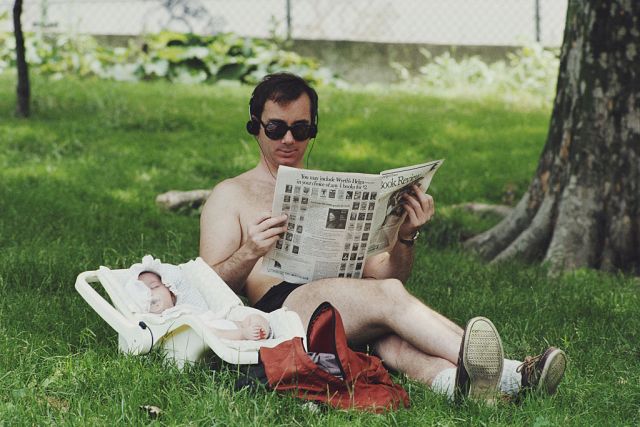
Hands-on time with small children decreases brain volume. Credit: Getty





Fifteen days after Theodore Roosevelt’s daughter Ethel was born, in August 1891, the future president left his wife and four children for a six-week recreational hunting trip out West. There were no pressing matters of business or politics to attend to. Roosevelt was only a civil-service commissioner at the time, so his casual absconsion from his newborn child can’t be dismissed as the atypical privilege of an atypically powerful man. He just wanted some guy time.
This anecdote stunned me when I encountered it in the celebrated Edmund Morris biography of Roosevelt: today, such behavior would be considered rank betrayal of the wife, or even child abuse, given the expectations placed on fathers since women entered the workforce.
The story came to mind recently, when I encountered the convoluted arguments of clinical psychologist Darby Saxbe in her recent book, Dad Brain: The New Science of Fatherhood and How It Shapes Men’s Lives. Saxbe presents new research on the neuroscience of paternity that provides some insights into “dad brain” — a euphemism for the stress, fatigue, and depression often brought on by early parenting. But she argues that the condition is good for men and families, a conclusion that her data does not support.
I read the book in hopes of curing my own case of “dad brain.” Since becoming a father five years ago, I have often felt that my brain is turning to mush. But my hopes were disappointed.
Saxbe is the head of the NeuroEndocrinology of Social Ties Lab at the University of Southern California in Los Angeles. She researches the brain science of paternity, with a focus on fathers’ involvement in “hands-on” childcare, performing observational, longitudinal studies measuring various aspects of fathers’ brain activity and hormones before and after the birth of their first child. On average, she has found, a man loses “about 1% of his prenatal brain volume” when he becomes a father. Testosterone levels, too, “naturally drop to support their parenting role.” The effect sizes often increase with the volume of childcare. This is true of testosterone, gray-matter shrinkage in the cortex, activity in the amygdala, changes in oxytocin levels, and the daily downward trajectory of cortisol.
Saxbe argues that “the downsized paternal brain” reflects “more readiness to parent,” and that these changes are positive. When men turn up their childcare “dial,” she contends, everyone benefits: “It’s not just children who gain an advantage from hands-on dads. These fathers reduce their partners’ stress. They enjoy better marriages….”
Unfortunately, the book suffers from a foundational contradiction. The author claims that fathers are innately “wired to participate in care,” because their brains and bodies respond to babies in ways that “prime nurturing and sensitive caretaking behaviors.” But most of these supposed adaptations only “come online when fathers invest time and practice into parenthood” — that is, when they agree to abide by the prescription that fathers should participate in childcare.
If fathers “need parental experience in order to trigger adaptation” in the brain and helpful changes such as increases of oxytocin, this does not technically support the interpretation that fathers are “wired” or even “primed” for hands-on caretaking. If that were the case, there should be evidence of brain changes before, during, and after the birth of a first child, but before the father submits to the practice. This is precisely what we find with mothers, who lose nearly 5% of their grey-matter volume during pregnancy, before they have engaged in caregiving.
The argument, more accurately, is that fathers can adapt to childcare, to some degree, when they have to.
Saxbe believes they should have to. And her own language betrays both her biases and the incoherence of her position. She writes, “I’ve heard the claim that parenting doesn’t come naturally to men because they lack the biology for it…. But new research can help us shift that narrative by showing us that great parents are made, not born.” If we’re “shifting the narrative,” that means parenting doesn’t come “naturally” to men: it’s constructed. The transformation, as her own data suggest, requires paternal submission to norms and expectations they prefer to avoid — not to mention acceptance of public-messaging campaigns in the form of parenting books.
This bias leads to a great deal of circular reasoning. For example, Saxbe points out that fathers who had “a greater sense of meaning” showed lower stress and found more satisfaction after their child arrived, so she suggests that struggling fathers find “meaning in the everyday toil of parenting.” Because many fathers “fear” that by doing childcare, they will break “an unspoken code of masculinity,” she lauds one psychologist who asks fathers to bring their child into his office as “a form of exposure.” Finally, she reasons that “time, practice, and experience help shape the brain,” and reports that “fathers who took paid leave showed smaller increases in stress and sleep problems after their baby’s birth” — the cure for not wanting to do childcare is more childcare.
In other words, if a father gets brain damage and depression from doing the unnatural work of hands-on childcare, he should find meaning in his suffering, go to a therapist who treats masculinity as a phobia, and keep doing childcare until the brain damage and testosterone decline makes him forget what vigor ever felt like. If none of the above works, he might consider an inpatient stay at the University of Southern California Re-Education Camp.
Would fathers and families be better off if the man steered clear of the kiddie stuff? Perhaps staying away from infants, in favor of securing economic resources and warding off external threats? Saxbe never asks this foundational question.
Ample data from many fields indicate that fathers are rather wired to avoid hands-on infant care. The book admits in passing that only 5% to 10% percent of mammal species feature males who care for their young. It also concedes that fathers today contribute more to childcare than “even the most hands-on hunter-gatherer dad.” In the American anthropologist John Whiting’s study of 136 preindustrial cultures, Saxbe notes, the typical arrangement in about half of the cases is that mom and baby sleep together, and dad sleeps elsewhere. Looking elsewhere, I found that the Standard Cross-Cultural Sample of 186 societies shows “regularly close” contact between fathers and infants in only 3 of 154 cultures, about 2%.
Where Saxbe does consider men who work outside the home and avoid all childcare, she frames it as an eccentric privilege exclusive to “billionaires,” never acknowledging that this has been the historical norm for all men, including working-class men. The British social historian Tim Fisher’s 2006 study of working-class British fathers from 1900 to 1939, for example, observed that hands-on care of babies was not expected of fathers at any time in this period.
One of the most inconvenient facts for Saxbe is that, while paternal involvement with childcare has only a weak effect on real outcomes for the child or family — for example, in two large British samples, how frequently fathers changed babies’ diapers and fed them in the first year of life was not correlated with children’s later behavioral problems at ages 3, 9, or 11 — it has a measurable negative effect on income. In 1993, Norway mandated four weeks of paid leave for fathers, which increased the number of men taking leave to 40%, up from 4%, but had only a small effect on children’s test scores at age 16. It did, however, reduce the later earnings of fathers who took the leave, and possibly their partner’s earnings, too.
The trade-off between paternal childcare and paternal effort in the economy is thus far from obvious. Compounded over time, it is possible that a family’s lost earnings from paternal childcare outweigh the benefits, especially given that when his child is an infant, most of a father’s wage growth is yet to come.
There is also the issue that the parents’ personal interests are often in conflict. Saxbe found that mothers recovered better after work when their partners did more of the housework. For the partner, of course, “more housework” represents a loss of professional or personal time that won’t be recaptured. This zero-sum dynamic is suggested by Saxbe’s own research, despite that she goes out of her way to deny it — in the book’s introduction, she explicitly says parenting isn’t zero-sum, for example.
The primary beneficiary of Saxbe’s cultural engineering is the mother, at least those mothers who have been raised on expectations of gender-neutral parenting, at a cost to the father and the family’s economic security. The book demonstrates a clear physiological and psychological trade-off between the husband’s vitality and the wife’s. “Dads who lost more volume in the cortex told us they had worse sleep quality after birth,” Saxbe writes. “They also felt more depressed and anxious, and they had more mental-health problems, even when we adjusted for their mental health during pregnancy…. The same brain adaptations that seemed to track with fathers’ time and bonding with their infants also signaled mental health risks.” The testosterone findings point in the same direction: men with lower T — presumably those who are doing more childcare and have adapted to it better — “struggled more with their mental health.” Higher-T dads — who presumably feel better overall — “found parenting more challenging” and, no surprise, their partners were “more depressed and unhappy in their relationships.”
Dad Brain attempts to rewrite one of the most universally observed tendencies in family formation on the grounds of neuroscientific evidence which itself does not support the book’s argument. The author sometimes seems to be aware of this, and makes thin, post-hoc justifications such as that she is trying to share a fuller range of options for a diversity of modern family types. She allows that in some cultures, dads who aren’t hands-on make sense, because “a father who drags home a tasty goat increases the odds that his child will survive past infancy” (notice the slightly pejorative, cave-man coding), but dismisses it because “our parenting culture expects a hands-on, low-T style of fatherhood.”
If “our parenting culture” — defined by the female-majority family sciences — expects a high level of involvement from fathers, then neuroscientific data ought to be tortured into a public advocacy campaign promoting paternal involvement. This is the book’s true reasoning. I found it useful in reverse: it taught me just how important it is for fathers to avoid hands-on infant care at all cost. And if we wonder why our society no longer produces Theodore Roosevelts, Dad Brain has accidentally given us the answer.