




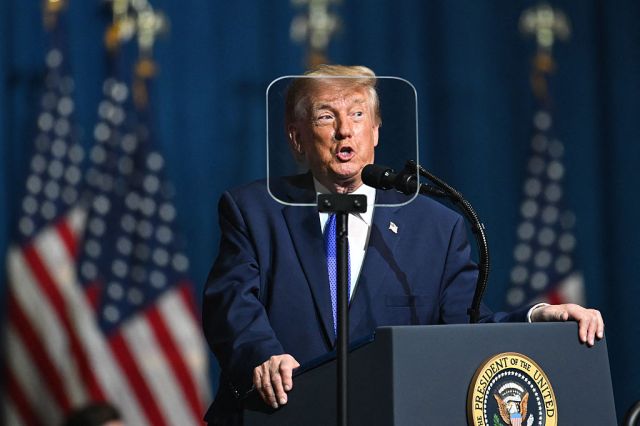
‘The midterm elections were a referendum on Trump’s handling of the economy.’ (Kent Nishimura/AFP/ Getty)





Last week, Donald Trump joked that $5,000 could at most buy you a hamburger and “maybe a small dessert” at Mar-a-Lago. “It’s not a good place if you’re price conscious,” he said about his Florida beach club. It was a typically tone-deaf comment. The price of beef is a particular sore spot for Americans, since it is a key ingredient in the fast food that defines the American way of life, and its price has soared by 22% since Trump took office last year.
When he was re-elected in 2024, Trump promised to bring down prices; instead, he raised them with his tariffs and his ill-fated war in Iran. The inflation rate, which had been running at 3% when he took office, is now approaching 4%. No wonder Trump’s Republican Party suffered a crushing defeat in Tuesday’s mid-term elections, in large part due to the nation’s worsening cost-of-living crisis. This week, even his own past supporters turned on him.
But the cost-of-living crisis that is reshaping American politics is not confined to the US, nor is it likely to go away soon. The UK is facing similar inflationary pressures. The Office of Budget Responsibility (OBR) now expects this year’s inflation rate to average out at 3.1%, up from the March forecast of 2.3%. It expects inflation to peak next year at 3.8% before settling down for a year-long average of 3.4% — a full 1.4% above its March forecast.
Much of the discussion surrounding the current inflation spike focuses on the impact of Trump’s war on the price of energy. The assumption is therefore that the high prices are temporary. The OBR assumes that by 2028, the UK inflation rate will be close to the Bank of England’s 2% target once again, making this inflation shock transitory. Ahead of the mid-term elections, Trump made much the same argument: that the price surge will prove fleeting.
Unfortunately, we’ve heard this before. The word “transitory” doesn’t have great currency among economists these days. The original inflation surge of 2021 was initially waved off by central bankers as a brief aberration, but here we are, in the sixth year of above-target inflation that we keep hearing is about to come down. Other than during a brief period in 2024, inflation has not returned to the 2% target Western central banks have set for it.
In fact, since last spring inflation has been on a steady upwards march — a trend we cannot attribute merely to the energy shock caused by the Iran war. In Britain, the European Union, America, Canada and Japan alike, the core inflation rate — which strips out energy and food prices to try and capture underlying pressures — has been stubbornly above target. At some point, you have to ask: when does this stop being temporary?
It appears there is something more than just an energy shock driving up inflation. For a while now, some economists who study the economic impact of climate change have been predicting that the inflation rate will move permanently higher. We may now be in the foothills of what could turn out to be higher peaks.
It had long been assumed that a gradual alteration in climate would over time affect the global economy, with countries such as Canada actually benefiting (from longer growing seasons) and poor tropical countries losing out. But we’re now seeing that the increased incidence and severity of extreme weather events is having a greater impact. Such events hit countries such as Canada harder, since there is so much more infrastructure and hence capital to be damaged or destroyed. In 2023, a summer of wildfires in Canada made it impossible for people to work in agriculture, forestry and mining in affected regions, while rail transportation had to be suspended, further hindering economic activity. As a result of smoke forcing citizens across large swathes of the country to stay indoors, there was an economic contraction that knocked the country’s per capita income back 1.3% that year.
The problem isn’t limited to Canada. Since the Sixties, the average annual number of extreme weather events has risen sevenfold. In the past few years, they’ve begun to take an unprecedented toll: of the 10 costliest extreme-weather events on record in the US, six occurred in the last decade. In Europe, this was seven. In Canada, nine out of 10 of the most costly years insurance companies have ever had to bear have taken place since 2011. These events do the most economic harm in the nations with the most capital to destroy: in 2023, four-fifths of the economic damage due to extreme weather occurred in developed countries. Not only are these catastrophes damaging property and infrastructure, they are raising insurance costs, which ultimately works its way into prices.
On top of this, rising food prices due to poor harvests resulting from drought, storms or flood damage are driving food inflation. The reason beef prices in America have risen so fast is that a persistent drought, attributed in large measure to higher temperatures, has depleted the US beef herd. President Trump may say climate change is a hoax but such declarations can’t stop prices rising. And the rising cost of food has an outsized influence on voters’ perception of inflation.
Similarly, while the surge in electricity prices has been attributed to such things as Britain’s gas-dependent pricing system or the excessive demand of data centres in the US, the truth is that energy bills are rising largely because of the costs involved in strengthening infrastructure against harsher weather. One study estimates that electricity bills could rise by as much as 25% in the US to cover these impacts. In that vein, Avanti West Coast rail recently had to pay British customers £20 million in refunds for delays caused this summer, mainly because the current train tracks were not built for such temperatures. Higher running costs will, of course be passed on to customers.
Since December 2019, there has been a relentless pressure on climate-sensitive price categories. US consumer prices have risen by 29%, but home insurance has risen by 37%, electricity prices by 43% and food prices by 35%. Similarly, in the UK over the same period, consumer prices have risen 33% but food prices have risen 38%. Such pressure raises the latent inflation rate. The result is that when exogenous shocks such as the recent oil spike occur, their effects are amplified. In his testimony to the Treasury Committee in September, Bank of England Governor Andrew Bailey and his colleagues said that climate change is causing greater volatility in supply shocks and that, over time, the subsequent pressure on inflation will be more upwards than downwards.
To make matters worse, higher inflation will be structural, not cyclical — which is to say the normal approach of central banks, of raising interest rates to reduce demand, won’t work. Assuming interest rates remain permanently higher, that will ultimately affect the pricing of other asset markets.
Take the property market. Benjamin Keys, an expert on the financial risks of climate change at the University of Pennsylvania’s Wharton School, suggests that falling house prices are being obscured by countervailing cyclical trends. Though rising storm risks have sharply lowered prices in parts of Florida, the Covid real-estate boom and the trend of boomers retiring to warmer climes have helped to soften overall price declines. Keys argues that unlike earlier falls in asset prices — which were caused by cyclical bubbles that, once burst, eliminated excesses in the economy and put markets back on a sustainable path — such re-pricing will occur for as long as climate change progresses. This permanently higher inflation rate is a feature of something I call the “Icarus effect”: that economic growth triggers a set of ecological, social and political changes which raise the cost of further growth, ultimately slowing it down.
Though the UK Chancellor John Healey may not be a climate denier like President Trump, he has joined many other Western governments in walking back some of Britain’s Net-Zero commitments in order to lower prices for consumers. Yet while this could reduce costs in the short term, it will aggravate the underlying problem. By trying to reduce inflation, Western governments could inadvertently entrench it.
John Rapley is an author and academic who divides his time between London, Johannesburg and Ottawa. His books include Why Empires Fall: Rome, America and the Future of the West (with Peter Heather, Penguin, 2023) and Twilight of the Money Gods: Economics as a Religion (Simon & Schuster, 2017).
 jarapley