




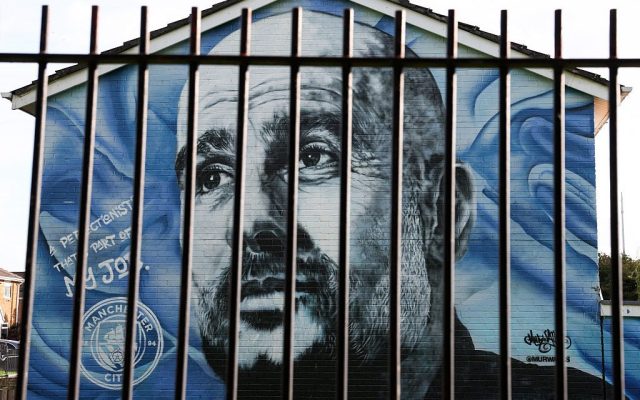
A mural of former Man City manager Pep Guardiola. (Molly Darlington/Getty)





“The imagined community of millions seems more real as a team of eleven named people.” So said Eric Hobsbawm — and it’s hard to disagree that football holds a mirror to society, the ebbs and flows of the beautiful game evolving in parallel with our island story. From the Football League’s origins in the industrial North and Midlands — an original product of grassroots, working-class communities emanating out from church, pub and factory — the English top-flight has now transformed itself into a globalised, deracinated brand, lauded for its ”soft power” and as the prime cultural export of “UK PLC”.
It’s a story that runs adjacent to another of Hobsbawm’s prescient observations: that of the “forward march of labour halted”, the implosion of the industrial proletariat and coherent, local, domestic economies, leaving only a wasteland of borderless, transnational capital in its wake. Sure enough, ownership of the terraces, the money behind the badge, was gradually transferred from provincial entrepreneurs, civic dignitaries, butchers, brewers and small family businesses, to sovereign wealth funds, private equity and a strange caste of billionaire oligarchs — the very trajectory of our “imagined community” in microcosm.
What does it say about Britain, then, that arguably the most successful club of this century has been found to have cheated its way to the top? Manchester City — founded by Anglican churchmen to ameliorate the effects of alcoholism and unemployment then blighting their parishes, and now symbolising a country beholden to greed and Gulf State spivs. Britain’s successes, like City’s, are built on the vagaries of “fictitious capital”, and our Exchequer, like the Premier League, is still reliant on the kindness of strangers. Meanwhile stadiums that were once ensconced among red-brick terraces, with punters paying on the day at the turnstiles, now resemble alien spacecraft, appropriate enough for a nation that has swapped architectural heft for theme-park prices and glass-and-steel hospitality suites for the out-of-town crowd.
City’s own trajectory is telling enough. Shortly before the First World War, the team faced financial scandal — when their star Welsh forward Billy Meredith bribed a rival £10 to lose a match. Earlier this year, The Blues were found to have inflated club revenues and understated costs by up to £900 million. Over the same period, from 2009 to 2018, they pursued illicit funding schemes in the name of third-party sponsors but which were, in fact, paid by the club’s Emirati owners.
From a footballing perspective, the root of the crisis, which could see the club docked points and ultimately relegated, are restrictions on spending that apply to all clubs — relative to their highly differential incomes. In this way, the rules preserve a de facto corporate monopoly over any sustained period of top-flight success, ensuring that the three or four teams with established, internationalised, inward flows of cash can maintain their dominance indefinitely. Manchester City cooked the books to inflate its income, then spent to compete with the best, and in turn became the best. The club’s fault, then, ultimately lay in breaking open a closed shop by underhand means. But the real question is whether City could ever have joined football’s elite without breaking the rules.
The Prime Minister himself has urged caution before any punishment is meted out, lest his erstwhile Mancunian citadel lose out on any investment. If Sheikh Mansour were forced to sell his club as a result of financial deception, “I’d be really concerned”, Burnham told the BBC in September. After all, the Abu Dhabi moneymen hadn’t just been a “huge partner” in building City “into the global force that it is”, but also “in the building of modern Manchester”. Burnham was, of course, forced to row back on these comments following a public backlash: as Downing Street was quick to clarify, no one was “above the rules” after all.
And so we find ourselves in a bind: with Britain as usual a supplicant to the whims of more agile and dynamic centres of global capital, but forced into pained expressions of distaste when the outcomes of these relationships are exposed. Our openness to the parasitism of a rentier private sector, and our fawning over super-wealth, has necessitated endless new layers of a cumbersome regulatory state — and which still neatly fail to improve behaviour. And so we become more officious still, piling on the quangos and the state-sanctioned bureaucratism, all while failing to create the structures and institutions that truly enforce and incentivise moral propriety.
The faux-incredulity of the pundit class, the pearl-clutching and feigned surprise, conceals the fact that Manchester City is no outlier in terms of net spending over time. Indeed, it’s an extreme outgrowth of the industry and the political economy that helped shape it. The financial rules City breached benefit only the clubs that have already banked their fortunes, and that have then had the gall to dress up “profit and sustainability” as a defence of sporting integrity. Chelsea FC come to mind, the West London beneficiaries of post-Soviet kleptocracy. For their part, Manchester United’s owners threw obscene money at a failing squad for years — all backed by unparalleled global revenues — before abolishing the £100 Christmas bonuses for ground staff. Meanwhile, Man United’s billionaire investor Jim Ratcliffe went cap-in-hand to the Government to arrange public-private deals for new stadium investment, all while sitting atop a global footballing empire.
Or else there’s the European Super League: a fixed non-event sitting outside and above the traditional football pyramid, American style, with no promotion or relegation, the door to new entrants welded firmly shut. This was only the most brazen expression of many clubs’ instincts, and City was among its putative founders until widespread fan fury scuppered the plans in just two days. Albert Camus, a goalkeeper as a boy in colonial Algiers, said that everything he knew “most surely” about “morality and the obligations of man” came from football. One suspects he had something more edifying in mind than the establishment of protectionist sporting rackets. The fact The Blues tried to even the score with doctored accounts makes them cheats, yes, but it doesn’t turn everyone else into honest brokers.
The former Leeds United chairman Peter Ridsdale was once mocked after he surveyed the wreckage of a debt-fuelled Champions League adventure, offering a line that has followed him around ever since. “We lived the dream,” he told reporters before Leeds descended precipitously down the divisions. “We enjoyed the dream.” He was widely ridiculed, and fair enough too, not least because Leeds had no silverware to show for their ill-advised £100 million binge. Yet if we put his words into the mouth of a City supporter, few would really quarrel with the underlying emotion. City, unlike Leeds, have their trophies. Plucked from mid-table obscurity and years of drift, spent in the shadow of their Salford neighbours, they rose to win the treble, painting Manchester blue. If and when relegation arrives, how many of those fans would say they’d swap it all to have finished a respectable ninth, perhaps to have yo-yoed between the Premier League and the Championship, but to have remained perennial underdogs fair and square, leaving the despicable levels of profligacy to the Red Devils? There’s a reason they sing “Sheikh Mansour, m’lord” to the tune of “Kumbaya”.
City and its fans took the logic of modern football, of modern capitalism, to its obvious conclusion: find a rich, morally tainted benefactor; buy expensive talent; win. It’s a model that has been pursued with vigour by every league-winning club of this century, and it’s the one that has turned the Premier League into an entertainment phenomenon watched by billions round the world.
Crucially, it’s also the model Britain has relied on for years to keep its high-income status. We spend more than we raise and buy more than we sell — the so-called twin deficits — and we cover the gap with other people’s money. So we’re open for business, whether that’s in the form of patient investment or as a laundromat for ill-gotten gains. We live off past glories, repackaging centuries of cultural output for global consumers, and we take money from all and sundry to paper over the cracks of decline with shiny new apartments. It’s not football’s job to create a new political economy in the shell of the old. To that extent, Burnham’s wobble over Mansour was simply candour, and the Etihad’s faithful merely have the admirable, “fuck you all”, us-against-the-world obstinacy to say the quiet part out loud.
Jonny Ball is a Contributing Editor at UnHerd. He formerly wrote under the name Despotic Inroad.
 DespoticInroad