




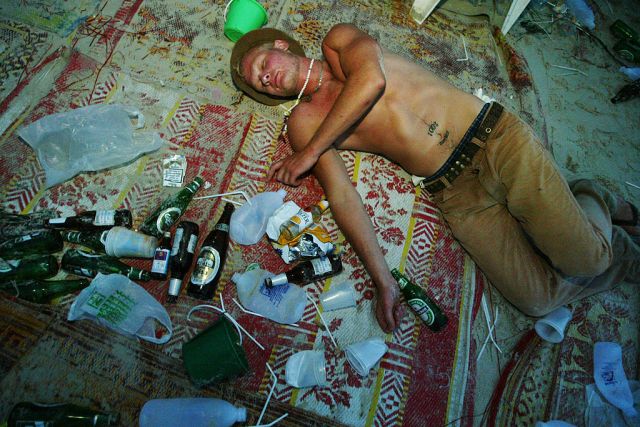
‘As might be expected, ketamine’s great American homecoming has come with consequences.’ Getty





Ketamine has come home. Readers may be surprised to learn that the medical anaesthetic was, like the Ford motorcar and the Tootsie Roll, born in the USA. The chemical was in fact synthesised in 1962 at a laboratory in Detroit, Michigan — an unlikely seeming birthplace given its reputation as a party drug across the Atlantic. In Britain and Europe, ketamine is king — beloved for its cheapness, its power to calm, to dissociate, to conjure hallucinations. Since the Nineties, “ket” has kept a tight grip on Ibiza dancefloors, Dutch EDM clubs and the kitchens of British house parties. Improbably, it made dancing to highly repetitive electronic tracks fun. In 2006, a study of clubbers in North-West England found 50% of trance-music enthusiasts had taken it at least once. In the intervening decades, that number kept growing. But, until recently, American party animals largely kept their noses clean. In the US, recreational use has always been more rare: by 2010, 67% of British clubbers had done the drug at least once in their lives, while equivalent American stats consistently hovered below one in five.
Yet in the past decade, the US has started to catch up. Ket use in New York City, according to a survey of clubbers there, has rocketed. In 2017, the general proportion of clubbers who’d done the drug at least once was 16.6%; by 2024 it was 22.7%. As the data gets more granular, it gets more surprising. Over these seven years, the proportion who’d done ketamine in the past month more than doubled; it more than tripled among women and, intriguingly, more than quintupled among bisexuals or those with “other sexuality” — more than any other demographic. A bag of ket, among this subculture, has become as de rigueur as a septum piercing. Fast-forward to this year, and a surface-swabbing study in NYC found that while cocaine was still the top dog (detected on 83% of surfaces), ketamine had nearly caught up, at 78%. MDMA, club culture’s erstwhile golden child, was at a measly 26%. Ketamine was found at all of the survey’s nine clubs, on every single one of the 15 nights. It is becoming a big deal.
As might be expected, ketamine’s great American homecoming has come with consequences. In 2023, the Friends actor Matthew Perry was found dead, face-down, in his swimming pool with a blood-ketamine level equivalent to what would be used for surgical anaesthesia. A long-term addict, Perry had sought legal ketamine therapy — then became hooked and sought it out through dealers. And in recent months, extensive testimony has emerged from the Cornell 7 case in which Jane Doe described being incapacitated by lines of “key”, as American Zoomers now know it. “The lights are on, but nobody’s home,” she told a university disciplinary hearing of the drug’s effects; whereas alcohol (which she’d also taken to excess that evening) disinhibits its user, ketamine dissociates them. Now, her and the seven accused men’s futures may rest on whether her intoxication — willingly doing lines at the Chi Phi frat house — proves or unravels her case. Whatever the outcome, Doe’s story shows the grisly consequences of combining a powerful and disabling drug with an extreme, and extremely confused, sexual culture.
To read the tea leaves for how ket’s American boom will play out, Yanks should look to the UK. In Britain, ketamine’s adoptive home as a party drug, there is an unglamorous epidemic of youths addled by memory loss, psychosis, addiction and, most notoriously, chronic bladder issues. More than one in four recent users report urinary symptoms, with some cases requiring major surgery; many addicts continue using ketamine — after all, an anaesthetic — to cope with the pain. One thing I noticed upon moving from the UK to America was the massive amount of billboard advertising related to “adult diapers”; if the ket boom continues, this investment will pay off handsomely.
Beyond beckoning a nation of bed-wetters, ketamine is worth paying attention to: it is useful as a symbol of the mood of detachment among the American youth. Though it’s a party drug in the sense that it’s used at parties, ket is not like cocaine or ecstasy. Its users are invigorated not by energy, intimacy or euphoria so much as they’re comforted by the high’s glorious stultification. So it is that, in your early twenties, a cluster of kids slumped on the settee is standard party fare while the coke maniacs bound and yammer. A first-time user might do it to fit in, but this drug is not ultimately about participation: though physically together, really the ket lot are opting out. Ketamine is becoming the Zoomer drug of choice because it dovetails with all of this generation’s favourite lonely pastimes: not roaming and relating but withdrawing, turning in. Ket is an atomising drug for an atomised age. Loafing, lounging, rotting: here is a drug designed for NEETs.
Like all recreational drugs, ket has a distinct class profile. Calvin Stevens, who developed the drug known then as CI-581 in Michigan, hoped to find an alternative to the longer-lasting and more psychoactive PCP, known on the street as “angel dust” and which, by the Eighties, had become strongly associated with young black men living in cities. In 1983, 86% of patients admitted to an East Harlem hospital for PCP-related psychiatric problems were black, despite this demographic making up only 32% of the hospital’s general patient body. Here, there is something analogous to the demographics and reputations of crack versus cocaine. PCP was dangerous, associated with violence and psychosis; its power to discombobulate was even a problem in its intended medical setting. Ketamine was a softer, safer alternative: it swapped delirium for oblivion.
These twin drugs developed opposite social identities. Where PCP was the choice of the urban black poor, ketamine travelled across the Atlantic, there to woo users who were more likely to be white, male and university-educated. Those crafty enough to sneak it into pubs could spend a cheap and pleasant evening retreating into their own heads. Angel dust was reputationally radioactive: “Down some dead-end streets there ain’t no turning back”, warned Gil Scott-Heron in his 1978 song about PCP killing a black clubgoer and devastating his family. British ketamine, by contrast, was a safer and less offensive diet version for Bristol-coded early-twenties yuppies. Affordable (typically less than half the price of cocaine), absent a crushing comedown and with an air of medical respectability, it suited the weekend hedonists who’d be back in the lecture hall by Monday for an “Introduction to Deleuze”.
So successful has this “Not A Big Deal” messaging been that ketamine has rapidly taken off as a legal off-label therapeutic treatment both in the US and UK for depression. Trials have long suggested that the drug is effective here. As ever, though, it’s worth being sceptical of any pharmaceutical interventions in the booming mental-health business, particularly when “microdosing” is advertised to users as a wellness-friendly alternative to weed gummies on Instagram — a lifestyle choice, a supplement. In Britain, we have a handful of specialist clinics, but America has widespread uptake. Joyous, the market-leading at-home telehealth ketamine peddler, has treated more than 90,000 patients since it launched in 2022. And no wonder; its message is appealing: leave yourself, find yourself. No derangement here, only psychological renewal. I can’t help but wonder whether the rehabilitation of ketamine’s image as a safe and clean medical solution has also helped launder its status on the illegal market, just as “ketamine therapy” appeals to experimental crunchy types who think sound baths are cool. Ambiguously perched between the doctor’s office and the DJ booth, ket has something for everyone.
This strange therapeutic afterlife is helping ketamine break America: when a drug can be found in stylish packaging in our vitamin drawer, it doesn’t seem so threatening even when it comes in a dime bag. It’s also what makes it perfect for the detached, depressive youths of this country. Here, a single drug has come to represent two of Gen Z’s favourite preoccupations: retreating from society and optimising the self. A drug sweeping through the frat houses of Ivy League universities is also being distributed as infusions, injections and oral preparations by slick clinics, a conspicuous new part of the private wellness economy.
But the honeymoon — the high — might not last long if Britain’s ketamine comedown is anything to go by. In the UK, the drug is the preserve of stumbling students, the poor man’s coke slung by dealers to freshers who’ll end the night vomiting in smoking areas. In America, ket is still new, still retaining a veer of medicinal legitimacy. Take it from us: this is a drug with real dangers, an addictive and incapacitating hit that could prove too tempting for a nation all too ready to tune out.
