




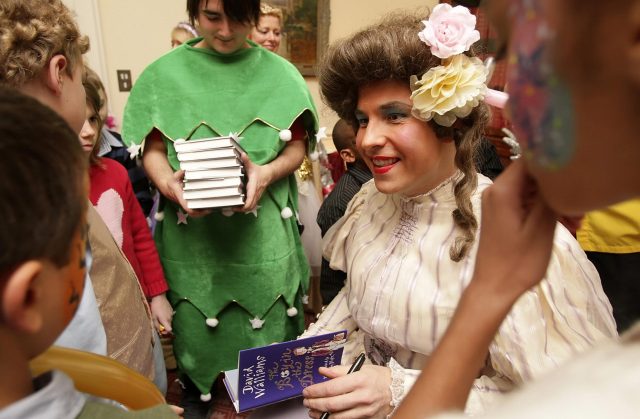
“The Boy in the Dress”. (Leon Neal/Getty)





David Walliams should have one of the most expansive and lucrative legacies in kids fiction. His fart jokes and stereotypes have sold 60 million books across the world, translated into 55 different languages. His characters even made it to Alton Towers, where a themed Walliams area featured “Gangsta Granny: The Ride”, as well as “Raj’s Bouncy Bottom Burp”. Until, that is, it was shuttered last week, just before the Walliamsverse imploded with allegations of grooming and abuse. Now no plucky tween hero with a sidekick dog can save it. His publisher has not only dropped him, but is no longer printing or distributing his back-catalogue of 22 novels and seven collections of short stories. No more new Walliams, no more old Walliams. That’s incredibly rare for a canon of that size and value.
And so, David Walliams ascends into that ever-growing anti-pantheon of writers who have been cancelled either posthumously or in vivo. While some parents proscribe Roald Dahl because the humour is crass, others object to his anti-semitism. Neil Gaiman lost his comic book publishing deal, and JK Rowling’s Harry Potter — give or take an evangelical book-burning session or two — is now protested more for the political beliefs of the author than the content of the books. But fan loyalty persists, even for the most egregious offenders. It’s easier to justify buying a problematic favourite when the author is long-dead and no longer in receipt of royalties, but walking home with a bagful of Harry Potter novels is likely to result in accusations of directly funding hate. The same is true of the upcoming Potter TV reboot, which will turn into a game of social-media chicken as viewers decide whether or not to risk admitting they watched it. At least they’ll have the choice. In the wake of the Walliams news, the BBC promptly removed an episode of Doctor Who he was in.
The trouble is, Walliams is one of a very small number of writers whom today’s children will insist on reading. Broadly aimed at ages eight to 12, the books have a natural constituency of readers who are old enough to have their own taste in stories, and young enough for that taste to centre on Walliams-style crassness. Theirs is the demographic for which fiction carries its strongest and most basic moral instruction, typically via colourful stories in which good behaviour is rewarded and bad is punished. The protagonist is invariably a child of similar age to the reader; all children are different, but not so different that they can’t relate to 11-year-old Harry, Ron or Hermione. Naturally, parents want the books to deliver appropriate messaging but, increasingly, they are expected to police their children’s interests based on very adult considerations. It’s no longer enough to decide whether the contents of a book are appropriate; the author must also pass a purity test. It’s not so long ago that Walliams’ first children’s book, The Boy in the Dress, was hailed as a progressive anthem, embraced by liberal parents for its message of acceptance and tolerance. Today, he’s not getting the grades. And parents are left wondering whether to explain that the funny man really was a baddie in disguise. It’s frustrating, because in the current childhood literacy crisis, kids need all the enjoyable books they can get. It is boys who are least likely to read for pleasure, and Walliams was one of the rare authors primarily read by them. Is it fair to demand they read something they enjoy less?
Some parents and teachers will greet Walliams’ demise with relief. The books might be popular with tweens, but have long been criticised for lazy writing, racial and class stereotypes and the general suspicion that four books a year smells a bit like a pocket-money grab. I have read several of them, and if they are turds, they’re the highly-polished variety. They are readable (damned with faint praise), sometimes linguistically witty (alliteration does a lot of lifting), and less reliant on snot, poo and farts than you might think. In a few years the whole thing will be moot, a cautionary tale fit for the fireside. In the meantime, what to tell the kids?
Becky, a mother of two, isn’t going to take the books off her shelves. “Partly because I feel squeamish about censorship, and partly because I don’t want to have to explain why to a nine- and eight-year-old. I try to keep the reality of sex crimes from them just now. They’re too young.”
Richard, now 24, was a Walliams superfan when he was eight. Little Britain was extremely popular on the playground, and the books were marketed as a natural successor to Roald Dahl. “I saw Walliams as a role model. I was a huge comedy fan in general, and wanted to be a comedian or performer of some sort. Little Britain and the Walliams books gave me permission to be silly, to create characters and not conform to male stereotypes, which of course is bleakly ironic in hindsight.” He tells me his older brother was reading the books, as were his peers. “Walliams was very popular even with boys who didn’t normally read, and it wouldn’t have crossed our minds to question why we were enjoying them. They were just instantly rewarding.”
By the age of 11 he had moved on to more mature prose, but this didn’t stop him from wanting Walliams to sign Mr Stink, his favourite novel by the author, at an event in a local bookshop. “I remember thinking he wasn’t particularly warm,” Richard says. “But afterwards, the book felt different. It was exciting that he had interacted with something that was in my hands and my house.” Richard’s edition became a venerated object; playground boasting rights, a core memory to be thumbed through at any time. He has no plans to get rid of it. He says that “by keeping the book, I’m not complicit in anything. It doesn’t mean I’m okay with what he’s alleged to have done.”
But while individuals can use their own discretion when it comes to Walliams and beloved tomes, schools have little choice in the matter. Many have already sent out emails reassuring parents they are on the case. One primary school teaching assistant told me this week that the kids had not mentioned the news, it perhaps being “above their heads”. But she still felt she had little option but to remove the books — because of the parents. “The only reason we are removing them is potential reaction from parents if their kid brings one of the books home,” she says. It’s hard to say whether those parents would be justified in complaining should their child be caught innocently reading The Boy in the Dress under the covers. But it’s easier for schools to avoid the issue entirely, undoubtedly damned either way.
We’re only briefly children, and those of us lucky enough to have been keen readers will be reluctant to let go of a foundational joy. I ask the school assistant to ask what will be done with the removed titles. She tells me the kids make Christmas tree collages from old books, so they might be used for that. “If not,” she says, “they’ll go in the bin”.