




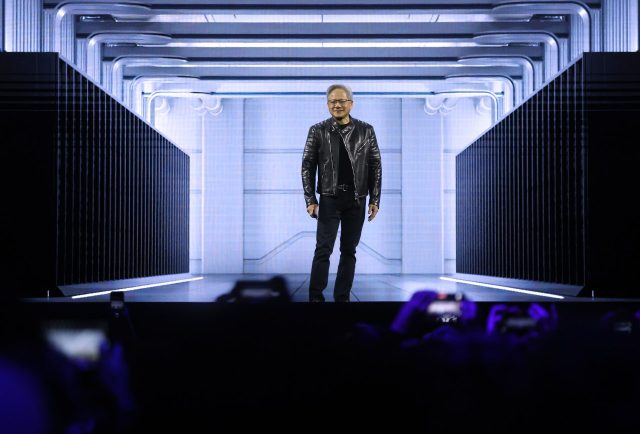
What will the Democrats do to Nvidia? (Credit: Justin Sullivan/Getty)





For most of the past decade, the political blob in Europe has been struggling with two things it does not understand. One is Donald Trump. The other is AI. Last week, Trump was battered in the midterms and AI-related stocks collapsed. What a wonderful day for the blob.
But that was last week. This week, Trump is back on his Truth Social sounding off about Democrat “sleazebags”, and the market is recovering. For the newspaper headlines were far more dramatic than the reality. The Nasdaq fell 4.8% — a correction, not a crash. The index is still up substantially over the past five years. A real tech crash would look very different.
Meanwhile, Europe still doesn’t get AI. The dollar and AI are what make America so powerful. The Europeans have a single currency, but no idea how to leverage it globally. And they are nowhere in the AI race. The gap between the US and China on one side and Europe on the other is massive and unbridgeable. The only important European high-tech company I can think of is the Dutch company ASML. It makes sophisticated machines which edge tiny pathways into integrated circuits of microchips. Further down that food chain are a couple of German companies that supply the precision optics. That’s good stuff. I raise my hat. Some of our old engineering skills do still count. But we Europeans are no longer at the centre of the world; our old maps are out of date.
We have sidelined ourselves by enacting a raft of disastrous anti-tech regulation. The General Data Protection Regulation (GDPR) might have started as an honest effort to protect people from abuse of their personal data, but it ended up a monster — a cookie monster. The legislation is a massive burden on small businesses in particular. And the AI Act has been an act of calamitous self-harm, preventing the formation of a viable AI industry here. Social networks are treated as criminal organisations that need to be censored by officially approved civil society organisations. We should have called it the Tech Business Destruction Act.
We can’t rule out the possibility that a Democrat-led Congress could usher in a Luddite phase by copying us — there are some Democrats who think like the Europeans. But I don’t think the party as a whole will go down this route. Bill Clinton, don’t forget, turned the Democrats into the party of financial capitalism. And both the Obama and Biden administrations supported US technology. My sense is that this new intake of Democratic lawmakers is different from the European centrist blob. Yes, they are certainly more cautious about data centres, which don’t provide many jobs and consume a lot of energy. But I have yet to see the rabid anti-tech vigilantes we have here.
In any case, there are limits to politics. We cannot un-invent AI, just as we could not un-invent the nuclear bomb. If a future US administration attempted to cripple Nvidia with ever stricter regulation, it would create a far bigger security threat than one posed by reports that Jensen Huang was dating a suspected Chinese spy. China is the reason America cannot just abandon AI as Europe has done.
Right now, the top Chinese AI companies are lagging behind OpenAI and Anthropic, but not by much. And these models can do mind-boggling things. I created my own AI-driven media app, by getting ChatGPT (which is brilliant at solving open maths problems) to give detailed instructions to Claude (which excels at software). After a night of intense hackery, my agents and I created something that would otherwise have cost me a fortune in software development. The idea that AI is just another bubble is spread by people who have no idea what it does and how it works. Many of them live in Europe.
And many of them are economists. There are honourable exceptions, such as Luis Garicano, who recently wrote that physical AI is currently the most important thing that is happening in the world. But too many approach AI through that familiar history of speculative bubbles: right about the valuation and wrong about the revolution.
The economists Carmen Reinhart and Kenneth Rogoff wielded an enormous influence on our thinking about what constitutes a bubble with their 2008 book This Time is Different. The title refers to a comment that market optimists have been using since time immemorial to justify high stock market valuations. It is the belief that whatever the technology they happen to be invested in at the time is special. We saw it play out with the Railway Mania in the 1840s, then with cars, radios, even bicycles. And most recently with the dot-com bubble. Investors were not wrong about the technology as such. The internet was indeed a big deal. But they made stupid bets on the wrong companies — like internet cafés in Europe.
The financial economist Robert Shiller gave us a way to assess these bubbles. He developed a metric to gauge whether the stock market as a whole is overvalued: the Cyclically Adjusted Price-to-Earnings (CAPE) index. Think of it as a smarter version of standard measures like price-to-earnings ratios. Right now, Shiller’s CAPE stands at 40.7, close to the all-time peak of 44.2 reached during the dot-com bubble in late 1999.
Taking into account the work of Reinhart, Rogoff and Shiller, it would indeed be rational to bet that AI has pushed stock markets into bubble territory. But be careful. The idea that AI is indeed different is based on something very real. Something that conventional economic analysis has undervalued: this technology is going to transform the inner workings of our economy. And it’s happening already. AI has decimated the white-collar profession of the legal assistant. It is coming for many more. The author Nassim Nicholas Taleb predicted that all jobs that were invented this century are prone to the AI tsunami. I agree. The financial sector in particular. Similarly, our think tanks produce tomes of biased and predictable analysis. The profession of the newspaper columnist, one I happen to know a little about, is also on that list. If I open the Guardian or the Daily Telegraph, and look at the columns there, I know exactly what each columnist is going to say. For AI, predictable, biased and unoriginal journalism is low-hanging fruit. So is pretentious modern art. No wonder that the blob is so alarmed. They are on the list too.
AI is going to have a substantial and measurable impact on the productivity of the entire economy. An AI-assisted law office or newsroom will be able to achieve the same output with fewer people. The productivity effect is not in doubt. But what is in doubt is the timing. History shows that we are often too pessimistic about the impact of a technology and too optimistic about the timing. Ten years ago, the car-tech fanboys predicted we would all have self-driving cars by now. Forty years ago, sci-fi movies suggested we’d be in flying cars.
If investors get the timing wrong on AI, the market might crash. The tech may have killed the legal assistant but it could take a lot longer for it to see off the mortgage broker or the high-street solicitor. Investors won’t wait indefinitely for promised profits to materialise. That said, progress in AI-driven robotics is proceeding fast and may bring surprises.
What we are seeing right now is how volatile today’s stock markets have become. The crash in Alphabet’s shares, Google’s parent company, tells us at the very least that the positive AI story is not a uniform one. As the economist Hanno Lustig remarked, current AI stock valuations presume “a structural transformation of US capitalism favouring capital at the expense of labour”. And this is AI’s inherent promise: the replacement of labour by capital. Reinhart and Rogoff’s book may have helped us be more suspicious about financial valuations, but AI isn’t another investment fad. It is a technological revolution. Make no mistake: this time it really is different.