




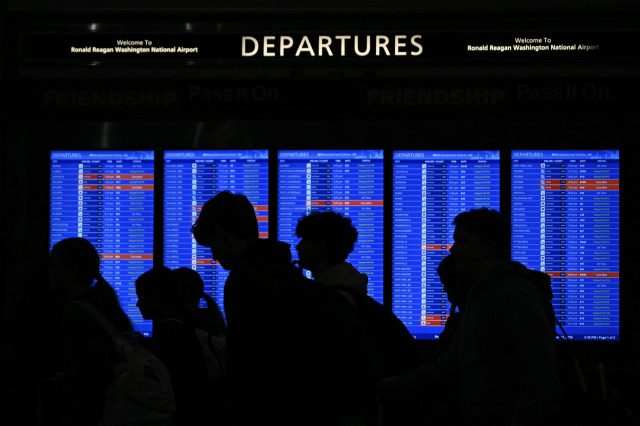
Last Friday, the US suffered cause of the longest nationwide flight outage since September 11, 2001.(Brendan Smialowski/Getty)





Last Friday, all air traffic in the United States ground to a halt for several hours as the Federal Aviation Authority (FAA) experienced a massive technical failure. Earlier that day, hundreds of millions of people worldwide were affected by a massive technical failure on Microsoft platforms — some of which went offline for roughly two days. Nobody even knew what had gone wrong.
In theory, these two incidents have nothing to do with each other. And, as a matter of fact, representatives from both Microsoft and the US secretary of Homeland Security have explicitly denied the two being connected. Superficially, of course, this is true: the Microsoft outage did not damage the FAA equipment. Yet, on a deeper level, these two crises are in fact linked.
According to the FAA itself, the cause of the longest nationwide flight outage since September 11, 2001 was the decrepit state of US physical infrastructure. The copper wiring that undergirds much of US telecom infrastructure is ancient. In the process of replacing a part of it with fibre-optic cables, some kind of systems error spread to and overloaded other parts of the sprawling flight control infrastructure.
Though the US handles the most flights of any country in the world, its physical infrastructure is far from world-leading. In fact, it is often 40 or 50 years old. And the $50 billion that the Trump administration has requested to upgrade it is still well below what the FAA claims it needs. Added to that, there’s a growing personnel crisis; the critical shortfall of trained air-traffic controllers is now so dire that the FAA has given up on solving it through recruitment efforts alone. To add insult to injury, the DOGE cuts did not spare the FAA: hundreds of probationary employees (many in charge of maintaining or upgrading its critical infrastructure) were laid off during those abortive efforts to constrain government waste. One potential solution that the FAA hopes will partially ameliorate these problems is to be found in AI. Of course, in yet another random coincidence, the newest FAA AI system (creatively dubbed SMART AI) happened to roll out just three days before this catastrophic systems outage occurred. Unsurprisingly, the FAA strenuously denies any form of connection between this AI rollout and the systems failure.
For its part, Microsoft has been increasingly reliant on AI coding for its own products. They strenuously denied that any internal use of AI could have anything to do with the massive outage it suffered, or the uncharacteristically long time it took for its engineers to restore functionality. Whether these denials really reflect the truth or not is an open question. Given the current precariousness of the entire AI sector, with more and more companies finding themselves over-leveraged and increasingly unable to borrow more money to fund their operations, it is clear that bad news is the last thing anyone needs right now.
Either way, the question of whether or not increased AI dependency caused these outages is much less interesting than the question of whether or not AI could cause other outages of this kind. And here, the answer is quite clearly yes. The FAA hopes to use AI as a cost-saving measure in order to employ fewer people (or at least make up for the reality that it can’t even find enough people to employ). Microsoft, and the wider tech sector in general, hope to use AI in order to replace coders, or at least hire far fewer of them. Already, the tech sector is in the middle of a dramatic jobs collapse for entry-level workers. The collapse in junior hiring means there won’t actually be that many tech seniors in 10 or 20 years’ time; our only hope is that the computers will have become so good at maintaining themselves that humans will no longer need to have a hand in the process.
In the realm of systems theory, a system can either be resilient or brittle when dealing with various problems and negative conditions. Resilient systems degrade slowly and gracefully, and tend to have built-in failsafes or counter-balances. Perhaps the best example of this is the human body itself, which possesses the nearly limitless number of tricks, adaptations, and self-repair routines necessary to deal with everything from blood loss, infections, broken bones, temperature swings, starvation and so on. A brittle system, by contrast, tends to shatter like a pane of glass: due to how it is designed, it is subject to rapid, catastrophic points of failure once its tolerances are exceeded.
As a technology, AI is an inherently brittle system, and it cannot be anything but. The primary reason for this comes down to what AI is supposed to do, which is to save money and increase efficiency. In vernacular language, “efficiency” is always a good thing, and more of it is supposedly always better. But in systems theory, efficiency is inherently oppositional to resilience. A fire station that buys three fire trucks to keep in reserve in case the one it is actually using happens to break down is clearly spending money inefficiently, but it is also one that is far safer to be around compared to one without spare trucks. Similarly, a company that fires nine out of 10 human staff because the AI can handle their tasks might be more efficient, but it has also gone from being a resilient company to a brittle one. Even during flu season, the chances of all ten employees calling in sick is close to zero: the chance of the AI computer system experiencing a failure that completely stops it from working, on the other hand, is far higher.
Historically, when societies are prosperous, they tend to favour resilient systems over brittle ones, seeing the extra added costs as a small price to pay for peace of mind and added security. Besides, they argue, they can clearly afford to splurge, so why wouldn’t they? Once societies and civilisations enter their autumn period, however, they increasingly turn to brittle solutions to their problems — hoping and praying that things turn out well despite the growing risks. To take just one example: during the heyday of the Roman Empire, it drew sharp distinctions between true Roman citizens and foreign barbarians, restricting the latter to less important auxiliary roles in its legions. As Rome began to decline, however, it no longer felt it could afford to do so. Towards its end, the Roman military mostly consisted of a rag-tag assembly of different tribes, most of whom could barely speak Latin at all. Having no loyalty to Rome beyond their next paycheque, these soldiers were quick to turn on Rome the second it was advantageous to do so. Today, we are clearly living in a period where all the hyped-up solutions to our problems (AI being just the latest and greatest) consist of cost-saving, labour-saving, efficient solutions, all of which have the side effect of introducing yet more points of brittleness — even as our electricity grids, sewage lines, and road networks all grow older and more decrepit.
All technologies aimed at increasing efficiency are brittle, but AI is uniquely so: significant points of brittleness are built into the very nature of how it operates. An LLM is nothing less and nothing more than an incredibly large and complex statistical model: it cannot reason, or think, or remember things, or do any other parts of human or animal cognition. Instead, it transmutes vast oceans of human writing, music, and other artistic output into a series of numbers, and then spits out an output which is itself just another series of numbers translated into a language or a picture or a snippet of audio.
The reason this is worth pointing out is that this basic aspect of LLM functionality is what makes them reliant on training data: a human programmer learns to code by reading a book and studying examples, and then thinks and reasons from there. A coding LLM does not think nor reason: it must begin from a gigantic trove of already existing code in order to then generate a statistical model of what code is. In other words, it is dependent on human labour in order to function, even as the job envisioned for it is to replace humans. LLMs that are exposed to the output of other LLMs quickly degrade into uselessness and incoherence through a process known as model collapse. The unavoidable result of widespread AI adoption — insofar as that adoption replaces humans — is the creeping degradation and eventual collapse of those AI systems themselves. AI depends on human creativity and ability to function, but its adoption undermines that creativity and ability: why would young people ever learn to code if they can’t work as coders?
AI (or so the FAA hopes) will one day make for a world where even fewer air traffic controllers manage the thousands of planes up in the sky at any given moment; AI (or so Microsoft hopes) will one day mean you can roll out new features twice as fast with only half as many coders earning only half as high a salary as they do today. And though the technology is unique, we truly have been here many times before.
Whether the invention of (LLM-based) AI represents a “revolution” or not is a hotly debated topic at present. Regardless of where one comes down on that issue, it’s worth pointing out that the area AI promises to revolutionise is the art of cutting corners. Today, we are “merely” dealing with sudden and unexplained record-breaking service outages, deferred maintenance, and ruthless cost-cutting. But, given the path we are currently on, it’s not inconceivable we might soon be dealing with electricity outages and planes falling out of the sky. As history teaches us, once a society becomes obsessed with finding new and novel ways of corner-cutting above all else, disaster soon follows.