




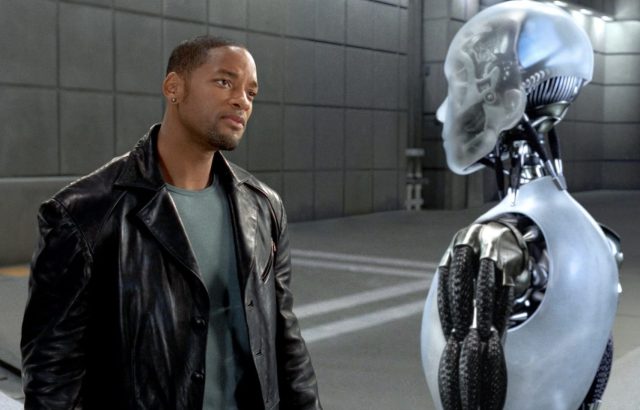
Though this month’s outages have caused irritation rather than catastrophe, they are an unfortunate demonstration of Western brittleness. (I, Robot/IMDB)





Spare a thought for the US officials who, in a more innocent time, designated this November as their country’s “Critical Infrastructure Security and Resilience Month”. To put it diplomatically, things have not gone wholly to plan. To put it bluntly, they’d have had an easier time organising Pride Month in Tehran.
Usually, cybersecurity incidents are solved before they affect the public. More recently, though, failings have become increasingly visible. On 11 October, the refrigerators of 700 French supermarkets were hacked, resulting in losses stretching into the millions of euros; on 29 October, the crypto exchange Binance suffered its biggest ever theft, losing $6.3 billion of assets (of which it successfully froze about half) to a group of hackers working for North Korea.
Last week, the pace picked up, and America embarked on a generational run of outages. It started on Tuesday, when Apple services, such as iCloud and Mail, failed for 90 minutes. From Thursday to Saturday, Microsoft services, among them Outlook and Teams, were disrupted in 74 countries. (Japanese workers dusted off their fax machines.) On Friday, the Federal Aviation Administration (FAA) grounded all flights in America — its longest stop since 9/11 — and on Monday some customers of Chase bank found their accounts inaccessible and transfers impossible. As if to stoke alarm further, it was reported on Tuesday that the NSA’s internal communications network, used to communicate highly classified material, was down too.
The spooks attributed the outage to “routine maintenance”; other affected organisations blamed botched updates, or, in the FAA’s case, a misfiring router in Arkansas. Still, these were very visible failures, all clustered into a single chaotic week. Donald Trump’s assertion that there was nothing to worry about — “It’s life”, he said, standing beside Narendra Modi at a summit in the Philippines — did little to quell public worry.
America, CNN reported, was “on edge”. Were massive cyberattacks to blame? Was it rogue AI setting up beachheads for itself? Does the country face blackouts? Bank runs? Doom? Online, a former White House press secretary said he was entering “full prepper mode”; on Capitol Hill, politicians on both sides of the aisle demanded answers. Hakeem Jeffries, the Democrats’ minority leader in the House of Representatives, told reporters that events were “troubling” and that it was unclear whether “malignant activity” was to blame. Josh Hawley, a GOP senator, said: “If this is all a coincidence, it’s the greatest coincidence in the history of the world. I mean, you can’t tell me that all of this just is happenstance.”
It is not happenstance. The FAA’s dodgy router, if that is indeed the sole culprit of the 12,000-odd cancelled flights, appears unrelated to the broader trend. But there is indeed a broader trend: of advanced AI models finding flaws in ancient code, and of cybersecurity teams trying — and sometimes publicly failing — to stay ahead. “It’s just crazy at the minute,” explains Conor O’Neill, the chief executive of OnSecurity, a cybersecurity firm.
O’Neill’s industry has been in turmoil. Last month, security researchers reported that they used AI to find a vulnerability in PHP, a coding language used widely across the internet. The discovery prompted a scramble to patch each website that used the language — and scrambles of this variety can result in outages, even of some of the most recognisable websites around. There were 32 British government services temporarily taken offline. Then, on Tuesday this week, another major vulnerability was found, this time in the ubiquitous programming language Java. “It used to be every couple of years, these kind of game-changing vulnerabilities where you really have to drop everything,” O’Neill says. Now it’s every few weeks. “I think it’s going to be a lot more regular.”
But the turmoil is not simply a story of rushed patch-up jobs initiated by public-spirited research. It is also a consequence of the proliferation of AI agents, which can be instructed in natural language — that is, conversational language rather than code — to work on the same task for hours at a time. They undertake this work using capabilities that are, in some respects, far higher than a human’s. For instance, hackers can now employ what are known as “swarms” of agents, instructing them to find weaknesses before extracting data or cash. “You can just be running an AI agent the whole time,” says O’Neill, “and it can operate faster than any human.”
One might wonder where these agents emanate from, not least because the mainstream large-language models (LLMs), whether they are made in the US or in China, are programmed to refuse any requests on the part of their users to conduct hacking operations. More powerful models exist, but are typically withheld from the public while they undergo safety testing. For instance, Anthropic’s Mythos models have, since April this year, been accessible to partner organisations — select governments, defence bodies, telecommunications providers — who are using them to eliminate vulnerabilities. Public release will come later.
But certain software already enables malignant actors to use LLMs as tools for hacking. Last Friday, the FBI urged organisations to protect themselves against ARTEX, a tool of apparently Chinese origin. Since at least August 2026, the agency said, “a variety of malicious cyber actors” have used the software to conduct raids on sectors including technology, defence, semiconductors, energy, healthcare, manufacturing, telecommunications, and law.
All this adds up to a situation that Sandip Wajde, formerly the head of emerging technology risk at BNP Paribas, tells me “will get really bad before it gets better”. Too many services, he says, are built on rickety codebases that are maintained by volunteers. Wadje argues that what is needed now is the digital equivalent of a Covid-scale mass-vaccination campaign — a coordinated effort between governments, regulators and corporations to identify and remedy vulnerabilities across the technology supply chain, rather than leaving individual organisations to defend themselves against the same weaknesses repeatedly.
The paradox, he says, is that the internet may ultimately become more secure but also more fragmented. Geopolitical blocs, in this vision, will impose their own security standards, supply-chain controls and digital sovereignty requirements.
Wajde, as it happens, is one of the optimists. People in cybersecurity tend to be more sanguine about the “vulnpocalypse”, as some have euphoniously called it, than people in AI safety. A recent third-party assessment of an as-yet-unreleased Anthropic model suggested that recursive self-improvement — that is, AI that can rapidly augment itself by writing its own code — was within the company’s sights. Many in the safety community fear that such a development would put us on course for an explosion of AI capability. Upon the arrival of runaway superintelligence, a temporary Outlook outage would be among the least of our worries.
Some suggest that AI has already escaped our control, and on a much grander scale than the HuggingFace incident in which, earlier this year, hundreds of OpenAI agents broke containment and hid on a third-party platform. The arch-doomer Roman Yampolskiy, who puts the likelihood of AI exterminating humanity at 99.9% to 99.999999%, wondered whether the apparently disparate outages were a result of “AI agents establishing themselves inside our critical cyberinfrastructure”.
As Yampolskiy admitted, there is little evidence for his hypothesis. Yet the public worry, though it has not settled on a particular scenario or culprit, is understandable. Several Western governments have recently advised their populations to stockpile food, water, medicine, to be prepared for some emergency that could encompass outages on a far wider scale than we have seen over the past fortnight.
The public knows, therefore, that some risk is posed to it — and, rightly or wrongly, is no longer as trusting of apparent experts as it might have been in the past. Covid-19 is a recent reminder not only of societal fragility, but of the fallibility of our leaders. As for AI, the public’s mistrust is, once again, understandable: this is a technology that, in the view of its creators, would automate almost every human job if things go well. A recent poll found that only 9% of Americans believe AI does more good than harm, an astonishingly low number.
In the meantime, there could be additional danger. Though this month’s outages have caused irritation rather than catastrophe, they are an unfortunate demonstration of Western brittleness. As David Kennedy, a former NSA hacker, said on Tuesday: “When there’s smoke, there’s fire, and adversaries know this. So if our infrastructure is going down because it’s so fragile, they’re going to go right after that infrastructure.” We can only guess at what problems China, which is less forthcoming than the West about cybersecurity, might be encountering.
This time seven years ago, when Covid-19 was a couple of weeks away from being detected, prepping was considered eccentric. Should a few more outages befall the West, it will be considered eccentric not to prep. But there is no turning back; the AIs cannot be eradicated from humanity’s inventory. Our only option is to become comfortable in an internet in which we are not the only inhabitants — but one in which institutions and individuals alike are under constant threat.