




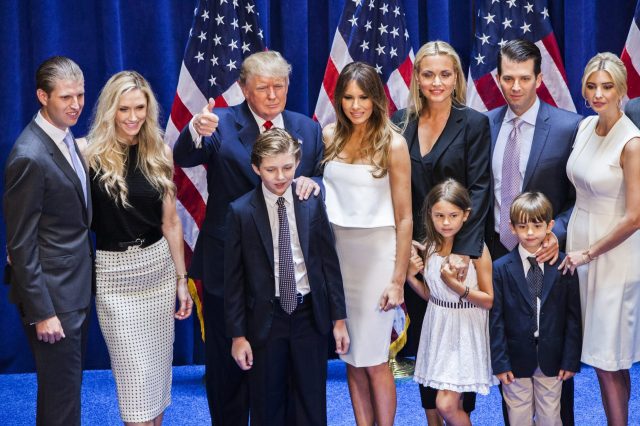
The Trump family’s financial interest often overlap with those of the American state. (Christopher Gregory/Getty).





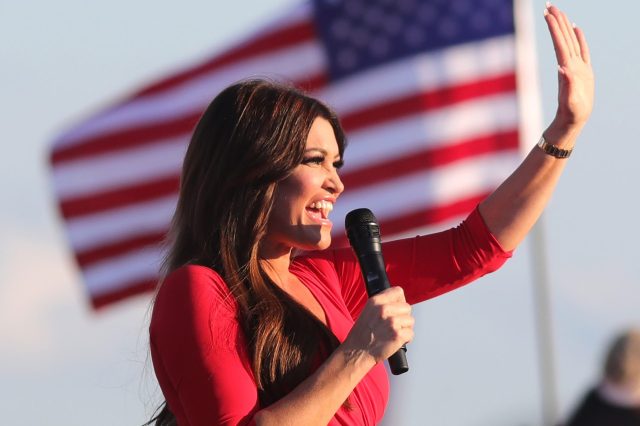
At 3:41PM on 3 July, 2025, Kimberly Guilfoyle sent a text message to a man named Eric. “Honey please I need you to get this done for me today,” she wrote.
What Guilfoyle was asking for was $100,000, which she needed to pay off a credit card bill, the Wall Street Journal reported this week. “It won’t show up anywhere if you wire money to American Express.” In the next message she just wrote “Please.”
Eric was Eric Deters, a Trump donor who made his money as co-owner of a pizza chain called Snappy Tomato and had become a right-wing talk radio host (he denies sending her the money). Guilfoyle was the former Fox News host and ex-fiancée of Donald Jr, the president’s eldest son. The pair had broken up in 2024, but Guilfoyle remained close to the family; at the time of the text messages Guilfoyle (who had previously been married to Democratic California governor Gavin Newsom, make of that what you will) was preparing for her confirmation hearing to become the US ambassador to Greece.
Deters, a long-time Trump donor, had already promised to pay Guilfoyle $300,000 in “speaking fees.” If the messages are authentic, and Guilfoyle has disputed their accuracy, they paint a remarkable picture of the cash-for-access culture surrounding the Trump administration. Indeed, this is practically the dictionary definition of corruption: Guilfoyle was allegedly directly offering access for cash. “I will be your Trump ride or die, forever and ever,” Guilfoyle told Deters, by Deters’ account, as she begged for cash.
If the messages are authentic, they paint a remarkable picture of the cash-for-access culture surrounding the Trump administration, and another low point in the Mariana Trench of corruption into which the Trump administration has been sinking. Guilfoyle is really just the tip of the fatberg of profiteering that Trump has enabled and even encouraged through his second term; indeed by the standards of Trump’s inner circle, a mere six-figure sum counts as a fairly contemptible return. It is Trump and his family who are truly raking it in — and the numbers and methods they’re using are extraordinary.
***
At the core of the schemes is often the president himself. Take the case of Nvidia. On April 15th, 2025, Trump posted “big and exciting news” on his social media platform, TruthSocial. The technology company had committed “500 BILLION DOLLARS” to build “A.I. SUPERCOMPUTERS” in the United States, “EXCLUSIVELY”. The White House later added in an official statement that this was the “Trump Effect in action”. Trump had employed a signature mixture of hospitality — he had invited Nvidia’s CEO, Jensen Huang to dine at Mar-a-Lago earlier in the month — and hostility, waving the threat of tariffs if Nvidia continued to make its graphic processing units in Taiwan. And it had apparently worked.
It wouldn’t be the only time he took an intense interest in Nvidia over the course of the year. In August, Trump overruled US Government security restrictions to allow Nvidia to sell its chips in China. There followed more posts, more closed-door meetings, multiple calls and surprise public appearances with Huang, whose business was meanwhile flourishing. By the end of 2025 Nvidia’s stock price had more than doubled, from $94-a-share in April to $188. Today, it is $225.
It is surely pure coincidence, than, that Donald Trump bought up to $67 million worth of Nvidia shares in 2025, according to a Financial Times analysis of his financial documents. The purchases were made through investment accounts that the Trump Organization says are independently managed by third-party financial institutions, with neither Trump, his family nor the organisation involved in selecting individual investments.
Similarly, Trump purchased $4 million of Tesla stock in 2025, and promoted the company on many occasions, even calling its cars “beautiful” — quite the endorsement. Indeed, the list of companies Trump has bought stock in, and which Trump has also posted about and/or given government contracts to includes: Intel, the clothing company American Eagle, Palantir, Microsoft, Amazon, Comcast, Meta, Apple, US Steel, and Dell, among dozens of others. Except the Trump Organization insists there is no conflict of interest here. All the investments are managed without the president’s input or knowledge — and when have they ever lied to us?
One explanation is that Don Jr and Eric, who run the Trump Organization, have simply inherited their father’s incredible business acumen — and are just very good at predicting which way the market will move. Then again, Trump’s disclosure documents reveal that he made more than 21,000 stock trades in 2025 — so separating the signal from the noise is practically impossible. But unlike presidents who have placed their assets in blind trusts or other arrangements to manage potential conflicts of interest — Jimmy Carter, for instance, placed his peanut farm in a blind trust — Trump has retained ownership of his investments while allowing his sons to continue running the family business. As he told the New York Times in January: “I let my kids, you know, do business.” They retain their own business interests and access to their father and members of his administration, while operating in sectors affected by government policy. The question is whether the family’s overlapping financial and political interests create conflicts that existing safeguards are ill-equipped to address.
But the Trump Organization’s activities are not limited to the stock market. It also does things like license the Trump name to products, meaning the presidency itself provides a useful extra source of revenue. There are Trump sneakers ($299), Trump watches (ranging from $499 to $100,000), Trump guitars ($1,250 or $10,000 for the optional “autographed” model). There is even a Trump Bible. These licensing deals are hugely profitable. Trump’s “Save America” coffee-table book alone netted the then-candidate $3 million in royalties. Putting his name on all these shoes, perfumes, watches, books and so on has netted Trump more than $10 million.
All of this activity has made those involved with the Trump Organization extremely wealthy in the last couple of years. Trump has learned from his first spell in office, when he dropped significantly down the Forbes 400 rich list. The financial disclosure document for the year before Trump became president for the second time ran to 234 pages and showed $622 million in earnings. The equivalent document for his first year in office runs to 927 pages. It shows that the president reported more than $2.2 billion in his first year in office.
In December last year, Forbes published an admiring article about how Don Jr’s fortune had increased sixfold to $300 million in just one year, “the kind of fortune that would make his father proud.” Eric fared even better: he had “supersized” his fortune ten times to $400 million (again, according to Forbes), supplementing his stock trades with investments in cryptocurrencies. “Donald Trump has offered a masterclass in turning political fame into personal fortune,” ran the glowing report.
All of this is “on a scale that has never happened before in American history,” says Claire Finkelstein, a professor of law and philosophy at the University of Pennsylvania. Something quite similar has, however, happened in the Russian Federation in recent years, where Vladimir Putin has used his presidency to accumulate vast personal wealth — and has meanwhile buttressed his political power by ensuring the oligarchs around him are larded with cash too. “Trump has basically hung a for sale sign outside of the Oval Office and said: ‘You can have dealings with me, and I will give you attention if you pay me in some fashion, or allow me to establish a golf course in your country, or otherwise benefit my interests’,” says Finkelstein. “And that means that American diplomacy is basically for sale.”
As if to underscore the growing convergence between the Russian and American modes of government, a ProPublica investigation recently revealed that Don Jr’s wedding, held across two private islands in the Bahamas this May, had been part-funded by a Russian oligarch called Umar Kremlev to the tune of hundreds of thousands of dollars. Kremlev is a close member of Putin’s inner circle with a wide range of business interests. He runs the Russian boxing governing body IBA, and is involved with companies that have a near-monopoly on the Russian gambling industry, including the national lottery. And there he is, peeping out of the wedding photos, directly behind the son of the President of the United States — along with a group of other Russians whose presence reportedly mystified the other guests.
And as we have seen this week with Don Jr’s former fiancée Guilfoyle, behind closed doors the relationship between Trump family members and their friends is often explicit in its bare-faced cash-for-access stance. One term for this is kleptocracy — a mode of government in which the prime motivation of those in power is personal enrichment. Another term is state capture. This is when a narrow interest group takes control, dictates the rules and the way they’re implemented, neuters the institutions that are supposed to hold them to account — and use all of these diverse mechanisms to award themselves privileges and advantages.
“ In some ways it’s a very familiar pattern,” says Elizabeth David-Barrett, professor of governance and integrity at the University of Sussex. “It’s something that we’ve seen in quite a few countries around the world.” The advance of state capture in the US is more shocking, however: “Because it’s the US, because it is faster than anywhere else, and because it is more blatant and open than anywhere else.”
Trump appears to be placing the enrichment of his family as high on his priority list as making America great again. Asked in January why he is allowing all this conflict of interest, Trump straight-out said: “because I found out that nobody cared.”
***
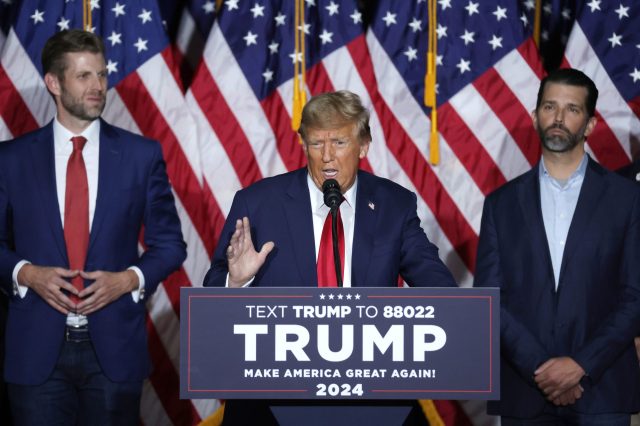
For those who do care, Don Jr, Trump’s eldest son – Kimberly Guilfoyle’s ex-fiance – is a good place to start. In addition to the work he performs with the Trump Organization, Don Jr is works with a firm called 1789 Capital Management, which was founded by Omeed Malik in 2022 to specialise in “anti-woke” investments. Don Jr joined as a partner two years later.
“ 1789 Capital has made remarkable investments in companies that then suddenly get beautiful contracts,” says Maria McFarland Sanchez-Moreno, the CEO of grassroots government accountability group RepresentUs. She points to August 2025, when 1789 made a big investment in Vulcan, a small North Carolina-based startup that manufactures advanced magnets. Three months later, Vulcan received a $620 million loan from the Pentagon.
According to the Financial Times, other companies owned by 1789 Capital that benefited from large government contracts have included BlinkRX, a pharmaceutical distributor in which 1789 has a stake (Don Jr also sits on its board). BlinkRX benefited directly from Trump’s October “TrumpRX” executive order opening up prescription drug direct-to-consumer sales.
In August 2025, 1789 invested in the online betting platform Polymarket, with Don Jr once again also joining the company as an adviser. It was an odd choice, given that Polymarket had been barred from operating in the US in 2022 by the Commodity Future Trading Commission (CFTC) — and that Don Jr was already operating as an adviser to Kalshi, Polymarket’s main competitor. Just eight days after his appointment was announced, CFTC staff issued a no-action letter that helped clear the way for Polymarket’s return to the US market, via an exchange it had acquired. With the rules on political betting loosened, both Polymarket and Kalshi duly exploded in value.
Don Jr holds other personal investments too, though he is not required to release details about them so we have no idea of their total scale. We only see it in glimpses, like when a small drone company called Unusual Machines revealed in a securities disclosure that Don Jr held a $4m stake.
Meanwhile, Don Jr was brought into Unusual Machines as a paid adviser, a couple of weeks after Trump’s election victory in November 2024. Less than a year later, in October 2025, the company announced it had won its biggest contract yet with the Department of Defense. Though the exact amount hasn’t been made public, “ there is a pattern of Don Jr getting very wealthy off regulatory decisions and contracting that is in his father’s control, right?” Sanchez-Moreno says.
Then there’s Eric Trump. Like his older brother, Eric has never had any notable successes independent of his father, preferring to operate either within the Trump Organization or close to the US Government when his father happens to be in charge. In this, however, he has demonstrated astonishing acumen. In April 2026, Eric was telling Fox News that Foundation Industries, for which he is an investor and chief strategic advisor, had just signed $24 million worth of contracts with the Department of Defense to build humanoid war-robots.
Otherwise Eric and Don Jr have a lot of ventures in common. Following Trump’s reelection, Don Jr and Eric were both involved in signing real estate deals on behalf of the Trump Organization. One of these involved licensing a Saudi real-estate company called Dar Al Arkan to build half a dozen Trump-branded hotels, residences, golf courses, and more across the Gulf and other places like the Maldives, netting tens of millions of dollars. (Dar Al Arkan is linked to crown prince Mohammed bin Salman, a close professional associate of Don Jr and Eric’s brother-in-law, Jared Kushner).
In February 2025, it was announced that Eric and Don Jr had bought stakes in a private equity firm called Dominari Capital which they were also advising. Dominari helped set up the cryptocurrency mining company American Bitcoin, which went public in September 2025 at a valuation that made Eric’s stake worth almost half a billion dollars (Don Jr’s stake isn’t known).
Because of the nature of cryptocurrencies, the true amount that the Trump family has made from them will likely never be known. The Center for American Progress tracks Trump’s total crypto earnings to the present day at around $2.4 billion, including $636 million from the Trump memecoin $TRUMP. Melania Trump also made $6 million from the sale of NFTs — “non-fungible tokens,” essentially individualised memes linked to a cryptocurrency unit — in her husband’s first year in office.
The Trump family also has a large stake in World Liberty Financial, Inc, the company behind a “stablecoin” pegged to the US dollar, from which they earn interest, estimated at $59 million. In January 2025, an Emirati company backed by a senior royal and government figure (Sheikh Tahnoon bin Zayed Al Nahyan, the brother of UAE president Mohamed bin Zayed Al Nahyan and the country’s national security chief) signed a deal with Eric Trump to purchase a 49% stake in World Liberty for half a billion dollars. This netted a reported $187 million for Trump family entities. A few weeks later, the Wall Street Journal noted, the Trump administration approved a controversial deal to export AI chips to the UAE. In October 2025 Trump also pardoned Changpeng Zhao, the founder of cryptocurrency exchange Binance, a large partner in World Liberty Financial.
Like stocks, cryptocurrencies are a confidence business. When one of the Trumps boosts it, confidence — and therefore the price – goes up. An investment firm based in Abu Dhabi has bought $2 billion in World Liberty stablecoins. And cryptocurrency companies have rewarded Trump’s support of the industry by donating tens of millions of dollars to Trump’s campaign super-PAC.
***
And what of Trump’s daughter Ivanka, and her husband, Jared Kushner? Finkelstein points to the $400 million Boeing 747 that Qatar gifted Trump in 2025 as an example of the sorts of dividends that his selfless work in the Middle East is reaping. (Albeit the luxury jet would be “a counterintelligence nightmare”.)
Kushner, who served in Trump’s first term as Middle East adviser, founded a private equity firm called Affinity Partners in 2021. Kushner had never worked in private equity before, but so confident was the Saudi crown prince Mohammed bin Salman in Kushner’s talents, he immediately invested $2 billion in the company via Saudi Arabian sovereign wealth fund. Qatar and the UAE soon followed suit with $1.5 billion more. Kushner had stoutly supported MBS’s regime, even after its agents murdered the Washington Post columnist Jamal Khashoggi.
Kushner has been closely involved in Trump’s second administration, too, and while the specifics of his job remain murky he has served in an unofficial diplomatic role in talks with Russia, Israel, and Ukraine, as well as Saudi Arabia — while still controlling Affinity.
It hasn’t always gone well. Backed by Affinity, Kushner and Ivanka, have also been attempting to build a $1.4 billion luxury resort in Albania. But after the Albanian prime minister passed a law changing regulations to allow the gargantuan project to go ahead, local protests began. These spiralled into a national movement, known as the “Flamingo Revolution,” which seems like it might even be on the brink of bringing about the downfall of the Albanian government.
Meanwhile, as Trump’s madcap war with Iran continues to spiral out of control, some of Kushner’s Gulf backers have reportedly started to question whether they are getting a good return on their investment — which shows just how explicitly they saw the deal in terms of cash for access and influence.
***
How did we get here? Throughout his presidency of 1977-81, Jimmy Carter was dogged by questions relating to his family peanut farm in Georgia — an operation worth a fraction of most of the Trump family’s business interests. Carter’s attempts to place the company in a blind trust did little to quell suspicions about a potential conflict of interest; and nor did a special counsel ruling that no irregularities had taken place. In part, the enhanced suspicion was due to Carter’s own promises to raise ethical standards following the Watergate scandal.
Finkelstein argues that the rot set in with President Ford’s pardoning of President Nixon over the Watergate scandal in 1974, which set a precedent that presidents are beyond accountability. The rule of law was then further eroded after 9/11, when President Bush’s Department of Justice allowed the use of torture in CIA blacksites. But in her view, the real turning point came under President Obama.
When Obama came into office, he had to make a decision about what to do about the Bush administration’s torture programme — and particularly the legal memos that had been used to authorise it. Obama banned the interrogation techniques and released the memos, but also promised that CIA officers who had relied in good faith on the Justice Department’s legal advice would not be prosecuted. For Finkelstein, this was a failure of accountability. “That set the stage for a kind of lack of transitional justice from one administration to the next,” she tells me. “Rather than robustly investigating and prosecuting those who violated the law during the Bush administration, he really decided to give everybody a pass.” In her view, President Biden’s attorney-general, Merrick Garland, similarly “majorly failed” when he didn’t appoint a special prosecutor for two years after the election, which “made it impossible for the Justice Department to meet the timeline required to prosecute Trump.
But Biden further blundered, laying an avoidable trap for any future Democrat or indeed Republican who might hope to hold the Trumps to account. “ Let’s remember that Biden pardoned his own son, Hunter Biden,” she says. “That was a colossal mistake from the standpoint of containing presidential authority and containing corruption, because it set a precedent that will be very difficult for Democrats to object to when it’s used on the other side”.
All of this means that those working to bring values such as honesty, transparency and probity to American democracy are not optimistic. “ In the US, anti-corruption laws are quite weak and have become weaker over time,” says Sanchez-Moreno. ” A lot of things that are corrupt and that other countries would criminalise and treat quite seriously are just allowed to proceed here.” The system of checks and balances that was once the pride of American democracy has not proved much help either. “You have a Supreme Court that ruled that the president has pretty broad immunity, and that has set the stage for an administration that is using its office for the family’s enrichment.”
Things may change, however, if the Democrats take the House back in next month’s midterm elections. The administration is certain to ignore any legal subpoenas — but the private sector companies will not be able to do so without risking prosecution. “So they’re gonna start subpoenaing all these companies,” says Sanchez-Moreno.
The president can issue pardons, but those don’t protect against Securities and Exchange Commission investigations or civil suits. If they start to feel pressure, maybe these companies will also start to reevaluate the value of their investment.
Guilfoyle seems, at least, to be facing consequences. She has been forced to resign her ambassadorship, and there are calls for her to be investigated by members of the House Foreign Affairs Committee. The Trump family has thrown her under the bus, with the President distancing himself from her on Tuesday.
But the Guilfoyle case was just a glimpse of the raw inside workings of how truly shameless the corruption can be. She has resigned in disgrace – but Trump family themselves will continue to make out like bandits, and there’s not much that can be done to stop them.