




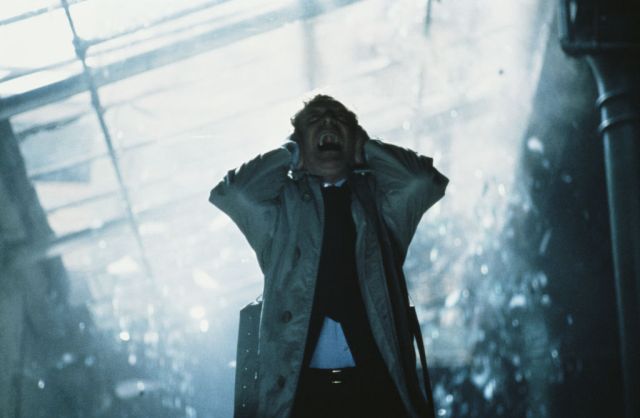
Michael Caine, seen in ‘Blue Ice’, (1992), appeared to understand the agony of cacophonous public transport. (Keith Hamshere/Getty Images)





Britain’s Most Trusted Man™ had had enough. Martin Lewis, the nation’s personal finance expert, was on a train with his family when a couple across the aisle started playing social media videos on speakers at full volume, culminating in the woman broadcasting a documentary about serial killers to the whole carriage. Unlike most of us, who variously tut, glance disapprovingly, find alternative seating arrangements or just suffer in (our own) silence, Lewis decided to act. “I politely said ‘please could you turn it down it’s not appropriate’,” he tweeted on X of the encounter.
The woman’s response, as Lewis reported it, was an interesting one: “It’s a public train, for heaven’s sake.”
Under this framing, it would appear that there are no customs or manners about noise in public places in Britain nowadays. Individuals and families are allowed peace and quiet at home. But once they leave that private space, they must put up with the freedom of others to do what they want, to impose and interrupt and disturb them at will.
The initial situation Lewis described is now depressingly familiar. Indeed the phenomenon, now known as “loudcasting”, has become so widespread that some travellers report facing it on pretty much every journey they take. Last week, the Prime Minister announced a campaign that promises to punish offenders with fines — though the instruction to watch videos “quietly”, rather than silently, suggests that little will change.
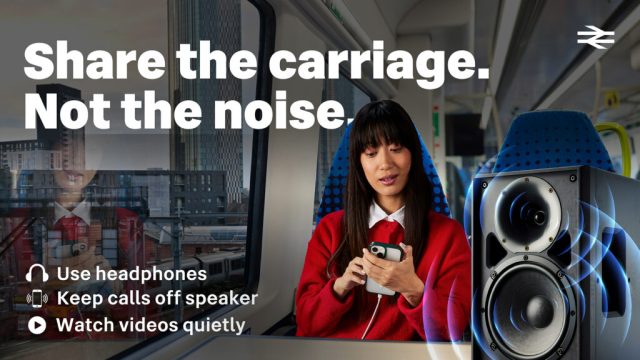
The practice is so objectionable because it irrupts through the boundary of our private space, imposing unchosen noise into the stream of thoughts that make for an individual life, while making private conversations more strained and difficult. It effectively imposes a law of the jungle onto public spaces, contributing to a sort of high-tech state of nature where the loudest and most brazen dominate public places, imposing their passing whims on everyone else.
The customs of private and public life that frame such encounters are the subject of Tiffany Jenkins’ recent book Strangers and Intimates: The Rise and Fall of Private Life. The book comes with a warning: that private life is not just under threat in the Western world, but has been under attack — and in retreat — for decades. Long before consumer technology allowed us to place our private thoughts, intimate pictures and noise tastes into the public realm, the barriers between private and public life were collapsing.
As Jenkins writes, “by the mid-1970s, the idea of a private life as freedom from interference, forged over centuries, was evaporating.” In Britain, the Younger Commission Report of 1972 revealed a generational divide, with people aged 45 and above describing privacy as “keeping your own private affairs to yourself” and “other people minding their own business”, while younger people defined it in terms of “leading your life as you want to lead it” and the like.
This might help to make sense of the couple that Martin Lewis encountered on the train. They were leading their lives as they wanted to. It was just that, by doing so, they were making it impossible for those around them to do the same.
Pressure on private life has come from many directions in recent times, not least from our own actions online. Revolutionary Leftist politics has also done its bit. In the late Eighties, the radical feminist Catharine MacKinnon argued that the very division between public and private spheres should be dissolved, suggesting that it “works to protect systematic inequality” and serves “male supremacy”. Another radfem, Carol Hanisch, meanwhile promoted the idea that “The Personal is Political”, one consequence being that all personal (i.e. private) life is open to scrutiny and intrusion. The Scottish psychiatrist R. D. Laing chimed in with the assertion that family life is a primary source of mental illness and social dysfunction, while promoting psychology, his own practice, as “the key to the interpretation of experience in its political significance.” From here on, it seems now, your private thoughts would be a primary target of experts seeking to engineer social change.
Social science, including psychology, has a crucial role here as a source of authority that justifies intrusions into the private world of the self and intimate relations. These intrusions, it is claimed, address the root causes of social problems. Left-wing social scientists and political figures treat such things as “hate” and “Islamophobia” as if they are perversions of the mind that the state and civil society must work to eliminate. The individual’s role is to follow and do what they are told; to line up on the Right Side of History, not to think and feel for themselves but to defer to the experts.
The big claims of sociology and psychology that underlie such efforts often tend toward totalitarianism. The Czech novelist Milan Kundera recognised something like this in the Soviet bloc in which he lived his early adult life, valuing by contrast the space that liberal society offered. “Public and private are two essentially different worlds”, he says in one of the opening epigraphs to Jenkins’ book, and “respect for that difference is the indispensable condition, the sine qua non, for a man to live free.”
Jenkins herself states: “It is essential to have a private space shielded from corporate, state and public scrutiny — a place where we can be alone.” Solitude, she says, “enables us to develop an inner life and a sense of self without constant external pressures.’
These “constant external pressures” may be those of the state, but they can also be those of our fellow human beings, variously “loudcasting” on the bus, shouting about politics via amplified sound systems in our town centres, or even dropping litter.
In a recent BBC article, Dr Rachael Kent, a senior lecturer in digital economy and society at King’s College, London, suggested that loudcasting is “performative… a way to rebel.” Harry Witchel, a professor of physiology at the University of Sussex, meanwhile described it as a “phenomenon of marking social territory”. Littering is similar: the person dropping the takeaway food carton or used water bottle on the street is rather like a dog peeing against a lamppost. They are leaving their imprint on the world, marking their presence, affecting others, perhaps enjoying how they can get away with it.
In this way, private life isn’t just something we experience between the four walls of our home. We take it with us: on the train, in the streets and the hospital waiting room. The condition of respecting it is what we might call “civility”: courtesy and politeness, respecting others.
In Britain, Jenkins writes, private life and the civility which facilitates it developed largely by accident from the late 17th century on, in response to religious and political conflict. “Out of the convoluted twists of history and the English Civil Wars, England’s people eventually forged a path towards the idea that political communities could survive in the midst of religious diversity if they limited their activities to a ‘private’ sphere, thus endorsing its possibility.”
In this time, toleration and freedom of conscience emerged as principles regulating public life. Queen Elizabeth I summed up the new spirit with the words, “Her Majesty is not inclined to peer into men’s hearts and secret thoughts”, later rendered into the famous line: “I have no desire to make windows into men’s souls.” As Jenkins puts it, “the new political order… established that there were places the state could not go. From this the private realm was built.”
By these principles, an individual human being was thereby allowed a space of their own to think and feel as they wished, in a “society of strangers”. This society was necessarily composed of people who, by and large, showed restraint and refrained from imposing themselves on others. In retrospect, perhaps the old reality of the train carriage full of silent commuters was the apotheosis of this, reflecting a society of non-interference and suppressed self-expression: Isaiah Berlin’s “negative liberty” made flesh.
The changes we are now experiencing reflect an evolution of liberal society away from restraint and towards self-expression, or what Berlin would describe as “positive liberty”. Globalisation has also contributed, bringing together populations who do not observe such strange rules as the divide between religion (as private) and politics (public).
Islam, for example, particularly in its modern Islamist strains, is a public, political religion whose leaders would never accept God being consigned to a private sphere, let alone one of individual choice. Conservative dress, such as the niqab, is one part of this. Public prayer, of the kind that occurred in Trafalgar Square in March, is another, as is the more abstract expectation that Muslims serve the “ummah”: that is, the global community of Muslims. There is private life for Muslims under the leaders who require or encourage this behaviour, but it’s not the same sort of private life that developed in the West. This sort of private life is not a place for religion but a place that must not interfere with religion. Even those Westerners who are not Muslim must take more and more care to mind their language when they talk about Islam, lest they suffer social or legal consequences or even be forced into hiding. Thus they, too, find their lives to be further intruded on by religion.
This reality jars against one of the most important aspects of private life for Jenkins: its interdependence with public life. As we have seen, private life is vulnerable and requires public permission. It requires the state but also our fellow human beings to show restraint. In turn, public life benefits, at least in theory, from the space available for thought and reflection in private life.
Systems of multiculturalism and diversity appear to threaten this idealised state of affairs, with old liberal rights that used to attach to the individual being quietly transferred to what are termed “communities”, overseen by community and group leaders. This attaches the Muslim, gay or black individual to the group rather than affirming their right to think and feel for themselves.
Individual conscience and freedom of thought have little role in this system of diversity, either for members of protected groups or for outsiders, who are more or less prohibited from interfering with this allocation of authority away from the individual and towards group representatives. In this way, through systemic multiculturalism and diversity, the relationship between private thought and public action, a crucial plank behind the promise of liberal democracy, has at least partially broken down.
Splitting the necessary world of society and politics from private life was, we might reflect now, a civilising process: allowing individuals, families and intimates the space to think, reflect, make mistakes, indulge interests and explore possibilities without being subject to the controlling gaze and noise of public life — including community leaders demanding fealty. As Hannah Arendt said, “Thinking and acting are not the same, and to the extent that I wish to think I have to withdraw from the world.”
The distinction between public and private also allows us the space to reach towards greatness. For, unlike what arts bureaucrats tell us, greatness in art and culture doesn’t arise from immersing ourselves in group orthodoxies, but from the mind being allowed to roam free. As Jenkins puts it, “Originality begins in private, shaded from the conformity of social pressures, long before it is made public.” The act of creation itself, as with scientific discovery, arises out of the self: from being on your own.
That self — and the private life that nurtures and protects it — is a foundation of modern freedom and civilisation. We let it wither further at our peril.
Ben Cobley is the author of The Tribe: the Liberal-Left and the System of Diversity and, most recently, The Progress Trap: The Modern Left and the False Authority of History.
 bencobley