




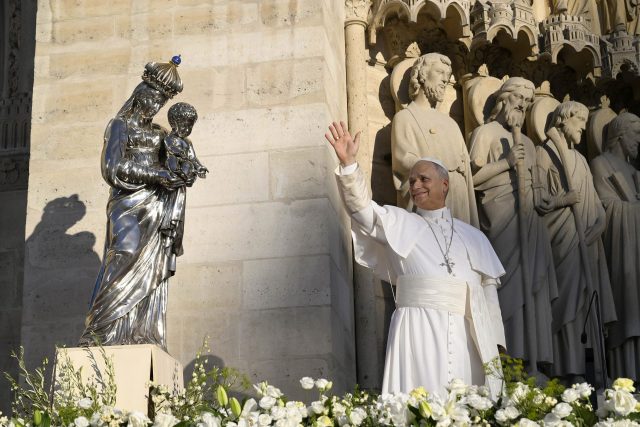
‘Leo is no longer a new pope and, a year and a half in, his diplomacy looks increasingly like inertia’. (Vatican Pool/Getty)





The jaw-dropping scale and fervent intensity of the crowds surrounding Pope Leo XIV in France have astonished everyone. Last Saturday, 800,000 people filled the Place de La Concorde, the square that once housed the guillotine, for the Pope’s open-air Mass in Paris. Lapsed Catholics wept in the streets as they knelt for confession. In the past 24 hours, I’ve heard the same words from a TikTok doomscroller and a claret-quaffing gent in his St James’s club: “I’ve never seen anything like it.”
Here’s what fascinates me. Leo’s triumphal progress has been greeted with rather subdued delight by two opposing wings of the Church: hardline liberals and ultra-conservatives. In front of the cameras, they’re all smiles. In private, and reading between the lines of their social media comments, not so much. For different reasons, both were disconcerted by the ferocity of the Pope’s attack on France’s assisted dying law and its constitutional amendment guaranteeing access to abortion, which has led to an epidemic of “terminations” of supposedly imperfect babies. Not for nothing did Leo choose six altar servers with Down’s syndrome for his Paris Mass — a gesture more beautiful than any liturgical finery. He doubled down on this in his sermon, in which he said that deciding an embryo’s future by test result was like assisted dying; that it’s thoroughly sinister “programmed death”.
You can understand why liberal Catholics, especially American members of the Democratic Party, were uncomfortable with this. They wanted the first pope from the United States to take a swing at Trump in time for the midterms. They failed. And they wanted him to steer clear of issues such as abortion, on which even Catholic Democrat candidates defy Church teachings. But why were some hardline traditionalist Catholics so disconcerted by both Leo’s statements and the sea of humanity surging around him in France?
I emphasise that we’re only talking about a fanatical rump. Most conservative Catholics were overjoyed by the papal visit, the pro-life exhortations, and Leo’s unexpected homage to the Catholic martyrs of the French Revolution.
And yet, it was precisely these things that wrong-footed the militant “trads”. Leo had deviated from the script they have written for him. Ever since he took office, they have insisted that he’s just Francis in nicer vestments. They look away when he behaves like an old-style pope, singing the Salve Regina until he’s hoarse, or weeping when he celebrates the Eucharist. Instead, they obsess over an ancient grainy photo of the then Fr Prevost praying in front of a indigenous statue in Peru; over an environmental stunt in which he blessed a block of ice; over the continuing (if rare) cancellation of Latin Masses; and over his enthusiasm for “synodality”, which under the last pontificate was shorthand for the hijacking of the Curia by liberal control freaks.
Last weekend’s tour de force undermined the Right-wing caricature of Leo as a mediocre or even malevolent liberal nonentity. Now we can all see that it’s false. And yet even the mean-spirited trads aren’t wrong about everything. The true state of the Catholic Church is always difficult to assess, especially after a papal public relations triumph. Pope John Paul II attracted crowds of more than a million in Poland, the Philippines and Ireland, while Francis’s 2025 Mass in Manila was the largest in papal history — attended by some six million people. Even so, both pontiffs presided over a devastating crisis of morale and, in Europe, collapsing church attendance.
Do we make too much of open-air spectacles? How many bystanders cheering the Holy Father in the streets, or at a one-off mega-Mass, then sat through a service the following Sunday (as the Catholic Church demands on pain of mortal sin)? I suspect the answer would be hard to reconcile with the florid talk of “spiritual hunger” during papal visits.
The truth is complicated and unsatisfactory, if not entirely depressing. Pope Leo is hard to read. He alternates between joyful assertions of the divinity of Christ and synodal jargon that lingers like a bad smell from the Francis era. He simultaneously favours brilliant young orthodox bishops and the greasiest bureaucrats of the ancien regime. Is this any way to run a Church? Until recently it was relatively easy to make the case that the less the new American pope intervened, the sooner he could narrow the factional divide deliberately widened by his Argentinian predecessor. But Leo is no longer a new pope and, a year and a half in, his diplomacy looks increasingly like inertia.
To allow the Traditional Latin Mass to be revived in one place and crushed in another does nothing to promote unity. Likewise, it’s all very well for the Pope to insist on covering up the artwork by the accused serial nun-rapist Fr Marko Rupnik at Lourdes. But scars will not be healed while, inexcusably, the canonical proceedings against Rupnik are bogged down and he remains a priest.
Unfortunately Leo is as hard to read literally as well as metaphorically. He has just published Freedom Under Grace, a collection of his addresses to his fellow Augustinians when he was head of the order. A page-turner it ain’t, and you wouldn’t expect it to be. But it’s still a curious mixture: encouraging and discouraging in roughly equal proportions.
Let’s get the bad news out of the way first. The former Fr Prevost was, to put it politely, politically naive. His “global south” rhetoric was supported by clumsy swipes at neoliberalism, the favoured bogeyman of most Catholic clerics ordained in the Eighties. But, since his political views didn’t matter at the time, and still don’t count for much even now he’s pope, we can let that pass. More disturbing is the lack of interest in the numinous aspects of worship that Benedict XVI understood so well. I have no doubt that Leo always celebrated Mass with reverence, and once he was in Latin America there would have been no demand for the liturgical aesthetics that have nurtured the faith of young Westerners. It’s also true that now that he is pope we see fewer of the ceremonial atrocities encouraged by Francis. But decades of attachment to the mind-numbing post-Vatican II liturgical consensus are still a problem.
Leo thinks of the ancient Latin rite as a personal preference rather than as a source of regeneration. And so he permits fanatical liberal bishops to persecute traditionalists, while also allowing trad-friendly bishops freedom to liberate the old Mass. It’s a mess.
On the other hand, the good news found in the formulaic prose of Freedom Under Grace is more significant than those disputes over the liturgy. Robert Prevost’s faith in Jesus is as potent as that of any successor of St Peter. The book blows apart claims by conservative fundamentalists that he is a syncretist or, worse, an indifferentist who believes that all religions lead to salvation. The latter charge could be levelled at Francis, though like a true Peronist he adjusted his orthodoxy to suit his audience or his mood. This pope is unquestionably a Catholic.
Again and again Leo reminds us of, and revels in, the salvific majesty of Christ, and as we saw in France, he does this with a quiet charisma that has already converted some unbelievers. What I don’t think he can do is succeed in his self-declared mission to bring “peace to the Church”. But, sad to say, that would be asking too much of any pope.
