




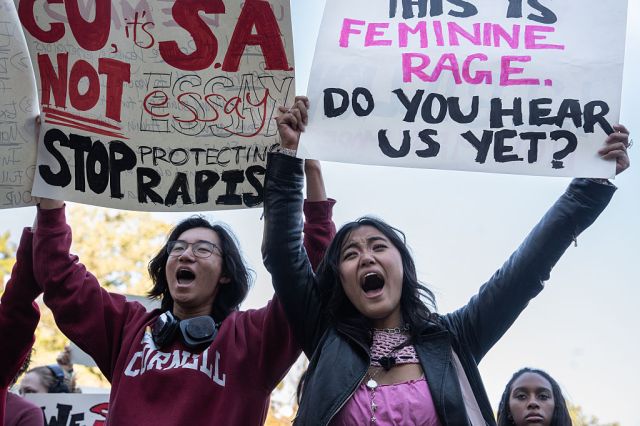
‘Cornell has become a loyalty test for women.’ Matt Burkhartt/The Washington Post/Getty





“The Cornell gang bang participant and/or victim looks exactly like how you’d think she would and we all know what I mean by that and I trust there won’t be any misunderstanding,” read the worst-faith post, in a crowded field, on X last week. Dasha Nekrasova, grande dame of the Dimes Square dissident commentariat, was comme d’hab ragebaiting libs in the wake of what has come to be known as the Cornell Seven scandal.
For those of you who have managed to miss the story that has divided America: a former student at the Ivy League university alleges that in October 2024 she was intoxicated with alcohol and ketamine, then assaulted by seven members of the Chi Phi fraternity. She reported them to Cornell police weeks later, saying she’d agreed to sex with two of the men but was coerced into the rest. No charges were brought; the district attorney decided that she had consented to the drink, drugs and group sex. Last month, Jane Doe sued the seven men and Cornell itself.
The story is perfectly pitched for an internet pile-on: X has pounced on Doe — insulting her, martyring her, castigating her, valorising her — as a stand-in for the experiences or behaviour of all young American women. Women have felt compelled to speak out about being sexually assaulted at university; many are using the hashtag #IAmJaneDoe in support. In different corners of the internet, people (mainly men, but some women too) are calling for Doe to be doxxed, shamed and arrested for making false claims. At their extremes, neither side has much patience for due process. Cornell has become a loyalty test for women: believe Doe in sexual solidarity, or prove your independence by despising her.
Whatever the determination of the courts — and it should be theirs alone — this was a grim and debauched event. That “gangbangs”, the most generous interpretation of these men’s actions, are part of the sexual repertoires of university students is unbelievably depressing. They reflect the dehumanising, unloving, ubiquitous influence of pornography on young people who have in all likelihood rarely even had good normal sex yet. But that, I’m afraid, is as far as we can go in terms of moral dicta before all evidence is in front of us. It is stupid and insulting to frame Doe as the heroine or villainess of the campus rape branch of #MeToo. It is stupid to chase alleged perps around campus and post your tongue-lashing to the internet before they get their day in court. And yes, it is stupid to weigh in, as Nekrasova did, with a craven swipe at the accuser’s appearance.
Of course, nobody is high-minded enough to let justice get in the way of a bit of online engagement. Photographs of the woman doxxers allege to be Jane Doe have quickly become among the most ubiquitous on social media. I have seen low-res 4chan blackpill memes using her likeness. I have seen sexy AI renderings. To be clear, the accused men should not have been doxxed, and neither should she. There is nothing clear-eyed about either camp in this case, with both unable to resist turning a legal matter into an indictment or redemption of feminism. For one side, feminism pushed Doe to be a reckless liar; for another, every claim she makes — however changeable, however contradictory — must be unquestioningly believed. It happened with Lindsay Clancy; now it’s Cornell’s turn.
Because the lawsuit has become a pitched battle between liberal feminism and masculine vengeance, some women who don’t fit the first mould have become highly vocal and extreme defectors. For these women on the alt-Right, throwing stones at Doe is a way of stylishly distinguishing yourself as a special case — a rare, based foid in a cesspool of feminazis. As one reply to Nekrasova put it, the post sneering at Doe’s looks made her a “high-T alpha female”. It must take a lot of grit to withstand your own nausea when joining in with a dogpile against your own sex; nevertheless, she persisted.
I understand the instinct to throw in with the chuds. It is more sensible for many young women to move in conservative circles than liberal ones because at least in the former, shame and disgust shore up taboos around high-risk and dehumanising lifestyle choices. Yes, you may still be pressured into violent sex, insultingly casual encounters or queasy experimentation in a milieu of mossbacks — but you are less likely to be called a prude for demurring. The broad Right, too, is more tolerant of political diversity in general; so it suits white-knuckled wordcels like Nekrasova to drift in that direction in pursuit of more curious and interesting audiences.
The problem is that it’s difficult to be in on the joke when you’re a foid. The more intrepid the scene, the more vicious its adherents. You might briefly belong, having a glorious moment in the sun as a leggy lodestar, an anti-woke Joan of Arc — all for the low cost of selling your sex down the river. But there are cautionary tales. Lauren Southern, herself a figurehead as a conservative YouTube provocateuse, once said women should not be in leadership positions. When her trad LARP was up and her marriage broke down, the movement treated her like a “leper”. Likewise Amy Dangerfield, a married woman whose public persona is as polished and respectable as you like, made a name for herself by associating with Nick Fuentes, a man who believes “women are made to be fucked”. The groypers inevitably turned on her and started calling her “Dangerslut”. In a movement which regards equality as the original sin, even the edgiest e-girl’s membership is conditional.
For those darlings the alt-Right has not yet spat out, a case like Cornell is a business opportunity. What better time to capitalise on engagement than when nastiness and stochastic speculation is at its apogee? X can sometimes look like a school disco gone horribly wrong, red-faced boys and red-faced girls shrieking at one another across an empty dancefloor. There’s an opportune moment, while all eyes are on you, to break away from the pack and prance into the vacuum. But tempting as it is, reasonable women should not do that. Both sides of the internet are hell-bent on turning Doe into a lesson for our culture. Really, though, we know nothing about her.
What we do know very well is the climate that raised these young people, that taught them to discard caution and inhibition in endless pursuit of adventure, or approval, or status. Some of us know that liberal feminism was always meant to make women shed this caution, to make them an easier lay. We know that Zoomer men and boys are for the most part watching hardcore pornography; that they have been oneshotted by bukkake compilations and hentai, AI deepfakes, simulated rapes. Many young women today have, for their part, absorbed the idea that every sexual boundary vaulted is a step closer to empowerment; some men on X think that any woman who is thus misled deserves nothing but contempt. The sexes are perfectly conditioned for the events of Cornell to occur: young men expect extreme and risky sex, and young women believe acquiescing means liberation.
In a few short days, Cornell became women’s most vicious culture war. I believe that in 10 years’ time this case will be considered a reckoning for sexual politics, a point on a graph marking an all-time low in common-sense debate. But women do not have to choose between liberal feminism and the hard-Right internet subcultures which also happen to identify its failings. If women online must draw “lessons” from this still-unresolved case, it should be that the extremes — softsoap liberal feminism and the dark corners of woman-hating X — are dangerous places for us to be. Blind belief and gleeful contempt are false choices. The Cornell Seven scandal has drawn women into a Left-Right trial of faith; the case’s uncomfortable truths, when they emerge, will probably flatter neither side. At this time, it is only appropriate to condemn one party: the sexual culture which bore this story.
