




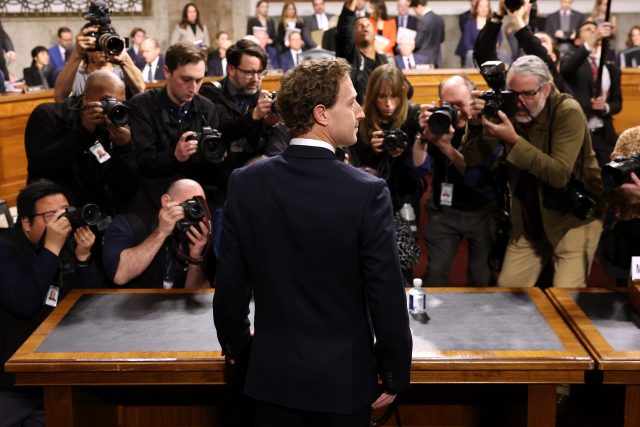
Is Mark Zuckerberg hated for the wrong reasons? (Kevin Dietsch/Getty)





On its surface, The Social Reckoning is a journalism movie, a story about a sly and dogged (and handsome) reporter aided by a virtuous (and sexy) truth-teller from within the evil organisation. The Boomer nostalgia in this narrative scheme is of a piece with Sorkin’s more general inability to face the present on its own terms. His angels-and-devils story of heroic journalism and corporate wrongdoing is the shallowest possible entry into the questions raised by social technologies like Facebook. But this nostalgic narrative scheme is merely a framing device for deeper and more unseemly narrative hijinks, which in turn show Sorkin as not just shallow, as a diagnostician of our technology troubles, but almost comically vain in his moral posturing about them.
Early on we see Zuckerberg (Jeremy Strong), shot from behind, sitting in a chair at a desk, silhouetted by floodlights that must be burning into his face. We’re given to think that this is one of those infamous congressional hearings in which Zuckerberg has conducted himself as a sort of spirited robot, admirably defiant but also less than endearing as a representative of his business sector. Except it’s not Congress, it’s a small auditorium inside the Facebook campus, on whose stage sits Zuckerberg at a theatre-prop desk. So it’s not a congressional hearing. It’s preparation for a congressional hearing, upcoming, a high-stakes training performance run by a specialist in “crisis communications”, an elegant and sensible black woman from the UK named Raya (Wunmi Mosaku), and she’s posing the expected questions to him and coaching him to do his best impersonation of a human being as he answers them.
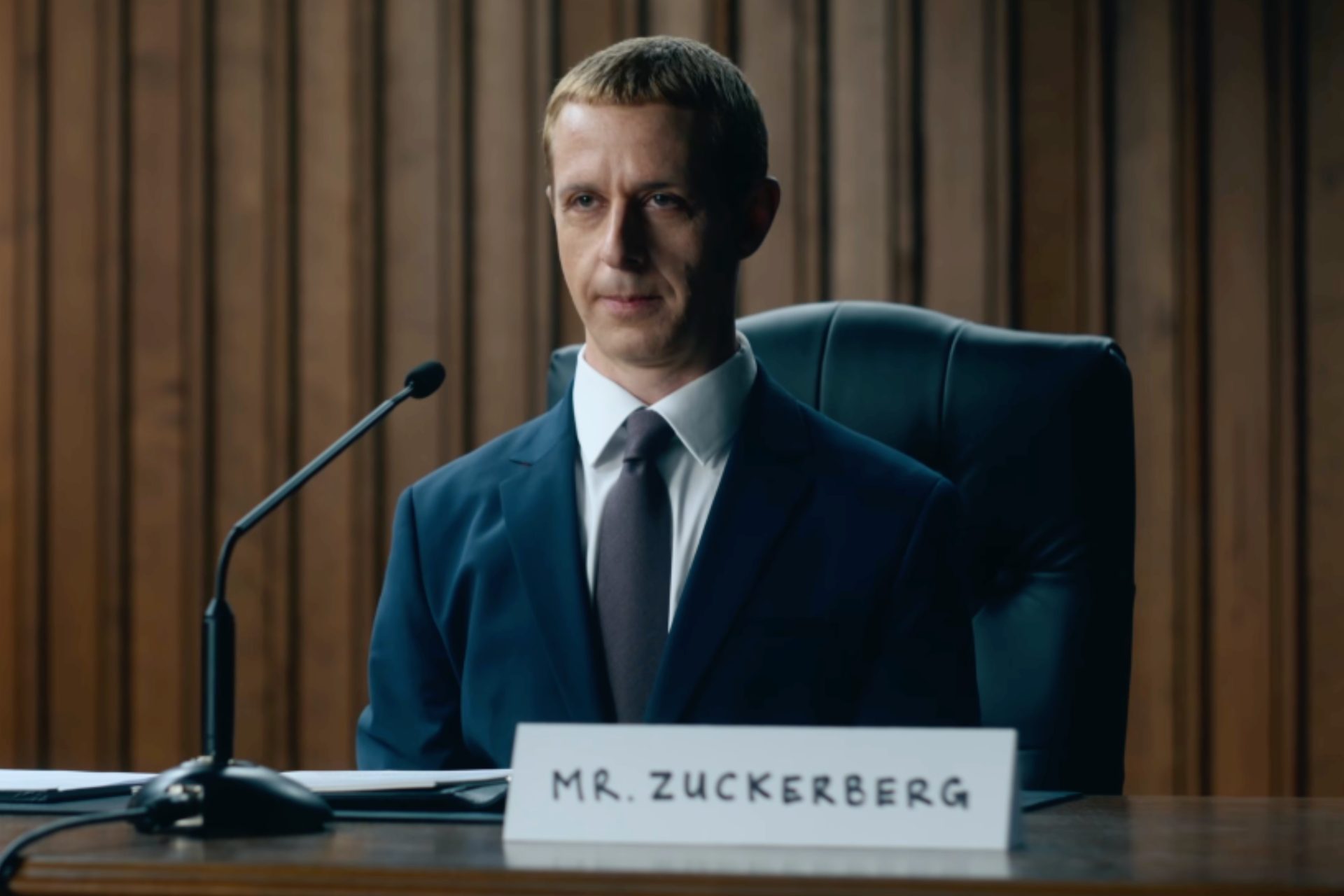
The crisis-PR session is contentious from the start, simply because Zuckerberg is an impatient and arrogant mogul who doesn’t want to be there, but it grows outright hostile when someone else besides the British lady starts asking questions, a sharp-talking man sitting high in the auditorium, in the shadowed seats behind the floodlights, a man named Charlie Garrigan (Bill Burr). Garrigan used to work with Zuckerberg at Facebook but stepped away from the company, and from a billion dollars in stock, out of principle. The British lady has brought in Garrigan, to Zuckerberg’s surprise and chagrin, because she wants a stout, smart adversary to give Zuckerberg a real workout before he goes before Congress. The Garrigan character is fictional but seems loosely based on early Facebook investor and later Facebook critic Roger McNamee.
As the film proceeds, the segments of the crisis PR session pieced throughout the narrative grow more dramatic and contentious, with Garrigan taking over the questioning and the session’s status as mere theatre, practice before the real thing, fading into the background. These segments start to resemble scenes from an actual inquest, with Garrigan descending from the high seats to debate at closer quarters, and the arrogant Zuckerberg growing defensive and flustered under the gathering weight of Garrigan’s moral rightness.
This is where the unseemly vanity comes in. Garrigan is clearly the film’s oracle, the bearer of its critical perspective and the speaker of its moral truths. In other words, he is Aaron Sorkin’s movie stand-in for Aaron Sorkin. Sorkin has made a movie fantasy in which, like a Torquemada for the good guys, he gets to put the evil robot Mark Zuckerberg under a hot lamp and make him sweat and stutter with some righteous questioning.
It’s fitting, given the inquisitorial spirit Sorkin breathes into the story so directly and shamelessly, that the critical takeaway from his film is basically: Facebook needs to censor more. In her memoir, The Power of One, the Facebook whistleblower Frances Haugen acknowledges that identifying and removing bad content raises often-insurmountable logistical and political challenges. For that reason, she tends to advocate algorithmic tweaks that weaken the bias for outrage and propaganda, along with a broader (though probably unworkable) desire for companies like Facebook to be more transparent about their programming and their internal research. But Sorkin, through his Carrigan avatar, presents the content challenge as one of mere common sense and moral courage, a willingness put the public good above profit and remove bad posts and bad actors from the site.
But merely putting Zuckerberg under his fantasy Inquisition isn’t enough for Sorkin. He has to decorate his simplistic message about bad content with an excited string of exclamation points. He does this by reversing time, so that Zuckerberg’s late-2021 PR session is presented as prologue for the riot that sore loser Donald Trump ginned up at the US Capitol 10 months earlier, and the riot is thus presented as the real-world manifestation of Zuckerberg’s defence of his business model, which in turn rests on various invocations of free speech.
Now, as someone who values free speech very much, I would not choose Mark Zuckerberg as my preferred defender of this foundational value. The phrase gets tainted with some potent self-interest on its way out of the mouth of the centibillionaire founder of Facebook. Indeed, an illiberal opponent of free speech who is also a filmmaker would be tempted to use the unlikeable Zuckerberg’s not-disinterested voicing of this hallowed idea, “freedom of speech”, as a way to discredit that idea.
I will not accuse Aaron Sorkin of doing this. I will accuse him of coming very close to doing this, of being heedless and power-hungry, in the way of many progressive activists and bureaucrats keen to impose direct regulation and censoring of political ideas, on social media platforms and elsewhere. Zuckerberg represents one side of a sticky dilemma that Sorkin pretends is neither sticky nor a dilemma. The ideal of free speech emerged at a time of pamphlets and newspapers and parliamentary debate. It is an odd fit, historically and practically, with globally democratised social media platforms, which do in fact reward odious forms of expressive novelty that do, sometimes, have violent and destabilising effects. And yet treating the problems of social media as matters of problematic content — “misinformation” and “disinformation” and “extremism” — involves you in illiberal censorship more or less as a rule. Frances Haugen at least gestures at this dilemma. Aaron Sorkin treats it as just something Mark Zuckerberg would say to make money.
One odd side-effect of Sorkin’s vain, personalised fixation on Zuckerberg, and his righteous glee in hanging January 6 around Zuckerberg’s neck, is that these moves let the real architect of that idiotic moment, Donald Trump, off the hook. Trump almost certainly could have summoned an audience to Washington for his pathetic post-election tirade, and then sicced his army of moron-patriots on the Capitol building, without Facebook’s help.
But the bigger problem with Sorkin’s focus on problematic content is its shallowness as diagnosis. To see this you just have to juxtapose the earnest fixations of The Social Reckoning with technology headlines in the days and weeks before its release – a crusading movie about misinformation on social media landing amid revelations about AI swarms hacking into companies and governments, AI systems poised for recursive self-improvement, AI slop invading all forms of writing so that links of trust between teacher and student and reader and writer are forever poisoned, all of these events hinting at a possible near future in which we will be keenly nostalgic for a time when misinformation seemed like a big deal to people like Aaron Sorkin.
My point is not that The Social Reckoning was already painfully outdated the moment it was released, though it was. It’s that it identifies a tiny mole on the vast, fast-growing, anti-human body of digital technology. Its focus on content and misinformation and all that stuff barely touches the actual villainy of Facebook, and its massively profitable acquisition Instagram (purchased for a mere one billion dollars), and TikTok, and X/Twitter. The business logic of these platforms, the relationship they forge with their users (who are not customers, in the traditional sense), is essentially extractive, parasitic, vampiric. As a form of entrepreneurship, it more closely resembles the creation of life-ruining gambling apps, or manufacturing highly addictive Tianeptine (“Gas Station Heroin”) for general sale, than it does the selling of cars or refrigerators.
It’s often said that the product these companies sell for profit is our attention, and that is to a meaningful extent true. The growing dominance of short-form video on social media platforms is a sign that this particular mechanism of engagement is the best, most potent attention-hack yet discovered, as anyone who’s awoken in self-disgust from an hour-long trance of “reels” or “shorts” understands. But this experience reveals the content fixation of Aaron Sorkin, the official liberal worries about “misinformation” and “democracy”, as laughably beside the point.
In other words, the bad content that finds its way onto social media is a superficial problem, compared with the technological form that defines everyone’s participation in these platforms. This dehumanising relationship of our dopamine systems with our computer devices was consciously designed, by people, for profit. Yes, the fact that these platforms enable bullying and degrade the mental health of certain teenagers, as The Social Reckoning mentions, is appalling. But by far the greater, deeper, larger-scale offense is that they strive, systematically and intentionally, to make everyone’s children addicted to their platforms, for profit.
If you researched tech and social media in the 2010s, as I did for my book on family life, Little Platoons, one response you may have had was shock at the utter shamelessness of this enterprise. In 2013, a tech consultant named Nir Eyal wrote a bestselling book called Hooked: How to build Habit-Forming Products. It was filled with insights gleaned from behavioural psychology about how to program apps and platforms so that people’s use of them becomes compulsive. You see, you use a “variable schedule of rewards” to mess with people’s evolved bias for finding patterns in their experience, which lets you hijack their reward systems so they act like the rats famously programmed by B.F. Skinner. Indeed, there’s a company whose original name cynically invoked our vulnerability to such programming, Dopamine Labs (the name later changed, perhaps from a belated dose of shame, to Boundless Mind). Stanford University, the academic hub of so much tech innovation, still houses something called the Behavorial Design Lab, which has helped a generation of tech entrepreneurs refine a practice that goes by the creepily perfect Silicon Valley name “Persuasive Technology”.
This business project of inducing compulsive screen use in teenagers has largely been successful, and one of its results is that kids, their attention spans measurably degraded by the everyday psychedelia of their short-form video feeds, don’t read so good anymore. Kids everywhere not only don’t read books but, as teachers and professors will attest, can’t read books. Well done, TikTok.
I suspect progressives’ superficial focus on extremist social media content, which flared up around Trump’s 2016 election and persists in such forms as The Social Reckoning, owes in part to their long-held belief in the internet and social media as forces of liberation. For them the problem had to be the dangerous exception of extremism, not the drab, dehumanising rule of social media addiction and stupefaction, because admitting the latter would have been to indict social media as such. And, for progressives, social media was where un-listened-to young people and oppressed identity categories went to empower themselves through self-expression. To criticise the very use-model of social media was to join stodgy luddites like me whose secret motive, they said, was to silence the marginalised people who had finally found their voices online. This corny equating of self-expression with political emancipation has characterised the post-revolutionary Left since at least the Sixties, but it became a true cultural and political force in the trauma-informed progressivism of the 2010s.
Idealising social media platforms as tools of emancipatory expression was always naïve, given the distortive power of those tools, the subtle manipulations that made them irresistible and, thus, profitable. But it seems even more naïve now, at the unquiet dawn of whatever AI is on the verge of becoming, because it turns out that all this self-expression, all our speaking into our computer cameras and computer mics, indeed this typing-for-the-internet I’m doing right now, was and is destined to be fed as training matter into programs of machine intelligence. Listen to Larry Page describing, in 2000, the AI dreams that have been guiding Google from the beginning. It’s all for AI. It always has been.
In this light, Aaron Sorkin’s The Social Reckoning registers as not just quaint and silly but downright ideological. The film is a publicity coup for its ostensible villain, Mark Zuckerberg. Zuckerberg is no less a visionary than Larry Page. It’s likely that, from the early years of Facebook, he saw the busy activity of its users as not just as a source of huge advertising profits but as training material for his own contribution to the world-historical project of machine intelligence. Zuckerberg has been inducing us to feed the machine by which, after we’ve been rendered unfit to govern ourselves by digital technology’s prior stage, he and the other moguls of AI mean to replace us. Compared to this, accusing him of allowing the spread of misinformation, or blaming him for January 6, is a convenient distraction, if not a compliment.