




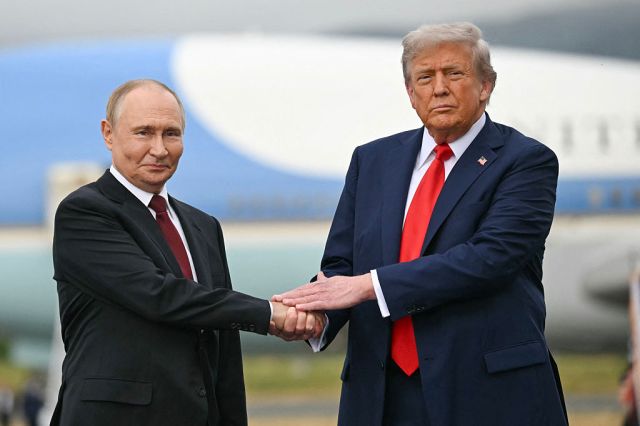
Putin and Trump, who met in Alaska in 2025, have struck a deal on diesel. (ANDREW CABALLERO-REYNOLDS / AFP via Getty Images)





After Donald Trump and Vladimir Putin met in Anchorage, Alaska, last year, there was a brief moment when it appeared possible that the US would enforce a peace on Russia and Ukraine. But the conditions for a deal were not in place. Neither Putin nor Zelensky would compromise over the status of the Donbas, the Russian-speaking region in eastern Ukraine of which Russia has occupied 90%. Putin wants it all, and Zelensky refuses to hand over any unoccupied land.
Then Trump turned toward Iran. The Russia-Ukraine war dropped in US foreign policy priority list. Now, because of oil and gas, it’s back at the top again. Trump realised that he cannot be at war with two of the largest oil and gas countries in the world. Iran may only be seventh on the list of the world’s largest oil producers, but by closing down the Strait of Hormuz, Iran indirectly affects some 20% of global oil production.
Russia, however, is the world’s second largest producer of both oil and gas. The Europeans dismissed the recent US-Russia diesel deal as another stunt by Trump, and it’s true that it won’t affect gasoline prices in the US by much. If it had been an isolated deal, I wouldn’t have paid much attention either. But it wasn’t. Trump followed up with actions he had hitherto shied away from.
The first sign came last Wednesday morning. Ukrainian media reported that, overnight, the country’s forces had experienced sudden restrictions on Starshield, the military part of Elon Musk’s Starlink satellite system. Ukrainian drones were losing signal when they travelled faster than 160 kilometres per hour. The sudden throttling of the service disrupted several Ukrainian drone missions.
The presumption within Ukraine was that SpaceX had imposed those restrictions on behalf of the US government. And the next day, Reuters reported that the order came directly from the White House, which had been angered by Ukraine’s continued targeting of Russian refineries. So this was not a technical service disruption, but a ruthless application of the kill switch. All we got from the White House, though, were news leaks. No official statements. Not even a tweet. For the Trump administration, this is not normal.
Along with the news of the throttling of Starshield came suggestions that the US had ended intelligence sharing. On the night of 12 October, Russia launched a volley of ballistic missiles at Ukraine. Normally, US intelligence would give the Ukrainians a warning. But on this occasion, there was no heads-up — and the results were horrendous.
Until that point, intelligence sharing had been one of the most important components of the defence of Ukraine. The Americans have satellite-based infrared systems that can detect ballistic missile launches, and the Ukrainians could rely on it.
But things had changed. Two days after the attack, it was reported that the White House had discussed ending the sharing of intelligence. John Ratcliffe, the CIA director, wanted to continue sharing intelligence — but others, it seems, didn’t. Trump denied that the US had cut intelligence sharing. Indeed, it is possible that Russia may have used weapons that resisted detection. We should at this point treat the disruption of information flows as suspicious, but unexplained.
Then, late on Friday, Trump used an executive order to waive the implementation of sanctions against Russia under the Graham Act, whose goal was to deprive Russia of financial resources that allow it to wage war against Ukraine. Named after the late Senator Lindsey Graham, Trump had signed it into law only last month.
The secrecy, the reports of meetings inside the White House, the reports from Ukraine itself, and the suspension of the Graham Act: together these developments give us a coherent picture, even if some of the details are still missing. They tell us that the US is no longer actively engaged in the defence of Ukraine.
That’s different from the situation in late February last year, when Trump and Zelensky clashed in the White House. After that meeting, the US paused weapons deliveries and financial assistance. The White House also cut off intelligence sharing for a week, but then resumed it.
But what the Americans are doing now is far more coordinated. And it presents the Europeans with a conundrum. They will attempt to mitigate the effects of this change in US policy, however, there is not much they can do. They can offer intelligence from their own satellite network, but this will not match the communication quality Ukraine’s fast drones require to function as intended.
Nevertheless, Zelensky turned up at the European Council in Brussels last week, where EU leaders took another opportunity to show their solidarity with the Ukrainian leader. He is a regular guest there. But beneath the bonhomie, tensions are rising. Ukraine is running out of money faster than the Europeans had expected. Last December, the Belgians vetoed the sequestration of Russian funds that are sitting, frozen, in a Belgian bank. The EU reluctantly agreed a €90bn loan to Ukraine, money they themselves borrowed, pretending that Russia would eventually have to pay back this loan. The loan was supposed to plug Ukraine’s funding gap for this year and next.
As it turns out, Ukraine now needs another €70bn. Marine Le Pen, the front-runner in the French presidential election race, has promised that, if elected, she would cut off all support for Ukraine. Friedrich Merz, the German chancellor, has promised more funding, but this money is not showing up anywhere in his government’s own budgets.
While Zelensky revels in the public admiration of Europe’s leaders, then, the foundations of Western support have been getting shakier. Now it is getting even harder, because the US is actively conspiring against Europe. The deal under which the US buys 4.8 million tonnes of diesel from Russia looks like an attempt to restart commercial relationships. I expect this will be the first of several natural resources deals between the US and Russia.
I could, for example, see a deal struck over Russian gas. Envoys have been discussing extending their new commercial partnership to the defunct Nord Stream pipeline that used to carry gas from Russia to Germany. This would be an ironic twist, because it was the first Trump administration that placed sanctions on the German and Russian operators who were building Nord Stream 2, a successor pipeline.
In September 2022, the section of piping that runs below the Baltic Sea was sabotaged. A Ukrainian commando is accused of being behind the explosion. The trial against one of the suspects started in Germany last week, and it promises to give us a lot of details of this operation, including information about the extent of Zelensky’s involvement.
Germans will be watching closely. Like Marine Le Pen’s National Rally, the hard-Right Alternative for Germany is also opposed to Ukraine aid. The AfD has, over the past year, enjoyed a fast rise in the opinion polls. The Ukraine war is one of the themes most central to its campaign, and the trial will be a gift to them that will keep on giving.
Trump’s negotiators recently pressed the Europeans to release parts of the frozen Russian assets: to make them available for a special Ukraine investment fund, rather than directing them toward further fighting. The Europeans rejected this request, because their plan is to fund Ukraine’s war with Russian money. I am reminded of the old Thatcher joke about why socialism does not work: because socialists run out of other people’s money. If the EU got its wish and were able to sequester the Russian money, given how fast Ukraine is spending money, it would not last for long.
Additionally, the EU is exploring the possibility of giving full membership of the bloc to Ukraine, but membership can only help fund the reconstruction of Ukraine if accompanied with large fiscal transfers. Right now, Germany is leading a group of countries that are opposing a plan by the European Commission to increase the size of the next EU budget. The Europeans say one thing, but do another: a classic case of revealed preferences clashing with stated preferences.
Politically, and financially, the room for manoeuvre by the Europeans is decreasing. The Europeans need the US, but the US, having enthusiastically supported Ukraine under Joe Biden, has become first a reluctant supporter and now a country that no longer pretends to support Ukraine. I doubt very much that, come 2029, even a Democratic president would expend political capital on a war, which by then would have been waged for seven years.
Wars usually end when one side is running out of food, oil, or other critical supplies. It is delusional to think that with an oil price at $110 a barrel, the world’s second-largest oil producer is running out of money. The war will end eventually, most likely with a dirty peace deal that will leave the Europeans in shock.
I suspect that it will happen during the remaining two years and three months of the Trump administration. Trump has been too inconsistent for any such forecasts to be made with complete certainty. But I am confident that last week’s decisions will go down as the turning point in this war.
