




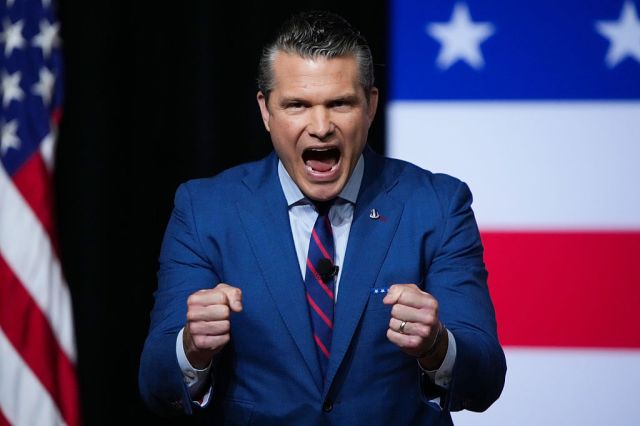
US Defense Secretary Pete Hegseth wants to livestream Nidal Hasan’s execution. (Andrew Harnik/Getty)





“We’ll make sure that people are able to watch it”. Pete Hegseth, America’s Secretary of War, sounds pretty excited about the prospect of a livestreamed firing squad. His candidate is Nidal Hasan, a US Army doctor who murdered 13 people at Fort Hood in 2009, and who was sentenced to death four years later. If the plan goes ahead, it will be America’s first public execution since 1936 — and wholly in keeping with what could diplomatically be called Hegseth’s unconventional style.
He may now lead one of the largest and most complex institutions in all of human history, after all, but Hegseth’s own career in the US military was broadly a story of failure. Rising no higher than the rank of major, he likely commanded no more than a single platoon. Just as striking, he was red-listed on account of his crusader tattoos — sometimes associated with the far-Right — and therefore banned from participating when his National Guard unit attended Joe Biden’s inauguration. Ironically, that helped Hegseth transition into what always seemed his real calling: political punditry and entertainment, with retribution-by-livestream just the latest example.
Still, Hegseth’s lack of formal qualifications for the top job at the Pentagon wasn’t seen as a total negative when he was confirmed in 2025. Clearly, the US military couldn’t go on with business as usual, so maybe a real outsider candidate was the solution? Recruitment, for one thing, had been a disaster for years, with institutions like the Army War College sounding the alarm that the military was incapable of fighting a real, protracted war. Procurement of new equipment was an even bigger problem, with the Army failing to secure basic artillery shells, and the Navy and Air Force stuck using rickety ships and planes. America still had 11 nuclear aircraft carriers, but, by late 2024, the generals and the admirals knew that if a major war started, the world would soon figure out the truth: that the mighty American lion, so impressive from a distance, was actually suffering from a severe case of arthritis.
Unfortunately, the changes Hegseth did pursue have all been of the wrong kind. It’s important, here, to understand just how common lying is inside the US military. Since the turn of the millennium, falsifying reports, hiding losses and costs, and defrauding other levels of the Pentagon and the US taxpayer more generally, has grown into an epidemic. Junior officers mislead senior officers, who mislead their flag officers, who mislead the politicians. Much of the ordinary day-to-day functions of the US Army or the Navy literally can’t happen without lies to serve as proverbial grease in the wheels.
The proximate cause for this epidemic of dishonesty isn’t hard to grasp. The officer who refuses to dissemble about the readiness of his troops, or the state of his unit’s maintenance backlog, embarrasses his superiors and risks being passed over for promotion. For their part, serial truth-tellers may soon find their careers destroyed. One perfect example of what this means in practice came in the mid-2010s, from the US Navy’s 7th Fleet. Based out of Japan, increasingly desperate captains warned their superiors they were being sent on missions with incomplete or undertrained crews; with equipment that didn’t work; and with critical maintenance that was being left undone. The response from the admirals was simple: just do what you’ve been told, or else. When this predictably led to US Navy’s worst peacetime disaster in decades — the USS John S. McCain and USS Fitzgerald both collided with civilian ships, leaving 17 sailors dead in total — the Navy immediately blamed the captains themselves.
Of course, none of this is unique to the US. Indeed that’s rather the point — the cultural malaise now infecting the Pentagon also assailed the late Soviet Union and any number of doomed Chinese dynasties. It’s a discontent that ultimately stems from the basic mismatch between the expectations of the political class and the actual reality on the ground. In the minds of American politicians, the US military is essentially invincible, always at the cutting edge of technology, and 10 times larger and more lethal than any of its rivals. There, at least, is something the octogenarians Joe Biden and Donald Trump can both agree on.
How did things end up this way? To answer that question would probably fill several books — but one aspect is surely the fallout of America’s so-called “Vietnam syndrome”. The war in Indochina nearly broke the country’s body politic, but it also smashed the Army as an institution. After Vietnam, the “small-r” republican tradition of the citizen-soldier was no longer tenable. How could it be when rich kids dodged the draft and the poor were sent off to die in far-flung imperial adventures? The solution was the creation of a smaller, radically different kind of military: one that would henceforth rely on hyper-advanced weaponry and tactics far more than mass and scale.
In practice, that meant wars like Afghanistan or Iraq could go on for decades without most people in “normal” America really noticing that their nation was at war. This separation of the military from the mainstream currents of American life turned soldiers into a kind of alien class. Whereas politicians in the first half of the 20th century either personally went to war, or had family and friends who did, Congressmen today tend to see the military in roughly the same terms as a customer might view a DoorDash delivery driver. Structural problems are irrelevant: someone else is doing the fighting, and anyone who brings bad news can easily be replaced.
Still, when Hegseth entered the Pentagon, he was presented with a choice. He could either usher in an era of tough choices and lowered expectations — or take the easy path and keep the whole show shambling along for just a little longer. In a very real sense, his plan for a livestreamed execution reveals which path Hegseth chose. Rather than addressing the military’s myriad structural problems, from procurement to maintenance, Hegseth has largely focused on culture-war stunts. His recent slogan of “no more trannies, just training”, or his push to make the Pentagon pay for troops’ testosterone supplements, is testament to a worldview in which American power is seemingly only limited by a lack of machismo. Listen to Hegseth, and the US military was never in decline: it was just beset from all sides by pinkos, trannies, and Islamo-communists.
In the event, of course, those structural problems didn’t vanish — indeed the Iran war has only brought them into sharper relief. The weapons are running low; the bases that were vulnerable to being destroyed have now been smashed; the stand-off munitions that were supposed to be used for a Taiwan contingency have now been swallowed up in the Gulf, and all with no victory in sight. Even Hegseth’s seminal achievement, supposedly halting the collapse in military recruitment, is likely to be undone by the Iran war, just as brutal Navy deployments could spell disaster for retention.
And if this is bad news for America’s geopolitical position over the years ahead, Hegseth is hardly safe either. If the US military has survived for so long on dishonesty, why not add one more falsehood: and blame the Iran debacle and everything that led to it on the Secretary of War himself? That story would be awfully convenient for the US military establishment — and Donald Trump — because it would free them from the need of thinking about their own roles in the debacle. Given his famously confrontational manner, meanwhile, Hegseth has hardly done himself any favours in terms of likability.
After Hegseth has fallen onto his sword, or anyway been prodded that way by the White House, might American politicians finally abandon the can-kicking and put a more serious reformer in charge? One good candidate here is Elbridge Colby, currently the assistant secretary of war for policy, and who’s made it his life’s goal to finally escape the Middle Eastern quagmire. The sad reality, though, is that it’s likely too late for real change. The weapons and interceptors are spent; the maintenance schedules are shot; the country itself is all but broke. As for Hegseth itself, it’d be grimly ironic if he ended up remembered for little more than livestream executions. His style, after all, may be far more abrasive than his predecessors’ — but the substance is much the same.