




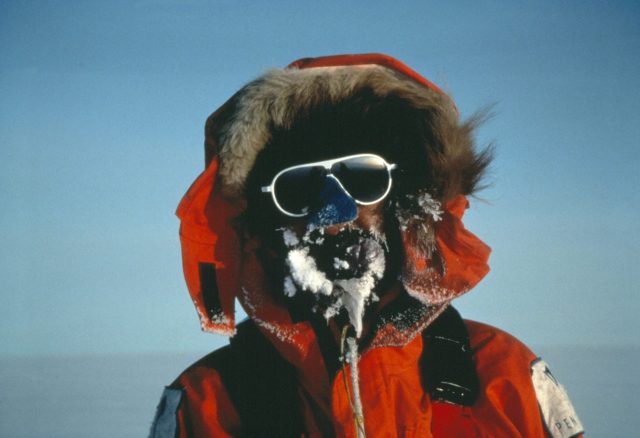
‘We shouldn’t forget that, in Fiennes’ professional life, he spent years being radically alone.’ (Ranulph Fiennes/Royal Geographic Society/Getty)





By his own account, during many a dangerous expedition Sir Ranulph Fiennes “mistrusted anyone else’s navigating abilities”. It seems that some family and friends share the worry, at least as it extends to Fiennes’ wife. Reports suggest that Louise Millington-Cotes has isolated the explorer from nearly all his familiars, and moved him from one care home to the next under false names. Even the King’s polite inquiry about the 82-year-old Parkinson’s sufferer has been rebuffed.
Though not much is known about the second Lady Fiennes other than that she is a horse trainer, it sounds as if she rivals Prince Harry in the paranoia department. She is said to be convinced that King Charles hates her husband, despite his being an enthusiastic patron of Fiennes’s projects for years. She is also alleged to have told friends that Queen Camilla arranged for helicopters to fly over the couple’s property in order to annoy them. Her estranged son is now crowdfunding for a legal review of Fiennes’ situation, and other loved ones are expressing grave concern.
With the rise of dementia and the social care crisis so much in the news, it’s easy to see why this story has hit a nerve, though more difficult to decide whether it is a tragedy or a comedy. At the heart of the tale, there’s a titanic Lear-like figure, as well as a supposed Lady Macbeth. There are several identity changes, and not just for Fiennes. At least one intrepid family member smuggled herself into his residence under an assumed name, and a famous thespian relative also secretly visited (the one who starred in the film Shakespeare in Love, in fact). Fellow national treasures Joanna Lumley and Monty Don are said to be up in arms. A heartwarming screenplay is writing itself, to culminate in a thrilling care home breakout orchestrated by Bear Grylls.
But despite the certainty with which some are viewing the situation, alternative interpretations are available. The police say there has been no illegality in Millington-Cotes’ actions, and the Office for the Public Guardian has repeatedly refused to intervene. Her husband has given her lasting power of attorney, a common enough practice in later life, and it may well be that she is sincerely acting in the perception of his best interests. Indeed, she may even be following his instructions. At one point, Fiennes apparently told a safeguarding team he did not wish to see friends or relatives. Having been so obsessed with physical accomplishment in youth and middle age, it doesn’t seem impossible he might want to spend his last years hidden from view.
Fiennes was 61 when he married Millington-Cotes, and already slowing down a bit. By then he had given up on polar exploration and was confining himself to smaller projects — like climbing Everest, and tackling the North face of the Eiger from scratch. But his real passion was always for conquering frozen wastes larger than Europe. His autobiography, published in 2007, should be required reading for anyone who thinks they probably shouldn’t go to the gym today because they have a small twinge in their knee. Gangrene, blindness, kidney stones, and crotch rot are just some of the delights Fiennes stoically endured, during months of shouldering heavy sledges across treacherous ice floes.
At one point, he writes of removing his own frostbitten fingers with a fretsaw, turning each finger “around several times to cut it from different sides, like sawing a log”. Later in the book, he declares that “a life without the prospect of any physical challenge would be no life at all”. Here it is clear that he would not include laboriously tying one’s shoelaces, or climbing the stairs out of breath.
For those who knew the earlier version of him, so magnificently self-propelling and imperious, the notion of his confinement now must appear obscene. In a quest to indict Millington-Cotes, one outraged friend has seen fit to circulate footage of Fiennes shuffling slowly along with a wheeled walking aid; as cruel an action as anything his wife is said to have done to the man. The accompanying voice in the video is seemingly hers, and sounds unnervingly brisk and infantilising; but still no more so than the voices of thousands of other carers across the country, addressing once vital adults as if they were naughty children. The whole situation is sad and unnecessary and perhaps even actively unpleasant, but none of this means it is public business.
At the heart of the furore is a confusing tendency to think of Fiennes as sempiternally granite-like and exceptionally vulnerable, both at the same time. Indeed it is fascinating to see how quickly the idea that he may have been heavily influenced by his wife in various matters — once again, a common enough occurrence in marriages, for better or worse — has translated into an image of him being heinously coerced. Charles Moore now even wonders whether the explorer’s surprising conversion in 2016 to supporting a ban on fox-hunting was a “ventriloquised” sham, controlled by his wife behind the scenes. Mere mortals are henpecked by their spouses, and nobody raises an eyebrow; but it is apparently easier to think that Fiennes has been deprived of free will completely than to think he might have been swayed by his wife.
In truth, no outsider can really tell what is going on, either in Fiennes’ marriage or in his mind now. If real evidence of abuse does arrive, that will be a different matter; but as yet, no compelling arguments for more state involvement have been aired. It is not even clear whether Fiennes has been judged to have lost mental capacity; and even if so, it is not obvious his friends would do a better job than his wife in making decisions for him. The Mental Capacity Act code of practice stresses that information about a person’s “past and present wishes and feelings” should be central to an assessment of best interests; and we still don’t know whether he ultimately wanted to be left alone or not. Many of those objecting to his current position say he did not, and would not; but equally, he might have confided different feelings to his wife. People can be complex like that.
And we shouldn’t forget that, in Fiennes’ professional life, he spent years being radically alone. Arguably, no man has ever been more alone, unless you count Captain Scott dying in his tent. During particularly trying moments, Fiennes wrote that he would imagine his loved ones “right behind me, helping to suppress the ever-lurking urge to put a stop to the pain and the cold by giving up”. It seemed to work. For all we know, that is what he is imagining now. Perhaps he doesn’t think he needs the real people there too. Maybe — as with some of his expeditions —more companions would only mean more arguments about navigation.
Yet another reason for the fascination with Fiennes’ case may be selfish: most of us fear getting old and dependent, having to relinquish agency and let others take control. The prospect of loneliness is also frightening, knowing that many familiar faces are likely to disappear. In every British town or city, right now, there are elderly people sequestered away, feeling miserable and forgotten, and charities trying to reach them, in dire need of volunteers. There’s something strange about ignoring this fact, while fretting excessively about the unusually dramatic situation of a much more glamorous man — and especially when, for all we know, he might just be walking back out onto the ice.
