




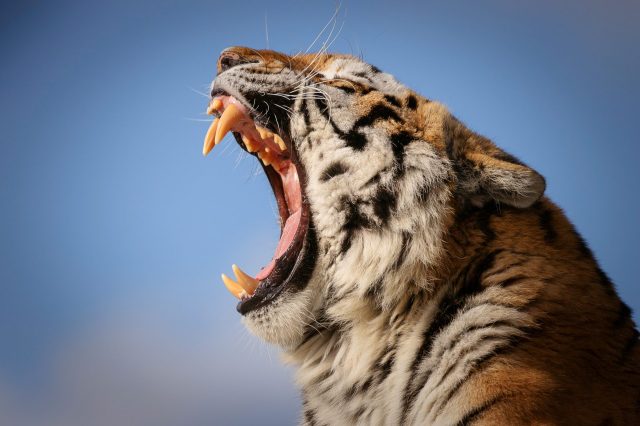
‘The story quickly took on a vast parabolic power.’ (Peter Travers/Getty)





The tunnels under the Colosseum’s floor held lions, elephants, bears and crocodiles, snared by imperial animal catchers to battle with gladiators. We tend to think of such spectacles as things of the past, Steven Pinkeresque phantasms of a more brutal time. They are not. Today’s online sequels can be just as gruesome — and they reach millions more eyes.
Only last Saturday, William Chapman was mauled to death by a tiger at Yorkshire Wildlife Park. The circumstances were deeply sad. Chapman asked a fellow parkgoer to take a picture of him with the Siberian tiger in the background; he then leapt into the enclosure. “He was on all fours, praying and bowing down to the tiger,” said one witness. In footage which is by now unavoidable on social media, though police are asking you to please not watch, he points his pinky finger up to the snarling cat — signing the word “bad” in Makaton. He tells it to “stop being naughty”.
The story quickly took on a vast parabolic power. Man and tiger were reduced to characters in a thought experiment about asymmetrical free will. The tiger is tethered to his own predatory nature; the man is unguarded, naive, jigging into his own damnatio ad bestias. Because the footage was so disturbing, people online began arguing with each other to rationalise why they watched it. The death was merely natural selection, brayed one camp; no, it was an indictment of “post-Christian morality” that the tiger was not gunned down, screeched another. Someone had to pay: the man, his absent carers, the authorities, the tiger himself. Until then, spectators will just keep watching the video, keep arguing about evolution, religion, disability, public safety and animal rights. And so we roll the dead man, and our own discomfort about his fate, quietly out of frame.
Many voyeurs even seemed to find the video darkly entertaining. These included President Trump, who posted the footage to his Truth Social feed along with the caption: “Don’t ever mess with nature! President DJT.” The White House Rapid Response account reposted this on the app formerly known as Twitter.
The footage quickly joined the ranks of social media’s many viral snuff films: jihadi beheadings, cartel executions, dark-web torture material… They are pure abjection in Julia Kristeva’s sense of the word: their victims hover darkly between man and meat.
Though we might not consider ourselves snuff watchers, mainstream social media is full of it. Older Millennials have been watching atrocities online since they were teenagers. The adults of the internet were weaned on scary chain emails, Flash animations, shock sites, illicit imageboards and links distributed through schools. Sites like Rotten.com, launched in 1996, provided unmoderated archives of crime-scene photographs, autopsies and accidents. In 2000 Ogrish drove the model forward by introducing video. Its slogan, “Can you handle life?”, gave gore the undeserved sheen of journalistic integrity. Then came 2 Girls 1 Cup (a gross fetish film from 2007), Tubgirl (a shock image from the Noughties) and 3 Guys 1 Hammer (a real 2007 murder filmed in Ukraine and shared widely online).
This material used to be relegated to the shadows, curiosities or titillations passed among groups of shrieking teenagers or paying perverts. Now, snuff is as accessible and commonplace on X, Telegram, TikTok and Instagram as baking tutorials. The gore sites of yore used to pull in anonymous voyeurs; today’s versions engage respectable citizens with government titles in bio, who watch them in between checking the weather and WhatsApp. On Monday, for instance, a man was ejected from a car on a rollercoaster at the Six Flags theme park in Georgia. Disturbing images of his death — including those captured for the ride’s souvenir photographs — were unavoidable on X. As usual, there were some calls not to share them out of respect for the dead man, but those stopped nothing. The viral video of Henry Nowak’s death earlier this year fit the same pattern.
Of course, the snuff content that seeps into the mainstream is far from the worst of it; elsewhere on the internet lurks a blue-black mass of the worst depravity imaginable. Last week, a 30-year-old man from London was jailed for leading a ring of southeast Asian monkey torturers. He’d written the scripts for the animals’ mutilation and dismemberment; the resulting videos could be watched for $500. Modern snuff such as this is a distinctly online phenomenon: extreme violence is relished by a faceless and remote spectator. And while such sadists and freaks have always existed, their ability to convene and trade has not. It’s the classic “toaster fucker” theory of the internet: before anonymous forums, someone expressing an interest in copulating with a kitchen gadget would be shamed and set right. Today he would find community with 1,000 other toaster fuckers; his life goes up in smoke.
Meanwhile, the culture of atrocity is even being embraced by elements of US government. The former US army major who killed 13 people and an unborn child at Fort Hood in 2009, Nidal Hasan, will be executed by firing squad on 3 December this year. The Pentagon announced last week that it would livestream his demise online, the first public execution since 1937. There have been objections — Vice President JD Vance, a devout Catholic, said he was “not going to be watching it”. The US Conference of Catholic Bishops called the potential stream a “barbaric promotion of a culture of death”. It is being limply proposed that the execution is a deterrent for other would-be jihadis, yet one grandee of the American Bar Authority instead condemned the “grotesque spectacle” as an ugly excrescence of the Secretary of War Pete Hegseth’s “eye-for-an-eye” philosophy. Trump is yet to “make a decision” on the livestream.
Whether or not it goes ahead — and it isn’t likely considering Hasan has federal appeals remaining — filming abjection is already part of the grammar of online culture. The legitimacy of the firing squad will be degraded in the company of online horror peddlers. What’s more, the fear and respect Hegseth expects the livestream to command may as well be an ancient Roman artefact. The internet’s collective morality, fattened on senseless brutality, is long inured to violence.
We may have lost all hope of regulating the internet. Yet we should remember that we drive its depravity, pull our seats closer to the stage in the ancient theatre of human cruelty. That confused man pointing his little finger at a Siberian tiger will almost certainly persist as a stupid, cruel meme for weeks to come. For what is a spectacle without an audience?
