




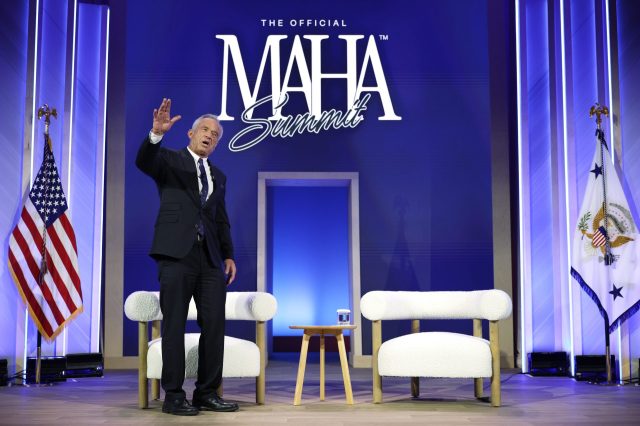
Health and Human Services Secretary Kennedy at the Official MAHA Summit earlier this week. Credit: Getty





Inside the Waldorf Astoria in Washington, DC, a colony of flamingos has gathered. Around 200 people are balancing on one leg with their eyes closed as they await further instruction. The instructor intones: “Hold it for five seconds… 10… 15… 30. Now put your foot down.”
The flamingos open their eyes and glance around. Suddenly, they remember that this is the second annual Make America Healthy Again (MAHA) summit, not a Maharishi Mahesh Yogi retreat. The instructor guiding them is, in fact, Bryan Johnson, the investor-cum-longevity influencer who has set himself the modest goal of becoming the first human to not die. “If your balance lasted between zero and seven seconds, your biological age is 60 to 80.” Several 40-somethings look distraught.
The scene was undeniably nutty. But behind the biohacking and balance tests, MAHA is becoming something much more serious: a political movement with money and institutional backing that is moving well beyond its activist roots.
Johnson might seem like an unlikely ambassador for MAHA. He is a Silicon Valley millionaire whose transhumanist worldview has little in common with the more quotidian concerns of MAHA’s crunchy moms. He worries about the end of the human race; they fret about Red 40 in their kids’ cereal.
But this strange alliance is what makes MAHA one of the most dynamic and politically potent forces in the United States today. Having evolved from a populist insurgency into a viable electoral coalition, MAHA in 2026 looks very different from the movement that helped propel President Trump to victory in 2024. It now counts in its ranks biotech bros like Johnson, health-care CEOs, and world-famous athletes, all of whom appeared at this week’s summit.
Trump's Boomer-palooza
Some of MAHA’s original supporters view these additions less as a success than a hostile takeover. They pointed to the summit’s corporate sponsors and its speaker list, which featured more CEOs than MAHA moms, as evidence that the movement has sold out or been captured. As one despairingly wrote: “It is a betrayal of what MAHA claimed to stand for.”
This is, however, a misread. That the movement is now working with figures it has long opposed should be seen as a victory, not defeat. The truth is that the only way to effect change in a country dominated by powerful pharmaceutical and corporate interests is to do so from within. That doesn’t mean MAHA should abandon its principles. But it does require resisting the temptation to frame every compromise as a betrayal, or allowing red lines to congeal into purity tests that leave it isolated from the institutions it is trying to change.
There was plenty of bad blood going into the summit. Days earlier, activists vented their fury online about the proliferation of corporate sponsors paying $300,000 for a seat at the table, while various “medical-freedom” stalwarts were left at home. Why, for example, was there no panel discussion on vaccine injuries? Why was a UnitedHealth representative talking about affordable health care? Why were scientists who lost their career for asking questions not given a hearing?
As one of a handful journalists allowed to report on the summit, I was curious to see if this anger filtered into the crowd. There were some familiar faces: celebrity chef Andre Rush, Del Bigtree, RFK’s former communications director, and Mark Gorton, MAHA Institute’s president, who once said that he was “the boldest anti-vaxxer in the anti-vax conference.” But they did not have any speaking role. In fact, most of the attendees looked as though they had just stumbled out of a boardroom meeting, with off-stage conversations revolving around advances in cancer research and boosted breeding in potatoes. Despite a healthy showing of amber-lens glasses, peptide-grown muscles, and one “vaccine police” T-shirt, this was not a crowd of cranks.
Having covered RFK during his presidential campaign in 2024, I was struck by how much had changed. Back then, Kennedy’s supporters comprised a motley bunch of crusty hippies, vaccine skeptics, and disillusioned Bernie bros. It was, in many ways, an expression of what used to be called the California Left: a blend of serious and kooky critiques of big business’s role in America’s health crises.
Channeling that spirit, Kennedy was the ultimate outsider candidate, building his campaign around three core issues: ending the forever wars, cutting America’s debt, and fighting chronic disease. It was the last of these issues that really galvanized his campaign, as Kennedy railed against agencies like the Food and Drug Administration, The Department of Agriculture, and the Centers for Disease Control and Prevention. All, he charged, were “controlled by giant for-profit corporations,” and the uniparty was “in cahoots with the big food producers, Big Pharma and Big Ag.” Now, he’s in charge of those very agencies, with the Big Pharma executives he once denounced appearing at his summit.
Since becoming health secretary, Kennedy has delivered some of the changes MAHA activists had long demanded, particularly on food additives and ultra-processed foods, but some of his bigger promises have stalled. His pledge to identify the root cause of autism within months went unfulfilled, he failed to win funding for a new chronic-disease agency, and his push to ban direct-to-consumer pharmaceutical advertising has gone nowhere. The biggest blow of all was Trump’s executive order to boost domestic production of the weedkiller glyphosate, forcing Kennedy to defend a chemical he’d spent years opposing.
These defeats have understandably angered many of Kennedy’s erstwhile supporters. But his success on food dyes demonstrates why it is best to work with, rather than against, industry. In the last year, Kraft Heinz, Nestle, Conagra, and other major food companies all committed to eliminating FD&C colors, which have been linked to behavioral concerns in children, from their US products. The FDA now runs a “natural-dye-pledge” website that allows the public to track whether companies actually deliver.
Perhaps his greatest success, though, is that the fight today against regulatory capture, and for cleaner food, has become a rare bipartisan cause. In California, Gov. Gavin Newsom signed legislation phasing out ultra-processed foods from school lunches, and by 2029, the state could become the first to label them in grocery stores. Earlier this year, Sen. Cory Booker (D-NJ) said that he “absolutely” supports some of Kennedy’s initiatives, including more testing of infant formula for microplastics and a push for healthier foods in schools. And progressive Democrats including Rep. Alexandria Ocasio-Cortez of New York and Michigan’s Abdul El-Sayed have been trying to drum up support for taking on Big Ag and Big Pharma. If Kennedy wasn’t in the picture, these topics may not have received the same kind of air time.
America’s pharma and food industries are notorious. The drug industry is routinely among the biggest spenders on federal lobbying, and it funds much of the FDA’s drug-review work through user fees, which means the regulator and the regulated are financially entangled by design. Similarly, the food industry is run by a handful of mega-corporations that control most of what fills supermarket shelves. These are fiendishly difficult opponents, and it would be unfair to judge Kennedy on failing to upend a decades-old system after just 20 months.
In the short term, he can focus on the issues popular with the public — fighting chronic disease, ultra-processed food, pharmaceutical influence, and environmental chemicals — while avoiding those that aren’t (such as his obsession with altering childhood vaccine schedules). Such efforts may not save his party from looming defeat in the midterms, but they would at least allow Kennedy to work across the aisle.
The great midcentury historian Richard Hofstadter once argued that the problem with third parties is that once they have stung, they die. His point was that these movements are often strongest when they are outsiders; once they have acquired power and begun implementing their agenda, they lose the energy that gave them their force in the first place. The same logic might apply to MAHA. Activists upset with the slow pace of change have already started to question if Kennedy really is the chosen one, and what life will look like once he’s gone.
This is no bad thing. For a movement to expand, it needs to shed some of its more eccentric adherents and broaden its appeal. That the summit’s loudest critics are also the supporters of the most unpopular policies is a telling sign that it is moving in the right direction. MAHA is growing up — and its followers should, too.
