




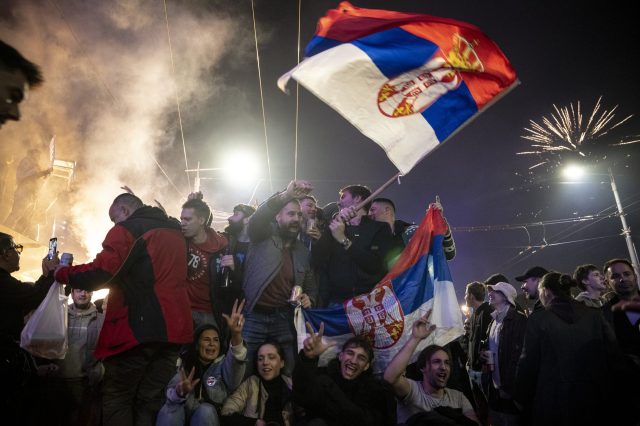
SL supporters celebrated vigorously. (Andrej Ivanov/Getty)





Until 9:30pm on Sunday night, Aleksandar Vučić still looked all-powerful. His stony face stared down from facade-covering campaign ads, which claimed that, during his Serbian Progressive Party’s (SNS) 14-year reign, the country was “doing better and better, day by day”. Sunday’s parliamentary election had been marred by reports of irregularities, including voter intimidation and beatings at polling stations, purportedly by thugs linked to the ruling party. In the hours before the polls closed, riot police amassed in Belgrade’s Pionirski Park, next to the Republic Electoral Commission (RIK), leading many to believe that Vučić was preparing to declare victory regardless of the vote count. Perhaps most ominously, large groups of men clad in black, many of them football hooligans rumoured to have ties to the state, began gathering in the centre of town. Almost everyone was expecting bloodshed. Pro-Vučić media even warned of the possibility of civil war.
In the end, Vučić surprised everyone — with an early concession. “It is clear,” he said, as he took meekly to the podium at SNS headquarters, “that we have lost these elections.” The most powerful man in Serbia for 14 years, a leader who had carefully cultivated a strongman image, stepped down without even a hint of resistance. What made his acknowledgement of defeat even more miraculous was who he lost to: the Student List (SL), a new outfit that emerged out of two years of mass protests. Every one of SL’s 250 candidates had been selected through decentralised student plenums; none was a professional politician. Among them were academics, doctors, lawyers, artists, and athletes. For political novices, the scale of victory amounted to an electoral coup. According to CRTA, an independent pollster, Student List received 52.45% of the vote, while Vučić’s “United Serbia” list received just 39.2%. At just under 70%, turnout was the highest it has been in decades.
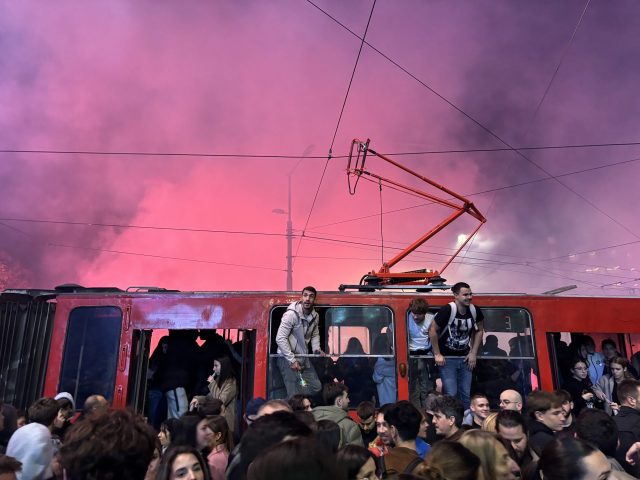
Vučić’s defeat sent thousands of people streaming onto the streets across Serbia. Belgrade’s Slavija Square, a traffic roundabout with a large fountain in the middle, became a spontaneous meeting point for mass celebrations. With all traffic stopped, revellers commandeered trams, climbed on top of bus shelters and the rooftops of buildings, and danced the kolo, a traditional folk dance. More than one stranger collapsed sobbing into my arms. It was a multigenerational celebration: university students brought their parents, and toddlers perched on shoulders. Some waved red football flares and set off deafening fireworks. Countless members of the crowd kept repeating “14 years” in a daze and in disbelief. Others chanted “pobeda!” — “victory!”. Some removed chairs from “Ćaciland”, a pro-Vučić encampment across the street from the parliament building, which had become a symbol of the confrontation between the student movement and the government.
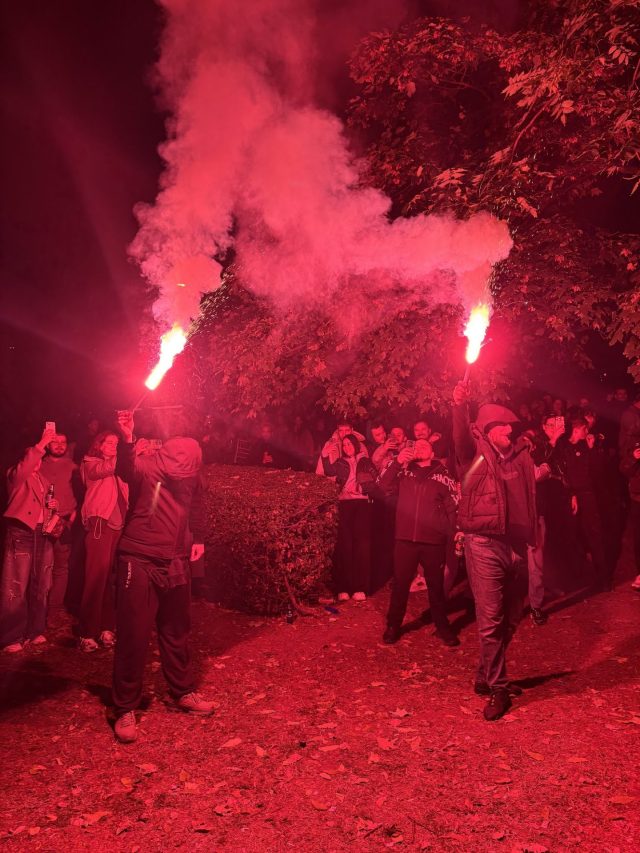
“We’re celebrating our freedom for the first time in 30 years, not 14 years, but 30 years,” Katarina, covered in pins and other Student List regalia, explained to me amid the cacophony. The “30 years” refers to a widely held belief that after the revolution that brought down Slobodan Milošević on 5 October 2000, not nearly enough changed. In Serbia, some even like to say “there was no October 6th”, meaning there was no real reckoning with the past or the atavistic authoritarian strain in society. Following Milošević’s fall, Serbia never underwent a thorough transitional justice process, leaving broad swaths of the security sector unreformed and former ministers like Vučić free to again take power. Student List has vowed to remedy this, and to undertake a rigorous purge that will hold former SNS officials accountable.
It’s about time. Past protest movements against Vučić had always generated excitement, only to peter out within a few months. But the student-led protests never slowed down. The trigger for the two years of unrest was grief, which quickly transmuted into rage. On 1 November 2024, a train-station canopy collapsed in the northern city of Novi Sad, killing 16 people. Many believed a recent renovation of the canopy had been hindered by corruption. The slogan of the ensuing protests was “corruption kills”, and their symbol was a bloody red handprint. The canopy renovation reportedly cost more than five times as much as the original estimate said it would, and the main project was awarded without a conventional public tender. For many in Serbia, indeed, the canopy collapse was symbolic of a deteriorating country. Under Vučić, critics say, Serbia has become a place where building contracts are awarded based on personal connections; where state institutions are staffed and stripped for parts by regime loyalists; and where health and safety are barely an afterthought.
Indeed, the Vučić government’s corruption scandals have been legion. In April 2016, masked men demolished buildings in Belgrade’s Savamala district near the planned luxury development Belgrade Waterfront in the middle of the night. The buildings had been blocking a foreign-funded development favoured by Vučić. For years, many have believed that he or someone in his inner circle had ordered it, and on the eve of the election, the former Belgrade chief of municipal police confirmed it. Vučić is also widely said to have a close working relationship with violent football fans and organised crime.
Little wonder, then, that some of the student protests were attended by more than 300,000 people, by far the largest since Milošević’s fall. With little access to the Vučić-dominated media, the students managed to find new ways to boost their visibility. They blockaded the faculties of universities, resulting in nearly six months of disruption to academic life. Hoping to gain the attention of EU officials, who for years regarded good relations with the strongman as a necessary evil for maintaining regional stability and keeping more dangerous ultranationalists under control, some students rode from Serbia to Strasbourg and Brussels on bikes. And, during countless street protests, they held silent vigil while standing in the street, always for exactly 16 minutes — one for each life lost in the canopy collapse.
During the past two years of protest, Vučić attempted to stem the discontent in a number of ways. First, he thought he would simply wait for the protesters to wear themselves out, just like their predecessors had. When that didn’t work, he tried sacrificing some of his closest associates. Early last year, Vučić had his Prime Minister, Miloš Vučević, resign, in an effort to appease the students. But when that failed, Vučić took more drastic measures. In one particularly jarring episode, the government allegedly used a so-called “sonic weapon” against protesters, prompting people to scatter in a sudden panic. Police and SNS-linked thugs have also beaten protesters, in some cases severely.
All the while, Vučić depicted the protests as a Western-backed “colour revolution”, while his surrogates have alleged that the movement is supported by “Ustaše”, a reference to the fascist organisation that ruled Croatia during the Second World War, and which massacred Serbs, Jews and Roma. The government has also used Pegasus, a powerful Israeli spyware tool, to surveil protesters through their phones. And, in the days preceding the vote, police raided SL offices and the private homes of several SL activists. At least seven people were arrested, accused of planning election-day unrest. But the students and their supporters were undeterred. As more than one told me, “We’re not afraid anymore.” Faced with determined opposition, and with his own party’s support in steep decline, Vučić likely decided that stepping down was preferable to a bloody street revolution.
The students’ most impressive feat was transforming street protest into a viable electoral vehicle. First, SL was adamant that no single leader would come to dominate the movement. This prevented opportunists from hijacking the protests for their own agenda, and excluded the kinds of narcissistic personalities who have historically gravitated towards Serbian politics. This also guarded against replicating the same personalist style that has disfigured Serbian politics for decades. The leaderlessness of the movement made it harder for Vučić to launch salacious smear campaigns against opponents in pro-government tabloids, a signature of his rule that always kept his political rivals cowed. Serbia’s official opposition were also excluded from the movement from early on, as they were often tainted by association with past scandals. As Savo Manojlović, a member of the Belgrade city assembly, and leader of a movement that supported Student List told me, “a crucial role in this process has been played by the emergence of new, uncompromised faces on the political scene”.
Student List is also ideologically heterogeneous, encompassing conservative nationalists, pro-EU liberals, and Leftists in its ranks. Indeed, the diversity of political thought in the movement is itself a testament to the obloquy in which Vučić is held. On Sunday night, Serbian flags and Orthodox Christian iconography predominated among the crowd of revellers, but there were also socialists celebrating in keffiyehs, and even some muted expressions of “Yugonostalgia”. Yet if that “big tent” approach proved effective at winning elections, critics can rightly point out that the lack of clear ideology will ultimately make it difficult to govern. Indeed, absent the singular, unifying cause of bringing down Vučić, SL members may soon find that more divides them than unites them. It helps, at least, that SL claims it does not necessarily aim to transform itself into a traditional political party like the SNS. Instead, members hope to use the movement to dismantle the Vučić regime: then create the conditions for fair ideological and political competition in future. In other words, SL is the custodian of Serbia’s transition to a genuinely democratic system.
SL has also been deliberately ambiguous about most aspects of foreign policy. This was partly a strategic decision, made to keep the focus on Vučić’s domestic malfeasance. As Vuk Vuksanović, a lecturer in foreign policy and grand strategy at King’s College London, tells me, SL’s victory actually means that foreign policy will change the least of any area of Serbian governance. “The Balkans are now a region where people are preoccupied with things closer to home,” Vuksanović says. Indeed, much of SL’s official programme deviates little from the SNS line. Under Vučić, Serbia maintained good relations with both the US and Russia, along with China and the EU. SL is already signalling that it will do the same. Yesterday, sociologist and SL representative Jovo Bakić went on RT to pledge that there would be no changes to Serbia-Russia relations, and that SL would continue Vučić’s policy of opposing sanctions on Russia.
The one area where SL’s foreign policy does dramatically depart from its predecessor is on Israel. Vučić cultivated close ties with Tel Aviv through arms sales, and oversaw the recent inauguration of a new joint Israeli-Serbian drone factory near Belgrade. But SL explicitly says that it would end arms sales to Israel and increase aid to the Palestinians. SL deplores Israel’s wars on its neighbours and view Tel Aviv as one of Vučić’s strongest backers. On the issue of relations with the EU, meanwhile, SL has had to tread more lightly. The movement contains both europhiles and eurosceptics, so has sought to balance between both. “SL has been playing a middle ground,” Vuksanović tells me. “They cannot fully reject the EU because it’s Serbia’s biggest trading partner, meaning the economy depends on it, but they also can’t do hyper-globalism because it irritates conservatives.”
SL’s success at transforming a student-protest movement into an electoral vehicle capable of taking control of the state will undoubtedly be studied for years to come. Surely, many would-be Gen Z activists will see their success as a template ripe for emulation, especially as youth-led protests are spreading across the globe, from India to Albania, while riots rage across Western Europe. If nothing else, the SL example demonstrates that such movements can have other fates besides wanton destruction and fizzling out into nothingness. Indeed, what is perhaps most distinct about SL is that it never descended into street violence. In fact, it always actively discouraged it, aware that the government would use any acts of violence to demonise the movement and justify more repression. Last week, after the last major protest before the election on Slavija Square, students even picked up rubbish left behind by protesters. Yesterday, after the vote, the students cleaned up the park that once hosted Ćaciland. It was symbolic of the task ahead. Now that they’re in power, SL will be cleaning up the mess that earlier generations of Serbs have made for them.