




‘Britain’s adversaries can call on organised crime networks of Islamists, Iranians or Albanians.’ (Getty)





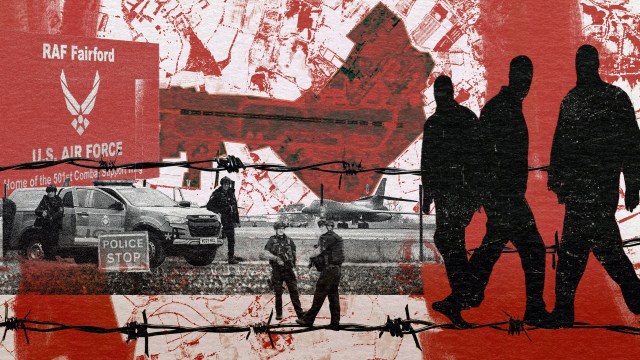
The tale of RAF Fairford grows stranger and stranger. In the early hours of Sunday morning, three white vans were found near the Gloucestershire base. Five men were arrested, first on suspicion of explosives offences, and then on suspicion of terrorism. The men were soon released on bail, prompting warnings from Donald Trump, and then US Secretary of State Rubio, that they were linked to Iran. British officials were less forthcoming, though they disclosed, confusingly, that one of the suspects had called 999 on himself.
On Wednesday, Andy Burnham finally acknowledged the Iran link, and the defence secretary, Wes Streeting, admitted that Britain faces state-backed threats to our military bases. On the same day, Benjamin Netanyahu said that Israel had told Britain there was going to be an attack; and on Thursday, Scotland Yard said a 27-year-old British-Iranian man had been arrested in Westminster on suspicion of the preparation of terrorist acts.
In short, the details of the Fairford incident remain murky. But the wider story, at least, is becoming clearer. This week I have spoken to current and former military personnel, Ministry of Defence civil servants, members of the intelligence community, and family members of soldiers, for whom these bases are home. What emerged was an account of new technologies and new social phenomena imperilling military bases. British territory as a whole, it seems, can no longer be thought of as wholly safe and friendly.
Of the 2,000-0dd military bases in Britain, among the most significant are the far smaller number that host runways and aircraft. An even smaller portion of these, such as RAF Lakenheath and RAF Mildenhall, both in Suffolk, as well as RAF Fairford, are used by the US Air Force. Fairford, like most runway-equipped RAF bases, has its origins in the Second World War, before being expanded in the Cold War. It is the only European airfield from which the USAF launches bombing sorties.
Even during the Cold War, the bases in Britain itself — those in Northern Ireland being a separate matter — faced few direct threats. As a result, they are far less secure than British bases abroad. Typically, they are guarded by a chain-link fence, a gatehouse, and a flimsy barrier. One army wife, who lives on a base, told me that damage to the perimeter fence has gone unrepaired for years. I was also told of procedural weaknesses as well as physical ones. It is widely-known that at some bases, staff do not check the ID of every person entering.
Those security weaknesses are becoming increasingly dangerous. Our adversaries, particularly Russia and Iran, conduct proxy and grey war against us, and have even recruited in-country agents via social-media platforms. On the one hand, these subcontractors might not have the competence of seasoned agents. On the other, they can offer our adversaries plausible deniability. And if they are caught, they will not be able to reveal much valuable information.
A recent example of this “Deliveroo terrorism” came via the Ukrainians whose arson attacks target a property and vehicle owned by Keir Starmer. These men were recruited via Telegram, and offered money for the task. There have also been instances of foreigners being seen around key military sites. Britain’s adversaries can call on organised crime networks of Islamists, Iranians or Albanians. “They can enact whatever form of mischief they want to create,” said George Simm, former Regimental Sergeant Major of the 22nd Special Air Service Regiment, calling it “terrorism by proxy”.
Worse, the recruitment efforts appear to have stepped up. Gwythian Prins, a geopolitics strategist and research professor emeritus at LSE, said that, since the beginning of the Iran War, the Islamic Revolutionary Guard Corps has switched to “swarm” tactics, meaning they are seeking to overwhelm our intelligence service by “recruiting useful idiots in the thousands”. “Can [the security services] monitor them? Not a hope.”
Many of these potential operatives have arrived via legal immigration, which has expanded in recent years to an unprecedented scale. Some of them have slipped in via Britain’s porous borders. Iran is among the countries believed to have sent agents or proxies via small boat. And if operatives arrive in boats which aren’t intercepted, or via light aircraft, they are able to bring with them equipment such as weapons or detonators. Simm warned that poorly guarded airfields are enabling adversaries to carry out smuggling operations “all the time — contraband, guns, people. I mean, the whole thing’s wide open”. This is a threat the state seems to be aware of, with Border Force issuing guidance in August encouraging people to report suspicious activity at private airfields. For its part, recent Royal United Services Institute report warned that “aviation misuse may extend beyond organised crime to wider national security”.
Roy McComb, a former Detective Chief Superintendent in the Police Service of Northern Ireland told me: “If you’re a hostile force, you find the weakest part of your enemy’s armour. There’s no doubt in my mind that the border is one of those vulnerabilities, and if you wanted to bring people in who were going to be involved in a hostile act, the easiest way [is to] bring them in, have them go dark for a period of time, have them meet up with some of their compadres, and then go to work.”
The task of the subcontractors is made easier by advances in drone technology. Thanks to the technological foment of the war in Ukraine, one can now legally purchase devices that can carry 40 kilograms, and be controlled via the internet from anywhere on Earth. Modern drones, I was told by Steve Tisseyre, a former police officer who specialised in counter-drone work and is now a director of an aerial defence firm, are “attractive to anyone wanting to carry out surveillance, cause disruption or get around traditional security measures”. They could also, as we have all seen in the Ukraine war, be used to directly attack vehicles and kill people.
Only in February did the Ministry of Defence establish restricted airspace areas over 44 critical bases. Until those orders were in place, therefore, it was legal to fly a drone over those bases. Indeed, it remains legal to fly drones over many other military sites. The MoD told me that restrictions will be put in place over 160 further sites “in the autumn” — surely an unnecessary delay.
What form could an attack take? Roy McComb, a former Detective Chief Superintendent in the Police Service of Northern Ireland, told me that a “capable opponent” might even attack a base with an improvised bomb, “whether it’s placed within the fence, driven inside the compound, brought in as a proxy, or launched as a mortar attack, I don’t think most of the bases in Great Britain are ready for that.” Other forms of attack, I was told during the course of my reporting, could come via drone, on foot, or through surface-to-air missile strikes against military aircraft during takeoff.
As McComb added, Troubles-era attacks on police bases in Northern Ireland resulted in significant effort and expenditure being directed towards hardening those bases with enhanced physical security, patrols and other measures. “Whether we get to the point of having to do that in GB is the question.”
Maximal physical security, however, is not necessarily optimal. Speaking on condition of anonymity, a retired very senior British army officer, told me that “there is a high degree of pragmatism necessary when one’s talking about protecting military bases, because the whole of the military could consume itself in marching up and down behind the wire.”
What, then, does Fairford mean for the defence of this country? Prins described it as “a wake-up call… we have become lazy and lax. And we know that our exposure to infiltration through immigration is wide-open.” The situation is exacerbated, he said, by Israel’s decision, following Britain’s sanctioning of its West-Bank settler population, to withdraw its intelligence cooperation.
A spokesperson for the MoD told me that the Government maintains “robust and proportionate security measures across the Defence estate,” and takes action where necessary “in response to evolving threats.” The MoD , I was also told, has committed £790 million to strengthen protection from air, drone and missile threats. “Whilst we will not comment on specific security measures, the public should be reassured the UK, and its allies remain vigilant against potential threats.”
But concerns remain that we are not doing enough to be secure. For instance, the British military has been slow to adapt to drone warfare. On 1 March, Iran launched strikes on RAF Akrotiri in Cyprus. “The only way we could think of defending the RAF base at Akrotiri,” said the retired senior officer, “is to send one of our Type 45 destroyers out [rather than deploying] some sort of system in a box that could be whizzed out there”.
And military bases are far from the only potential targets of hostile states and their proxies. Our military supply chain, as well as our critical national infrastructure, including power plants, water supply and airports, are all at risk of attack. And the targets aren’t only on land. As Prins noted, we face an acute and proven sabotage threat to British undersea critical infrastructure — internet, gas pipelines, electrical interconnectors — from Russia’s formidable GUGI fleet of specialised submarines, which are designed to attack targets on the sea floor.
Intelligence is absolutely key to defending our bases. As Simm put it, that the men arrested near Fairford “could rock up almost to the fence unchallenged is a sign the system is overwhelmed or at least confused”. It doesn’t help that operatives are savvier than they used to be. “These days the terrorists are very surveillance aware and good at communicating in codes, which makes it harder to know exactly what they’re talking about.” This means that intelligence is rarely able to identify a “specific threat” unless we have “got an agent in there”.
As several of my interviewees said, Britain is still underspending on its military. We need better-resourced intelligence services and urgent investment in anti-drone technology — as well as radically strengthened borders, both at sea and at our airfields.
For the long peace is long over. The rules-based international order is dead. Soft power, always a comforting lie, must be cast aside. We need to get serious about security, serious about funding the military, and serious about our borders before it is too late.