




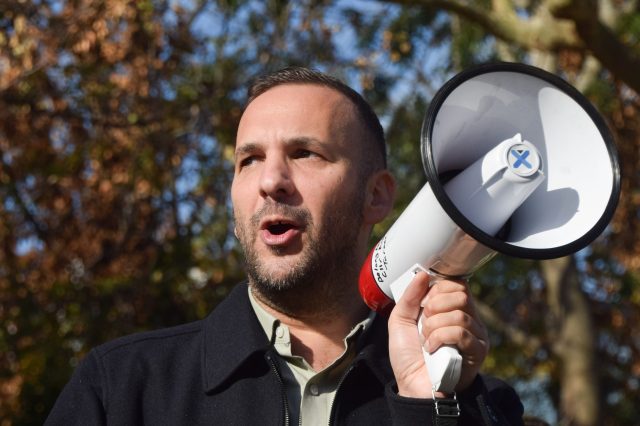
Can he find his voice? (Vuk Valcic/Getty)





“Hope comes from honesty.” As Andy Burnham uttered those words to the Labour faithful by Liverpool’s Albert Dock, Zack Polanski was working the doors in central London. From the mosques and pubs of Somers Town to the affluent lanes of Tufnell Park, the Green leader was panning for votes like an electoral prospector, sometimes finding veins of gold — Palestine, disquiet around housing — at others disappointment.
This weekend, the Greens too will host their own conference, a scaled back affair in Brighton. Yet as Polanski’s resolute campaigning suggests, it’s the Holborn and St Pancras by-election, now less than a week away, that truly matters. That shouldn’t surprise anyone, not least because, this year, the great British by-election has re-shaped Westminster. Holborn is the fourth, and all but one, when Nigel Farage triumphed in Clacton against a man dressed as a bin, have been of national importance.
First came Hannah Spencer’s triumph in Gorton and Denton, the only by-election win in the Green Party’s history. Little more than two months later came a similarly strong performance in local elections, with success in London sealing Keir Starmer’s fate. Over the weekend that followed, Polanski emerged as a genuinely national figure, proudly asserting that two-party politics was “dead and buried”.
And so, in June, came Makerfield. More than simply deciding that constituency’s next MP, it was clear from the outset that it would also provide a launchpad for Andy Burnham’s ambitions: first into Parliament and then into Downing Street. Those vacillating members of Labour’s NEC, who had previously blocked the former health secretary from standing in Gorton, now changed tack, their endorsement underscoring how far, and how fast, their party had fallen.
The Green ascent thus changed the fortunes of both themselves and Labour. Now controlling several London boroughs, a party which boasted a single MP before 2024 had triggered an internal revolution within Government. Yet a cruel irony to those accomplishments would inevitably follow. Polanski’s rise made Labour pursue otherwise unthinkably high-risk measures — measures which now appear to be paying off. No longer facing a moleish bureaucrat for control of the Left, Polanski’s struggle is simply to remain relevant.
Labour are confident of a win in Holborn and St Pancras, and the bookmakers have their candidate, Sagal Abdi-Wali, as the overwhelming favourite. And, to an extent, this makes sense. Camden Labour performed relatively well in May’s local elections, with the Greens failing to break through here as they did in less prosperous places like Harringey, Lambeth and Hackney. Polanski also doesn’t live in the constituency — which counts more than ever in Britain’s hyper-localised politics — as Reform found to their detriment with Matt Goodwin in Gorton and Denton.
Even so, having been to the seat, and spoken to campaigners and voters alike, Labour’s self-assurance does surprise me. As a campaigner, Abdi-Wali seems cagey and lightweight, with Camden Labour operating a “ming vase” strategy lacking the energy that infused the party’s Makerfield victory. Where Burnham was eager to talk to just about anyone in Wigan — from aging Lexiteers to people saying he was complicit in the grooming gangs scandal — Labour in Starmer’s old patch are protective and insular.
And while Burnham is pledging to “end neoliberalism,” Camden Labour — which controls the council, holds the mayoralty and, for now, represents both the borough’s parliamentary constituencies — is going full steam ahead. Among other things, the group is presently selling off a local recycling site, replacing it with one half the size. Their Community Investment Programme, meanwhile, is regarded by critics as a giveaway to private developers. Public services, from street cleaning to waste management, are all outsourced too, with some contracts renewed as recently as last year. Labour’s record at a local level is very much at odds with the rhetoric of its new leader.
Yet if Polanski is fighting hard against a politically exposed opponent — putting in the hard yards to win every vote he can — it’s also clear that his party has no real national message. From what I understand, the Green leader has been submerged listening to the concerns of local residents, from LTNs to parking. But that leaves little space for connecting those street-level worries to a broader set of principles, with Polanski more often reacting to the news cycle than defining it. A case in point was his defence of the triple lock following Burnham’s speech on Tuesday, with the Green leader asking why Labour was “going after pensioners”. That might make sense — had the Greens themselves not pledged to end the triple lock at the last general election. Hardly Burnham’s conference-hall plea for hope through honesty.
Why, at their zenith, did the Greens take their foot off the pedal? There are many plausible answers, not least that some within the party view their role as being little more than a pressure group pushing Labour left. And so, with Starmer gone, some concluded it was mission accomplished. Then there’s the fact that building an organisation in an age of frantic digital activism feels harder than ever, with ideological zeal on social media often masking lace-thin commitments off it.
Perhaps most importantly, though, the party’s core values remain unclear. The Green movement is stronger than ever: people, after all, are far more interested in the work of Friends of the Earth than the Fabian Society. So where were the Green politicians making vertical videos in Wisley this summer, when the Surrey village saw no rain for two months? Or when New Forest businesses were slammed after wildfires deprived them of peak-season tourist trade? Why, when the A31 was closed for almost a fortnight as a result of the flames, wasn’t the party making the case for temporary free train travel as an emergency response? In their defence, the Green leadership might say they were knackered after an extraordinary few months. That carries more than a grain of truth: rapid growth is often exhausting for insurgents. But national politics is utterly relentless, and things always move on. More reason, then, to focus on building an effective organisation that transcends the gravitas and personal pull of any single individual.
Amid such frustrations, the Green conference in Brighton feels like a lost opportunity. It could have provided the party with a moment to reflect on a remarkable year, and debate their policy platform moving forward — especially in the very different context of a Burnham premiership. Instead, the party is offering refunds to members who’d paid to attend, but who now want to canvas in London. Holborn and St Pancras matters, of course, and the party is more competitive than many realise, but that also underscores a tendency of the radical Left towards “actionism”: where thinking, debate and theory counts for less than it should. Collective deliberation, and a vibrant intellectual culture, especially offline, are the lifeblood of any party seeking to transform society.
Not that it’s all bad for Polanski and the Greens. For even if it seems unlikely he’ll triumph in Holborn, he could come a close second — something which might end up benefitting both him and Burnham. The former never meaningfully expected to win, after all, and he’ll have built a formidable operation for when he stands (and likely wins) in one of the Hackney seats at the next general election. Making inroads into Labour’s majority, at the very moment that the Government is enjoying a honeymoon with a new leader, would remain an impressive accomplishment, whatever Polanski’s detractors might spin next Friday. As for Burnham, a narrow margin of victory might provide a valuable impetus to change his own party. The remnants of Starmerism would need to be dealt with.
Yet whatever the tactical result next Thursday, that still leaves the Greens in the same strategic quandary. Are they building an organisation, and a movement of their own — defined by thick offline ties, a vivid intellectual and social life, and local experiments in politics — or are they simply a response, or indeed a symptom, to a collapse in two-party politics? The same question can be posed of Reform, of course, but then it’s rather easier to avoid existential angst when you’re receiving tens of millions of pounds in donations.
For all the enmity between Polanski and Farage it’s clear that, until now, both men thrived in part because they weren’t the big two — with effective strategy often requiring little more than opposition to a moribund “uniparty”. But what happens when one. half of that uniparty, Labour, explicitly admits their complicity in decades of failure, and openly says the country has been on the wrong path “for a long time”? Suddenly, being purely antagonistic no longer works, and can even start to resemble puerility. That the Conservatives won’t do something similar, and admit their own fiascos on austerity, migration and Europe, should perhaps provide succour to Farage and Zia Yusuf.
What, then, should the Greens do? At a national level, they need to determine where they are distinct from Labour, and craft their message and policies accordingly. Clearly a large part of the answer involves climate change. That, after all, remains the basis for a potentially vast coalition: from the Countryfile viewers in the shires to urban graduates who are more likely to watch Gary Stevenson. It’s worth remembering, too, that while the Greens, Reform and Labour all have memberships of less than 300,000, the Royal Society for the Protection of Birds boasts over a million. The National Trust, Europe’s largest conservation charity, has a membership five times that.
Secondly, the Greens need to decisively become the party of struggling urbanites. But this means focusing on problems like fly-tipping and quality of life as much as the housing crisis or other immediately Left-coded issues. If Auckland can build a new metro, in a decade no less, why can’t the likes of Leeds and Bristol? Solving problems like that, from supply chain constraints to planning oversight, should be the party’s bread and butter. Britain’s cities are appallingly managed, and the Greens should relentlessly seek to provide answers, even when those aren’t especially ideological. To put it another way, the Greens should be the party most committed to making Britain a more pleasant place to live: advocates for lapwings, but public lidos too. For that to happen, though, Polanski’s team will need to dump the reflexive negativity — instead linking values to policies that forge a national movement, all while being open about the threats and opportunities of a genuine green transition. Yes, some risks will be involved, and yes, any endeavour on such a scale will include mistakes.
There’s another, easier option available to the Greens as well: wait. Wait for Burnham’s honeymoon to end. Wait for the Labour in-fighting to return, as the party’s perennially toxic Right attempts to take back control. That will inevitably happen — not least because it is the Labour Right that still controls the NEC and much of the party bureaucracy. And, when it does, the Greens will be there, an oven-ready alternative for progressive voters. That’s an alluring strategy for Polanski, not least because it isn’t really a strategy at all. “Never interrupt your enemy while he is making a mistake,” Napoleon reputedly said. Fair enough: but, more often than not, that’s a line deployed by people who are simply unsure of what to do. Like the Prime Minister says, real hope comes through honesty. In these fractured times, that’s a line everyone in politics can learn from.
Aaron Bastani is the co-founder of Novara Media, and the author of Fully Automated Luxury Communism.
 AaronBastani