




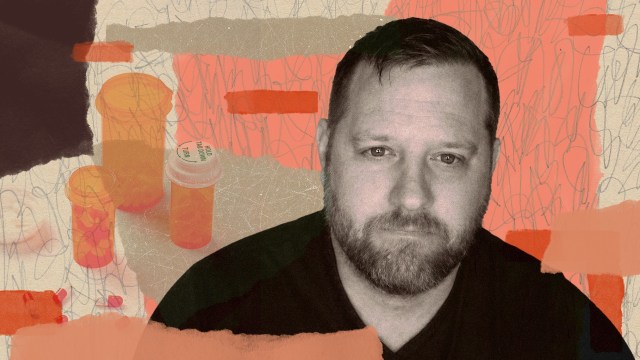
‘Freddie deBoer soon became one of Substack’s better-known and most controversial writers.’ (J.G. Fox)





When I meet Freddie deBoer on a sunny Sunday afternoon in New Haven, Connecticut, at an upscale Japanese grocery market, he arrives wearing a black Sunn O))) t-shirt — a nod to one of the world’s loudest and most frightening drone-metal bands. “You gonna get food? I’m gonna get food,” he says, before I can answer. It’s a brief, almost brusque, introduction, from a polarising writer who is known for making some feel uneasy.
In an earlier era, deBoer, 45, might have been anchored in a university department or a prestigious magazine. Today, he writes on Substack. His third nonfiction book, All in Your Head, a crisply argued analysis of modern disability culture, is out next week. Though he’s a socialist and civil libertarian, deBoer is known for his biting critiques of fashionable progressivism. That tension, between his Left-wing politics and his intellectual disposition, runs under much of what he writes.
Had deBoer been born before the advent of modern psychiatric treatment, he’d have fared much worse. He has spoken openly about living with bipolar disorder, and the wreckage brought on by its worst symptom: acute and escalating paranoia. He was first involuntarily committed in 2002, after an altercation with a neighbour. His worst psychotic break occurred in August 2017, when he publicly attacked the writer Malcolm Harris with knowing lies, accusing him of rape. Less well known is that around the same time, deBoer threatened an ex-girlfriend with violence, after he imagined she’d hacked into his bank account. She insisted that he check himself into a psychiatric institution — or else she’d call the police. DeBoer suspects the intervention prevented a jail sentence or eventual suicide.
His childhood was marked by loss and instability. His mom died of brain cancer when he was seven. His father, Fritz, a radical theatre professor, died while deBoer was in high school, from hepatocellular carcinoma and hepatitis B and C. Freddie remembers him as physically imposing, rascally charming, and “incredibly loving”, but so incapacitated by alcoholism that he was unable to provide ordinary parental guidance, even on matters as basic as personal hygiene.
DeBoer built an audience blogging in the early 2010s, then earned a PhD in English at Purdue in 2015, even as he cycled in and out of manic episodes. He gives the impression of making it through grad school as a high-achieving, hard-living, cerebral party monster. He hoped to become a professor, but entered the academic job market at the worst possible moment. In the mid-2010s, the collapse in tenure-track humanities hiring had become a national story, and — it’s true — white males had an especially tough time getting hired. Yet he found an administrative position at the City University of New York (CUNY), where he oversaw assessments of student learning. He dutifully informed his new employer he had a registered disability for which he was medicated. “I told them my memory is going to suck, my focus is going to suck, and I have fatigue issues.”
DeBoer publicly apologised for l’affaire Harris in 2018 and vowed to stay off the internet; a history of bruising online disputes had made him untold other enemies. Following an aggressive regimen of medication and therapy, however, he emerged as an author in 2020 with The Cult of Smart, an argument against tying human worth to academic talent. But he lost his CUNY job that year. He was unemployed and uninsured during Covid, watching his $75,000 book advance dwindle by the month, while wondering how he would continue paying for the mental health treatment he plainly needed. Substack extended a lifeline: a $125,000 advance against future subscriptions. DeBoer soon became one of its better-known and most controversial writers.
DeBoer frequently stresses his bona fides as a former progressive organiser; a critic of US foreign policy and Israel; a pro-choice absolutist; and a supporter of trans rights — all apparently to inoculate himself against claims that, when he attacks the Left, he is carrying water for the Right. Still, he frequently expresses frustration with today’s online activist culture, which he finds annoying, performative, and culturally elitist. A good example is his 2021 epistle to the woke Left. It’s titled: “Please Just Fucking Tell Me What Terms I Am Allowed to Use for the Sweeping Social and Political Changes You Demand.” DeBoer also maintains a savage “Good White Man Roster”, a list of progressive white men whom he regards as ostentatiously performative online. If politics provides one set of adversaries, the arts furnish another, and some sense he’s drawn to assaying writers of a certain type. Often they’re precocious or au courant: literary darlings. Admirers find him caustically funny; others call him rude. “You can cut out the middleman and just ask for pussy directly,” he admonishes showboating male feminists.
Sometimes, deBoer is called “reactionary,” though he almost never invokes the conservative canon. His work does, however, show an appreciation for the ways biology, institutions, and human nature impose constraints, something philosophical conservatives likewise emphasise. In The Cult of Smart, for instance, deBoer argues that genetics place limits on educational equality that politics cannot simply wish away. Another book, How Elites Ate the Social Justice Movement (2023), shows how egalitarian ideals can become warped by status competition and bureaucratic incentives. And in All in Your Head, he stresses that good intentions don’t guarantee anything; lots of genuinely well-meaning disability activists have, he says, increased the suffering of the mentally ill.
All in Your Head begins with a murder that once haunted deBoer’s hometown of Middletown, Connecticut. On 28 July 1989, David Peterson — a serially violent patient at Connecticut Valley Hospital (the same place where deBoer was confined) — found his way out of the forensic ward. He took a bus downtown, to a crowded sidewalk, and fatally stabbed a nine-year-old girl, Jessica Short, in front of her mother, sister, and stricken onlookers.
A stirring chapter in All in Your Head indicts deinstitutionalisation: the process, begun in the idealistic early Sixties, of shuttering or shrinking mental health hospitals. Some facilities were, indeed, overcrowded, or unwholesome. But deBoer fumes that the era’s anti-establishment reformers took One Flew Over the Cuckoo’s Nest far too seriously. It never made sense, he argues, to think of modern psychiatry as a tool of oppression. Deinstitutionalisation only became possible thanks to the mid-Fifties success of modern psychopharmacology, which helped many patients find some functional stability, so long as they took their meds.
Since the mid-Seventies, it has been generally illegal to forcibly hold psychiatric patients long-term unless they’re likely to cause imminent harm. To many, that seems legally defensible and emotionally intuitive, though the system is imperfect since, deBoer writes, “psychiatrists are not fortune tellers”. Meanwhile, deinstitutionalisation all but guaranteed that large numbers of people with schizophrenia would be left to fend for themselves on city streets, untreated or addicted, homeless, destitute, and filthy. Many such people would plainly be safer in structured therapeutic facilities but instead find themselves in jails or prisons.
DeBoer does not call for a return to the grim asylums of yore; he’d rather see patients steered toward more effective community and outpatient care. But by opening the book with Short’s murder, and stressing the harms that untreated mental illness inflicts upon neighbourhoods, he arrives at points more commonly associated with conservatives.
DeBoer also traces how the discourse of mental illness has “gentrified” online: the minimally disabled hog attention and shape how disabilities are understood. Conditions such as ADHD and autism, diagnosed with increasing frequency, get folded into the anodyne language of “neurodiversity” or are even celebrated as “superpowers” — obscuring the fact that both are strongly associated with adverse life outcomes. Meanwhile, many disability activists insist that no one should question another person’s self-diagnosis, on the theory that nobody would fake a disability. The problem is, some people do lie, and the internet only makes it easier. Similarly, when someone with a psychiatric disorder does something terrible, certain online advocates insist “mental illness doesn’t do that”. Such advocates, deBoer writes, deny “the most essential protection we have for mentally ill people — the communal understanding that mental illness confuses the question of basic moral culpability”.
DeBoer stresses that these arguments owe little to partisan politics, which is narrowly true. But as Michael Oakeshott argued, small-c conservatism is less a doctrine than a disposition — a preference for the actual over the possible, the tried over the untried. A frequent theme in deBoer’s work is that we ought to be realistic about how perfect we can reasonably expect the world to be. And whenever he makes that case, he’s in good conservative company.
It is important to know that deBoer thinks my suggestion is, as he puts it, “horseshit”. He didn’t tell me directly, but anticipated it here, in 2023: “The socialist mantra is that a better world is possible, not that a perfect world is possible.” “If you want to insist that saying there are limits to the possible is conservative, enjoy your dream world, but leave it out of my politics. The question is pre-political.”
Dream world? DeBoer seems to think he’s drawing a boundary that shuts conservatism out of his politics. But when he stresses that some things are “pre-political” — that they are prior to, and constrain, what politics can do — he echoes Oakeshott’s formative account of the conservative temperament itself. And when he applies it to critique his own side’s naivety — for instance, when discussing progressive education policy, culture war rhetoric, or deinstitutionalisation — he appears dispositionally conservative. This isn’t a strange or hostile reading. It simply speaks to his habit of reaching conclusions by scrutinising the world and studying how people actually live.
He reminds me a bit of Theodore Dalrymple, the British psychiatrist whose critique of liberal pieties arises from first-hand knowledge. For decades, he treated criminals and unfortunates in jails and slum hospitals — roughly 10,000 of them. In Life at the Bottom (2001), he writes confidentially, against the grain, and laments the ways bad ideas circulate through elite circles. Dalrymple argues that relativism and non-judgementalism are ideas the intelligentsia can afford as lifestyle accessories. A well-off person’s marriage or career survives their promiscuous tolerance of other people’s dumb, destructive behaviour, and self-serving fantastical beliefs. But when those without money, family stability, or above-average intelligence reject bourgeois values, that usually produces poor results.
All in Your Head applies the same logic. When comfortable progressives insist upon the individual rights of psychotics — to refuse treatment, to eat from garbage cans, to soil themselves, to take refuge in cardboard shacks — it costs them little. It’s not morally courageous: their tolerance is purchased with someone else’s suffering. DeBoer, by contrast, realises that constraints, even coercions, are sometimes necessary: whether for the greater good, or as particular forms of care. If you don’t want to call it conservative, fine: call it tragic realism. “The world is broken,” he writes. “We are obligated to cobble together the best life we can for everyone.”
DeBoer is a quick, effusive talker, and projects complete assurance. But later, at a bar down the street, he catches me off guard. He mentions being drawn to the internet’s “impermanence”, because, he says, “I regret so much of what I say and do”.
“How so?” I ask.
“Just being the shithead. Or being ‘too much’. Not regulating myself properly. I mean, it’s like… I don’t know.”
“I get so paranoid,” he continues. “I mean, look, I’m medicated right now. I’m fine. We’re having a conversation. I might be kind of an eccentric guy, but I don’t look like I’m crazy and I’m not crazy. [But] there is never a time when I don’t have that feeling in the back of my head that someone is trying to kill me.”
“Who do you think is trying to kill you right now?”
“That’s the thing. Because I’m medicated, I know rationally that’s not true. Right? But it’s… just a sensation of: ‘I’m in danger. People around me are conspiring. If I [don’t] get them first, they’re gonna get me.’ It’s all — look — it’s all squashed down with 1,200 milligrams of lithium and who knows what else… The drugs smush it down.”
The disclosure had emerged organically from our conversation. I’m certain deBoer doesn’t intend it as a revelation, much less a skeleton key to help me wrap up my profile. But his description of living with the low-level hum of medically managed paranoia must surely inform my understanding of the person I’d been reading for years and had just spent an afternoon with. The fiercely independent, contrarian essayist was, at least in this moment, staring into his Campari and confessing to living with abiding vulnerability.
That image scarcely explains deBoer’s place in contemporary intellectual life. But perhaps it does help explain his sharper edges. It also offers a different way of understanding his politics. A man who knows firsthand how little control we sometimes have over our own minds has good reasons for doubting that goodwill, or social justice hooey, can overcome reality and nature.
“Come on,” he says, a moment later. “Let me walk you to the train.”