




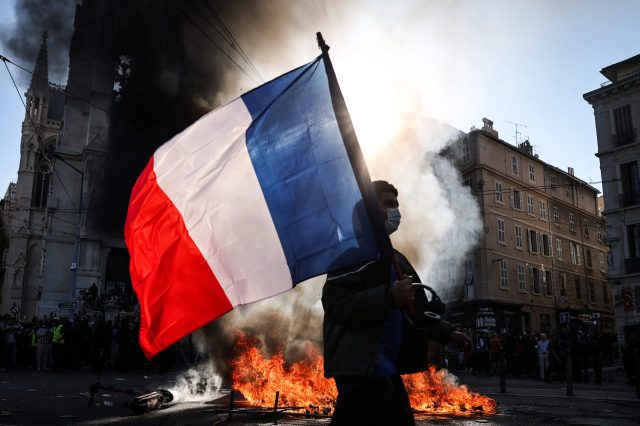





The Anglophone response to France’s riots has divided sharply by politics. The Left has largely treated the disorder as an occasion for commentary about “neoliberalism”, while the centre-right sees the events as some kind of uniquely French pathology. As for the Right, the broad thrust seem to be that the entirety of French civilisation is going up in flames, a situation already so severe that it might be best for everyone if America took all their art away for safekeeping. And behind all this a general sense that unless Something is Done France’s future will come to America.
Observing this, my thought was: but this isn’t the future for America! This is recent American history. Does no one remember the summer of 2020? Six months into Covid, George Floyd’s death triggered riots across the USA. Cities burned, youths rampaged and looted, and at one point an anarchist group took over central Seattle, declaring it the “Capitol Hill Autonomous Zone”. The total cost in insurance claims would, according to reports, total more than a billion dollars.
There are parallels between the Floyd riots and the disorder now sweeping France. But there is one significant difference. The Floyd riots didn’t stop at the borders of physical America: they permeated digital America, and spilled back out into other physical places, triggering copycat protests wherever social media holds sway.
Back then, the mimetic riptide was swift and widespread. As far back as 2020, The Guardian reported BLM protests in locations without any black people. In Manchester, Bristol, and Westminster, crowds chanted “Hands up, don’t shoot” at British police officers who — unlike their counterparts in the US, where the chant originated — almost never carry guns. There have been mimetic echoes of the French violence in other European countries; but no one in Minneapolis has come out on the streets in solidarity with the banlieues of Paris or Marseilles. Why not? Well, while we have grown used to thinking of the digital realm as sort-of neutral, a de-materialised “public square” in which every voice carries something like equal weight, the reality is that it’s not neutral. It’s American.
That means the mimetic currents mostly flow the other way. Arguably recreational protest looting is itself mimetic and (as Time put it) “as American as apple pie”. For those of us who live substantially inside the Anglophone internet, but outside geographic America, it’s easy to forget this. Like the protesters chanting at unarmed British bobbies, this can sometimes have absurd or comical effects. In 2023, for example, the British Left-wing commentator Ian Dunt decried the damage the Tories’ then-proposed “Rwanda bill” would do to “separation of powers” in Britain. Except that “separation of powers” is a political concept native to the USA, but nonexistent on this side of the pond.
But perhaps this is understandable, given that the online realm is as much a projection of US soft power in the 21st century as Hollywood was in the 20th. Joseph Stalin is reported to have once said: “If I could control the medium of the American motion picture, I would need nothing else to convert the entire world to Communism”. And, back in his day, the US State Department was sharply aware of Hollywood’s role as a vector for soft power, working closely with film industry bodies to entrench US movie-making dominance overseas.
In our own time, digital tech plays an analogous role. Just recently, for example, the US ambassador to the EU threatened “devastating” retaliation to EU proposals to reserve some satellite bandwidth for local operators, a proposal that would weaken US competitors such as Starlink in the European market. Ongoing tussles between the US and EU over “freedom of speech”, and proposed US legislation against overseas speech restrictions, can also be understood in this light.
The result is not just a tight American rein on economic and legislative leadership of digital media, but also an ideological and discursive landscape in which everyone is incentivised to filter their own country’s news through an American register. Last week, in explaining to Americans her decision to move back to Britain, the writer Freya India felt compelled to describe her homeland as “a silly little country”, and there are many more such cases.
Ever since the Great Depression, it’s been said that “when America sneezes, the rest of the world catches a cold”. So I say this mostly without rancour: empires gonna empire. We in Britain had our turn being Top Nation. But the important thing is not to get confused. And it’s easy to get confused: as the Irish writer Conor Fitzgerald has noted, the sheer volume of money, and the loudness of transatlantic Anglophone discourse, can have a distorting effect on domestic politics outside the US.
The absurdities of the Summer of Floyd vividly illustrate this. As Tomiwa Owolade has pointed out, so too does the propagation of American progressive race politics in cultures without America’s history of slavery and segregation. More recently, the Democrat Congressman Ro Khanna added his Left-wing contribution to the general noise of American projection onto European affairs. This time these events were pegged not as the tragic consequence of open borders, as Trump suggested, but what happens “when nations let wealth and power accumulate in the hands of a few”.
This kind of projection and confusion abounds on the Right, of course., and is not confined to commentary on France. It’s most pernicious when it works to refocus contentious issues away from domestic coalition-building, towards whatever sells in the international clickbait economy. For instance, Elon Musk’s contribution to amplifying domestic British debate on the so-called “grooming gangs” certainly did much to draw attention to the issue. But it was also an egregious case of this precise dynamic in play: the cost of this amplification was a hyper-focus on internationally legible, highly emotive aspects of the crimes, particularly race and sexual torture. These aspects are real. But the net effect has been further siloing the topic as a Right-wing talking point, foreclosing otherwise fruitful lines of coalition-building. And, in the process, a crucial point has been drowned out, namely that the industrial-scale horrors suffered by British girls at the hands of these gangs is the tip of horrifically large iceberg: entrenched, networked, predominantly Pakistani-heritage organised crime, active across a plethora of criminal activities beyond child sexual exploitation, and most likely embedded in British local authorities.
Tackling this represents a policing challenge roughly analogous to the measures required to curb the Sicilian mafia, which plagued American cities in the last century. A problem of this kind, and on this scale, ought to be a clear bipartisan issue. No one, Left or Right, wants to live in a mafia state. Unfortunately, a large and eager market exists, well beyond Britain’s borders, for prurient ragebait about sexual torture. That market is likewise eager for proxies through which to debate “mass immigration”, “Islamification” and the like. And when all the incentives pull toward rage-bait, anyone trying to get a hearing for a concrete programme to tackle organised crime can forget it.
Let me be clear. None of this is to say that everything in Europe is hunky-dory. Ethnic mafias is no one’s definition of “hunky-dory” here in Britain. The riots currently raging in France, meanwhile, are the most violent and widespread since the gilets jaunes protests of 2018. There is footage reportedly of private homes being invaded, and unconfirmed reports of some rioters being found with guns. If true (and not hysterical clickbait) the situation may be escalating. France has deep underlying demographic and fiscal problems. These structural issues are real, and a version of the same pattern now plagues most developed nations to varying degrees: a shrinking tax base relative to welfare liabilities, and social solidarity weakened by the demographic pluralism embraced by political leaders, the latter done in an attempt to mitigate the former.
But also? The Floyd riots did a billion dollars of damage, but America did not “fall” in 2020. France has not “fallen” this week either. The point is this: while the structural patterns producing this week’s riots may be echoed across many Western polities, the political choices best placed to respond will vary in each case. France’s political process will grind on, toward a leader able to grip the country’s domestic difficulties. This is a matter, in any case, for the French to resolve. An overwhelmingly loud, one-size-fits-all internet discourse has little to contribute to that process, except Schadenfreude and its own projections.
And this is perhaps most urgently a lesson for those polities that share a language with the USA, but diverge in political culture. The French remain at least somewhat insulated by the barrier of language. By comparison, divided as we are by a common language, we in Britain are all but defenceless. As for becoming better-defended, inasmuch as it’s possible at all, this likely entails some strategic blocking and muting. It might also entail knowing our own political history and constitution better than Ian Dunt, and by that I don’t mean the castrated postwar account approved for “Western Civilization” enjoyers.
If the AI boosters are right, American hegemony is going nowhere. Though also, if they’re right, social media will soon be so overrun with bots and slop that everyone abandons it. That might be a mercy all round. But whether Britain would emerge on the other side with a distinct political culture once more is anybody’s guess. Perhaps instead by then we’ll all just sound like AI.
Meanwhile there’s still that standing invitation, from the internet, to offer up our home for likes and reposts. As a spectacle, a “silly little country”, a cautionary tale, an object of scorn or synthetic pity: a succulent morsel for the clickbait economy. Don’t take it.
