




‘Everything is safe, solid, and unquestionable. Everything will be the same for ever and ever and ever.’ (J.G. Fox/Getty)





It looked like a Victorian madhouse from where I stood: all smoke-stained redbrick with the windows barred to discourage suicide. My mother had dressed me up in a tweed jacket and a tie, only to deposit me there outside the last-remaining all-boys prep school in the north of England. An older boy appeared and spirited me away to a new life, which only felt real once I lay on the first-night hardness of a piss-proof bed, listening to the dorm chorus of sobbing that began soon after lights out. This would be “home” for the next five years.
It was advertised as “a place where boys could be boys”, with its acres of park, valley and woodland, into which boys could disappear and beat each other with sticks and fenceposts and marinated conkers. Our sacred texts were the Dangerous Book for Boys, Cherub, Our Island Story and anything by Kipling. Girls, alien creatures of ill-repute, were absent, as were high academic standards. Instead, we were free to play sport and musical instruments, and to work on our “Character” — to become stable, self-assured Englishmen of the last century, who could stand firm in the flux of the present one.
I was not the first of my family to board there. In fact, I was “Adair minimus”, the fourth of my brothers (minor, major, and maximus) to attend the school. Each had returned, quieter, for their first exeat, insisting that it was such fun. And it sort-of was. It could not be avoided, so we had to make do. This was, after all, England’s annual trick of renewal, the ritual by which the country had sustained itself for nearly 200 years. To maintain an empire, the Carthaginians had sacrificed their children; the English merely spent vast sums of money on packing theirs off to board. This had once been considered “progress”.
And yet progress has now left the prep school behind. By the time I arrived, in 2010, these institutions had been confused into taking one of two paths: rapid modernisation or entrenchment. Mine chose the latter, and that made little sense: the world for which they hoped to raise us was long-since dead, and the ritual had become a hollow repetition. Eight-year-old children were being weaned not, as once, to rule the waves and administer an empire, but to lament their ill-fortune in therapy rooms and broadsheet supplements, or else to exert their wits in the lower rungs of the insurance market. Once upon a time, these old boys would have been public-minded; now they were just “posh” and their only certainty was that the rest of the country really cared how this made them feel.
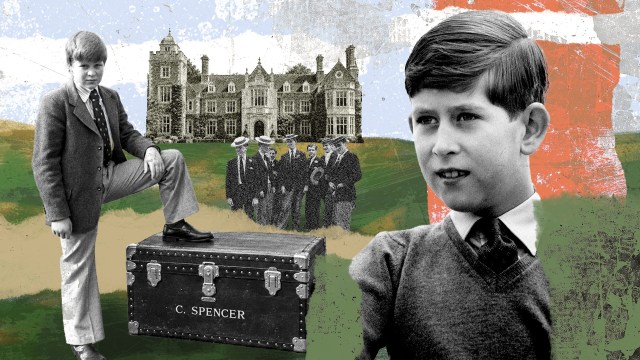
Nowhere is this clearer than in the character of Earl Spencer, who has spent the past fortnight busily “ragging” the King. His life maps effortlessly onto the decline of the prep school, and the upper and upper-middle classes more generally: a transition from steely coldness to self-centred loquaciousness. Over his last two books, Spencer has done more to dismantle the vestigial myths of hidebound English “society” than the Labour Party could ever dream of. In his memoirs A Very Private School (2024) and last week’s Swan Song: Diana, My Sister, he has moved beyond the stoic and illusive stability of prep-school England into everything that is its antithesis, a confessional, tabloid desperation that Philip Roth might have deemed a very English berserk. Neither the prep school nor the Royal Family will ever quite return to their former innocence: these books, which he insists are not attacks but memoirs, have undermined the very structures that enabled 19 generations of his family to reside at Althorp.
Prep-school England is now dead. There are only 163 eight-year-old boarders in Britain, down from 468 in the year I started. This means a bygone elite will not reproduce itself. And yet, should these schools and their attendant way-of-life die, something will undoubtedly be lost because, however obsolete and exclusive they seemed, they did their best to promote an ethos we lack today: “Character” over results, the individual over the statistic, and the sort of self-restraint that could prevent these tabloid squabbles between the houses of Spencer and Windsor.
Mine was the county school, which meant that everyone in the county sent their children there, and that all the county’s fine class distinctions — between middle, upper-middle, and upper class — were quietly endorsed. There was a rifle range and a clay-pigeon shoot, and boys were permitted to skip lessons and ride to hounds at the hunt’s annual meet in the school carpark. Then, the boys who rode would be served honey-mustard sausages and cups of Bovril by those who didn’t.
Our lives, our characters, felt old there — enchanted. The wars felt nearer than the local town, and the school register was haunted by the same surnames that appeared on our war memorial. It was a world without irony, much like the Boys’ Own universe described by George Orwell, in which “Everything is safe, solid, and unquestionable. Everything will be the same for ever and ever and ever,” even if, really, it was already doomed. Each year, we re-enacted the Second World War and played a game called German Spotlight. The boys had to get from one end of the school site to another without being spotted by the SS officers, whose roles had been assumed by the teachers. I could never evade the Nazis for long, and would trudge back to the school building, where a film was showing for the re-imprisoned boys. “1940, Somewhere in England,” the credits read, and I would think of those boys still out there, sticking it to the boche in the frost-bitten grounds.
The school was founded in the late 19th century by a “monocled and fanatical Jacobite”. He designed it as a modern school, complete with concrete playground, Eton Fives courts, and a gaudy arts-and-crafts chapel. He chose the site for its “healthy aspect”, in the hope that this might prevent his charges from snuffing it too readily — a common problem in the earliest prep schools. This happened half-a-century after Thomas Arnold purportedly invented the prep school, back in 1837, when he decreed that he would not accept under-12s at his school — believing them to be unsafe among the older boys, many of whom were bullies, or pederasts, or both. And yet more than Arnold, it was the age that necessitated them: the rapid expansion of an empire that required officers and administrators — and somewhere to deposit their children — as well as a newly enriched caste of industrialists whose rougher edges needed a shine. In practice, that meant imparting “Character”: an Arnoldian idea that incorporated moral imperviousness, muscular Christianity, and an odd streak of anti-intellectualism. As Jan Morris wrote, Arnold had “implanted concepts of privileged service [in his students] that led logically to the idea of a new Rome”. His boys would become “Christian Gentlemen” — moral, not empathic, but with enough sense of duty and cold detachment to rule the natives in Gujarat or the Gambia.
This doctrine outlasted the century. Orwell, author of the best prep-school memoir, Such, Such Were the Joys, attended St Cyprian’s in the 1910s where he was thrashed for wetting his bed by the headmaster. In hindsight, Orwell thought, to enlist a child at prep school delivered them from the family to the nation, and so created foot soldiers — like Orwell himself — who, at only 19, could assume responsibility for some 200,000 Burmese subjects.
In Orwell’s day, there was a cruel logic to this. By John le Carré’s time, some 30 years later, there wasn’t. In his fallen Britain, there was a clear original sin: “the maiming of the privileged young.” They were thrashed, bullied, and buggered into eligibility for that Philoctetean caste of mandarins who presided impotently over national decline — their survivors’ coldness inflicted, now, upon British subjects instead of colonial ones. Thus, le Carré held the schools accountable for “the traumas, deformations, and truncations of character that explain the British Establishment from the appalling Doctor Arnold to the Thatcher Matronocracy”. Le Carré’s words blurbed Nick Duffell’s The Making of Them, a polemic that popularised the concept of “boarding-school survivors”. The BBC documentary followed several children in their first weeks at Maidwell Hall in the early Nineties, the very school where Charles Spencer was abused. It presents a collage of interviews with new-boys, middle-aged “survivors”, and parents — one of whom dismisses the idea of speaking to his eight-year-old on the telephone since “[children] can’t express themselves very well”. Often, what was most difficult for “survivors” to come to terms with was how parents who had suffered in their own time could inflict the same suffering on their own children. Not Charles Spencer — who desperately tries to excuse his parents. In A Very Private School, Spencer documents the scholastic North Korea that was Maidwell, where he was bullied, beaten, and sexually abused. His book weakened the prep-school ritual’s spell, to the extent that Maidwell itself closed down in the summer of 2025.
Britain stopped thrashing its privileged children soon after it lost Hong Kong. Corporal punishment was abolished in private schools in 1998, some 12 years after the ECHR had triumphed over le vice Anglais in the state system. Unsurprisingly, an hour-long detention proved no match for the slipper and cane. And as their disciplinarian Victoriana morphed into twee gentility, so too did the boys the schools produced. If, once, it had been necessary to drill them into inhuman stoicism, all they really needed now was a psychiatrist’s phone number and a recommendation for the MCC, and then it was off to an interminable lunch in Leadenhall Market or to oversee the decline of their familial estate. For all that these schools continued to market a timeless, Boys’ Own fantasy, these days they could only sell connections and access — a means for an impotent elite to reproduce itself. If they couldn’t build “Character”, they could, at least, make you posh.
This was clear enough in the boys at my school, much as my headmaster tried to drill us with old-fashioned, Anglican ideals. Bald and bespectacled, his was a doctrine of self-assurance and deference, which encouraged us to be polite, civic-minded, and Christian, as well as to take responsibility for the consequences of our actions. And yet in daily chapel, his sermons confused the word of God with news of how the First XV had performed in their away match at Terrington. It couldn’t have been further from the “hellfire and masturbation” that Cyril Connolly remembered from his time at school. Perhaps that’s because it was markedly less sexual in my time, save for the wanking epidemic that briefly spread among the third form. Sex had fled the chapel, and now belonged in the PSHE classroom. It fell upon a science teacher to inform us how sex and its attendant organs worked. Modern parents, after all, weren’t paying to have their children terrified of sex.
And that’s what mattered. “It’s difficult to realise that a school is primarily a commercial venture,” Orwell wrote — and so all schools will do as the market dictates. Our headmaster had believed in the school and its vision, but the market increasingly didn’t. Modern psychology and the new British values made sure of this. Power moved from the headmaster to the parent, and boarding became flexible. Those who still boarded often went home on the weekends. The Fives courts were converted into classrooms and after the headmaster retired, the school became co-educational.
Their death could be blamed on Labour’s VAT policy, but, really, it was inevitable. Most old boys have, now, enacted their own little berserk — therapised out of their former class allegiances. And, besides, the only people interested in an old-fashioned education these days seem to be the Chinese and the Rees-Moggs. Most of Britain now regards these schools as they do the Catholic Church: as safe houses for perverts. Those that remain will be (mostly) southern, and will focus on “excellence”, not Character, and so will foster a new kind of snobbishness — the untethered, Spencerian sort, whose cruelty is its destructive self-concern. The much derided Arnoldian doctrine will, perhaps one day, be missed. It could have blossomed in a modern institution, cut loose from cosseted datedness and cruelty.
And what became of us, trapped between the old world and the new? The world in which we were raised bore no resemblance to the one we entered. The traditions were dead and the rituals meaningless. Civic-mindedness is of little benefit in a City career, where stoicism proves an inconvenient stopper on the second bottle of claret. Some could still lead vanished, institutional lives, but would find themselves to be hollow men clutching onto romantic visions of lost grandeur, or else expensive and out-of-date ideals. Character could take us so far, but that alone didn’t seem of much use in a world of chaos and smartphones and Snapchat and hardcore porn. “How I did loathe that preparatory school,” wrote the 19th-century author Herman Merivale, “preparatory, thank heaven, for a life that was not to be.”
