




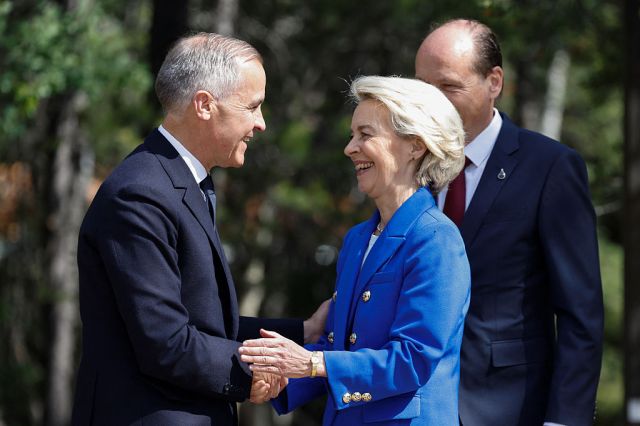
Mark Carney and Ursula von der Leyen. (Ludovic Marin/POOL/AFP/Getty)





This summer, Mark Carney was confronted by dozens of cousins he never knew he had. The Canadian Prime Minister was visiting Aughagower, a small village in the west of Ireland. It was the home of his grandparents until 1925, when they decided to move to Canada to build a better life. “Welcome home Mark!” screamed hundreds of Irish admirers. To mark the bonds between Ireland and Canada, the prime minister planted an oak tree next to the graveyard where his relatives are buried.
In his speech to the European Parliament last month, Carney kept planting (metaphorical) trees. He described how First World War Canadian lieutenant Leslie Miller had gathered acorns from a scorched French battlefield, smuggled them back home to Ontario, and planted them. In time, they grew into a fine oak forest. A century later, grafts from those oaks were replanted in France. “A profound circle of renewal was completed,” Carney told MEPs.
Now, Carney wants to graft a our Canadian maple onto the European family tree. Today, he is hosting European Union leaders in Montreal, in the hope of establishing how Canada can become the union’s first ever “associate member”. But the bloc may just drop the offered title entirely, after major pushback from EU members who don’t want Canada formally in their club.
Carney is attempting to pull off a monumental act of historical reverse engineering — one that would see the New World returning to the shores of the Old. Finding itself in President Trump’s crosshairs, Canada is trying to pivot from being America’s dependent northern brother to Europe’s long-lost child returning home. “It is my strong personal view that the international order will be rebuilt, but it will be rebuilt out of Europe,” Carney has predicted.
The problem is that this reunion will not work out. While their roots intertwine, Canada’s relationship with Europe faces hard geographic, economic and cultural ceilings that cannot be overcome by mere treaties and titles. Canada is a non-native species on European soil.
Carney takes every opportunity to remind Canadians of their British and French “founding peoples”, even persuading King Charles to travel to Ottawa to open Parliament last year (Carney’s brother is the chief operating officer at Kensington Palace). Yet despite the current feud with President Trump, Canadians have far more in common with Americans. Our European ancestors, who threw caution to the wind and boarded ships bound for Canada, chose to leave the Old World behind for a reason: to seize individual and economic opportunity. To escape wars, class divides, and poverty. To build a new and different society.
What, then, is Carney hoping to get out of the EU? He has vowed to double non-US exports in the next decade and wants Europe to be a bigger trading partner, claiming the continent is even more economically enticing than China. He is particularly interested in European defence technology: Canada has inked a Canada-EU Security and Defence Partnership, and chosen German-Norwegian shipbuilder TKMS to build it a fleet of 12 new submarines. There’s also been talk of Canada joining an EU-Canada Digital Trade Agreement, Erasmus+ (the EU’s education programme that allows students to study abroad), and Horizon Europe (the bloc’s funding programme for research and innovation). There are rumours that Canada is aligning with Europe on AI regulations, pension investment, competition watchdogs, forest fire water bombers, and undersea telecommunications cables; it is also said to be taking part in the EU space programme. But, most importantly, Canada has joined the European Broadcasting Union, clinching a spot in Eurovision and the chance to introduce the rest of the world to Inuit throat singing.
The Europeans, in turn, are interested in Canada’s critical minerals (lithium, graphite, and nickel), energy (liquefied natural gas, hydrogen), and the Canadian Arctic. A deepened Canadian partnership would make Europe less reliant on China’s rare earth deposits, America’s technology, and Russia’s oil. “Canada is truly the most European of the non-European countries,” Ursula von der Leyen, president of the European Commission, asserted during her State of the Union address in June. That was when she extended the associate member invite to Carney, whom she calls “dear Mark”. As she landed in Montreal today, the German politician signalled she hasn’t given up on granting Canada the new title, standing in defiance of many of her European colleagues.
The Canadian government views EU associate membership as its best chance of diversifying away from the US. (This is after Carney walked out of American trade deal negotiations in the eleventh hour because, as he put it, Canada’s sovereignty was being stolen.) Europhile Canadians see Europeans as kindred spirits equally devoted to democratic institutions, large social safety nets, and the defence of Ukraine. They dream about the possibility of greater freedom to live, study and work across Europe.
Those opposed to EU membership, however, are wary of Europe’s anemic economic growth, lack of technological innovation, and ageing population, as well as its strict data rules, agri-food standards, and energy regulations. They fear that joining the EU could result in more migrants at our borders, as well as Canada having to send roughly 1% of its economic output to Brussels. They say that rather than surrendering our sovereignty to the Americans, we’d just be surrendering it to the Europeans. “We will never be the 51st US state. And we will never be the 28th EU state,” Conservative Party of Canada leader Pierre Poilievre told his supporters.
According to recent polling, around 81% of Canadians want closer integration with the EU, while remaining outside of the union. But Canadian support for closer integration falls to 49% when the prospect of EU membership is raised. The consensus is clear: Canadians want to have a closer relationship with Europe, but they do not want to become Europeans.
This tension is evident in the difficulty the Canadian government has had describing the new “associate member” relationship — are we just dating, or getting married? The relationship is now up in the air, as members appear prepared to vote against the associate member designation. “We’ve definitely put the cart before the horse,” admitted one European diplomat. “Nobody really knows what it means,” said another. “The good news is it doesn’t matter about specific names or nomenclature,” said a visibly perturbed Carney responding earlier this week. “What matters is the difference that it will make to lives of Canadians.”
Talks around Canada’s new membership status have seen Germany, France, Italy and Greece push back. They don’t feel consulted. They are frustrated that Canada is receiving “association without accession”, reaping European rewards without meeting the standard requirements to gain membership.
The obstacles to Canada’s European romance are numerous. On the economic front, 72.5% of Canada’s exports are sent to the US; the entire EU currently takes a measly 5.5%. In addition, 85% of Canada’s energy is sent to America. In a single month, Canada exports more to Oklahoma than Germany, more to Kentucky than France, and more to New Jersey than Italy.
Then there are the societal barriers. It is admittedly difficult to pinpoint a distinct Canadian culture: in many ways, Canada is already its own often dysfunctional union. A vast country of 10 provinces, three territories and two official languages is home to far North Inuit, Quebecker maple-syrup makers, Newfoundland fishermen, Albertan cowboys and everyone in between. Add to that the vexing interprovincial trade barriers that cost our country $200 billion a year, and it becomes clear we have our own issues getting along among ourselves.
Yet a shared Canadian culture does exist, and it is plainly different from Europe’s. Our ancestors left behind most of the Old World’s traditions, bloody revolutionary battles, and class hierarchies. We are a young country of just 159 years old. We are more individualistic. Our work often defines our lives. Living in the second-largest nation in the world, we spread out across our vast landscape. We live in larger homes and drive bigger cars: for 16 years straight, the Ford F-150 truck has been the best-selling vehicle in Canada. Then there’s the fact that within Canada, hundreds of Indigenous nations increasingly practise self-governance. Our nation is undeniably “un-European”.
While we hate to admit it, we share much with and depend on Americans more than anyone else. Two-thirds of Canadians live within 100 kilometres of the American border. The US covers 60% of the budget for our Arctic defence radar stations. English Canadians consume almost exclusively American arts and entertainment: in 2023, only 3.3% of our total box office revenue came from Canadian films.
Currently, 56% of Canadians say they have more in common with European nations than the US. But the hostile American president has completely muddied the polls. Remove Trump from the equation and far more Canadians would agree they have more in common with Americans than Europeans. In the end, Carney’s best intentions, buttressed by globalisation, technology and emotion, simply cannot trump geography, history and culture. As much as Canadians might want it to, Europe cannot fill Canada’s America-sized hole.
Prime Minister Carney keeps a map of his grandparents’ Irish hometown of Aughagower on his desk in Ottawa. He says it acts as a friendly reminder of where he came from. But that’s just it. The reality is Europe is where Canada came from, not where it is going.