




The MAGA legacy presents a problem for establishment Democrats . Credit: Getty





In many ways, the history of the past decade in US political life boils down to an effort by the liberal establishment to undo populism. During the first Trump administration, Democrats — along with their allies in the media and the security apparatus — sought to hobble the presidency through endless lawfare that culminated in two impeachment attempts. This pattern continued through the Biden years, which saw Trump and his associates barraged with prosecutions, civil suits, debanking, and other strategies of the kind.
None of it worked, and Trump returned to the Oval Office in January 2025 with a stronger mandate. Now, if the polls prove correct and Democrats regain control of the House of Representatives and perhaps the Senate, the question is whether they can finally achieve what they couldn’t pull off in those years. The answer is, likely, no: despite the unusually personal nature of his rule, Trump has, in fact, institutionalized his populist revolt.
An ambitious, energetic cadre of MAGA activists who’ve learned the ways of power stand between establishment Democrats and the dream of rolling back the revolution.
The desire for turning the clock back to 2014 is there, to be sure. Witness the recent remarks from Sen. Elissa Slotkin (D-Mich.). Speaking earlier this month at the University of Chicago, the former CIA and Pentagon bureaucrat offered a revealing glimpse into the Democratic establishment’s plans for the remainder of Trump’s presidency.
Asked how Democrats should use congressional power if they regain control after the midterms, Slotkin proposed pursuing a handful of high-profile investigations into Trump administration officials. The point, Slotkin explained, was not merely to hold officials accountable for alleged wrongdoing, but to send a stern message to the next generation of Trumpian staffers. She imagined a prospective staffer thinking to himself, as she put it, “Lord, that might be buying myself a ton of problems that I don’t want, and so let me avoid participating in that.” She concluded: “I want that deterrence message sent.”
Following Republican backlash, Slotkin backtracked on her statement, insisting she meant investigations into corruption and illegal conduct. But her national-security background makes her explanation unconvincing. Deterrence has a specific meaning in her world. It involves convincing an adversary that the costs of an action outweigh its benefits. To operationalize this approach requires making painful examples of a handful of targets to influence a broader group.
Slotkin’s comments ultimately underscored a growing sense of panic within the Democratic establishment, among its career politicians, unelected Washington bureaucrats, and networks of NGOs and corporate interests pushed out of power by the Trump administration. They fear that the MAGA revolution has the potential to become an enduring force in American politics that could outlast Trump himself. And, perhaps most sobering of all, Slotkin’s comments appear to indirectly acknowledge that establishment Democrats have no legitimate political means of stopping it.
And they aren’t wrong.
Trump and the MAGA movement represented a powerful rejection of the overgrowth and abuses associated with the postwar liberal order. The order’s large governing elite had grown increasingly detached from the American people as it consolidated more power across the federal bureaucracy, universities, media, and other major American institutions, using authority for purposes beyond the desires of the ordinary citizen. Undoing this order would require Trump to challenge the very institutions through which the center-Left, especially, had exercised power for decades. The center-Left establishment, in turn, understood the threat from the start of his first presidency.
Early on, Trump’s personality made it easy to cast him as a villain. Over the course of a decade, establishment forces built a powerful movement among Democratic voters, particularly older and college-educated female voters, centered on opposition to Trump’s crass and bombastic style. From this emerged a broader narrative portraying Trump as an authoritarian whose presidency threatened American democracy itself, increasingly conflating the establishment’s loss of political power with an attack on the nation’s democratic norms and institutions.
To be sure, Trump at times went out of his way to vindicate this picture of him, most notably in his refusal to accept the outcome of the 2020 election. Even so, the narrative failed to stop his movement. More importantly, the playbook is becoming increasingly unsuitable for a political struggle that must continue after he leaves office.
With two years remaining in Trump’s presidency, establishment Democrats will need a new antagonist and a new pretext to continue clawing back institutional power. But the problem confronting them, as with much of the postwar Western liberal establishment, is twofold: they have lost their grasp on political reality, choosing instead to inhabit a powerful fiction of their own making; and consequently, they have become incapable of formulating a convincing strategy for returning to power through democratic means. The victories for Democrats expected in the upcoming midterms, after all, come not from the party’s establishment, but from insurgent forces in both its populist and radical Left.
It is this dangerous combination of political desperation and an inability to accept her side’s dispossession by American voters that helps explain Slotkin’s apparent willingness to use the threat of investigations to intimidate and deter the next generation of conservatives from entering government.
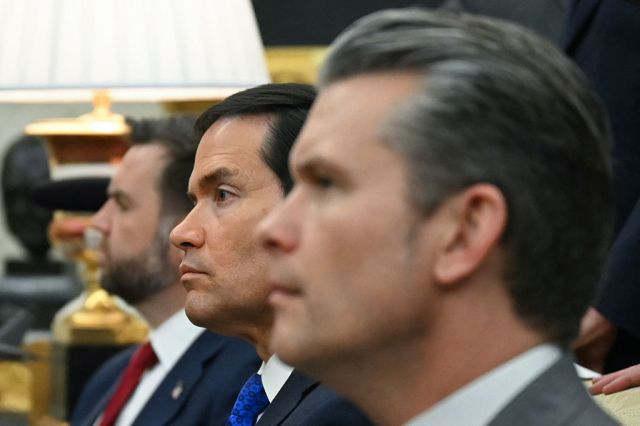
Her desire to send a deterrence message may also reflect an understanding among Democrats that, unlike during his first administration, when Trump often found himself surrounded by officials who disagreed with his political goals, his second has brought into Washington a cohort of conservatives committed to translating MAGA’s ideological principles into government policy. Among them are Vice President JD Vance and Secretary of State Marco Rubio, both of whom sharply criticized Trump during his first presidential campaign in 2016 but have since become leading figures in his administration and potential successors to his political movement. Their ambitions extend beyond serving the president. They are seeking to change how the federal government operates, who exercises authority within it, and how much power its agencies should possess. The significance of this development is not merely that Trump has found more loyal officials this time around, but that they are gaining the experience, building the networks, and developing the institutional knowledge necessary to continue the political project after he leaves office.
Ultimately, what we are witnessing is not the crisis of American democracy feared by establishment Democrats, but the fading of the postwar liberal governing order and the administrative state that expanded under it for the better part of a century. Their unwillingness to recognize the distinction is perhaps understandable given how pervasive their authority became. For decades, the political and professional class operating within Washington’s institutions came to regard its own position as an essential feature of American government, rather than a temporary claim to political authority. The possibility that this arrangement might be challenged, or even permanently altered, is consequently difficult for them to separate from the idea of a constitutional or democratic crisis.
What makes their loss of power particularly painful for members of the establishment is that MAGA isn’t simply seeking to replace their class with another of equal size. Its ideological ambitions include reducing the federal bureaucracy, transferring authority away from administrative agencies back to the states, and concentrating greater federal decision-making power in the executive branch.
The threat to the old establishment is therefore not simply another four or eight years out of power, but the possibility that many of the institutional mechanisms through which it exercised that power will no longer exist for it to reclaim. The Biden years offered a reminder of just how consequential control of that machinery could be. Having spent four years out of power, Democrats returned to Washington and pursued sweeping policies, from expansive Covid-era mandates and inflationary spending, to opening the southern border, and waging a proxy war against Russia through Ukraine.
That same pattern appears to be repeating itself, with establishment Democrats showing an even greater urgency to return to power and a willingness to consider increasingly extraordinary measures to regain it. From Slotkin’s proposed “deterrence” campaign to calls to pack the Supreme Court and admit Puerto Rico as the 51st state, the lengths some Democrats are prepared to go to reclaim that authority are becoming increasingly apparent.
There is a final irony in the Democratic establishment’s predicament. It has become so consumed with recovering its former authority that it risks overlooking the socialist insurgency growing within its own party. The longer the old establishment goes on fighting for political order that is slipping further from its grasp, the more room it creates for a young generation of Democrats to remake the party in their own hard-Left image.