




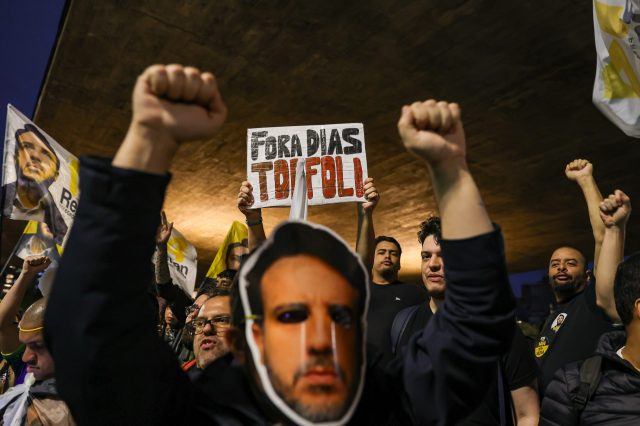
Renan had led the field among under-24s with 36% in polling earlier this year.(Allison Sales/Getty)





Nothing less than Brazilian sovereignty is on the line in this weekend’s presidential election, which reaches its denouement on Sunday. Profound questions loom for the winner: how can Brasilia respond to Donald Trump’s assertion of dominion over Latin America? Can Brazil leverage its large deposits of rare earth minerals? How will it work with China and the BRICS?
The two candidates left in the run off have sadly offered up the most vacuous contest in living memory. Though keen to defend sovereignty, the Left-wing octogenarian Luiz Inácio Lula da Silva talks mostly about his past achievements. The 45-year-old Flavio Bolsonaro principally wants to get his dad, disgraced former president Jair Bolsonaro, out of jail.
It is Flavio who looks the most likely to prevail, to the delight of US interests, from Donald Trump to Big Tech. However, the emergence of a new force in Brazilian politics — the upstart Missão party, led by the former student activist turned political entrepreneur Renan Santos — offers the possibility that this settlement may not hold forever.
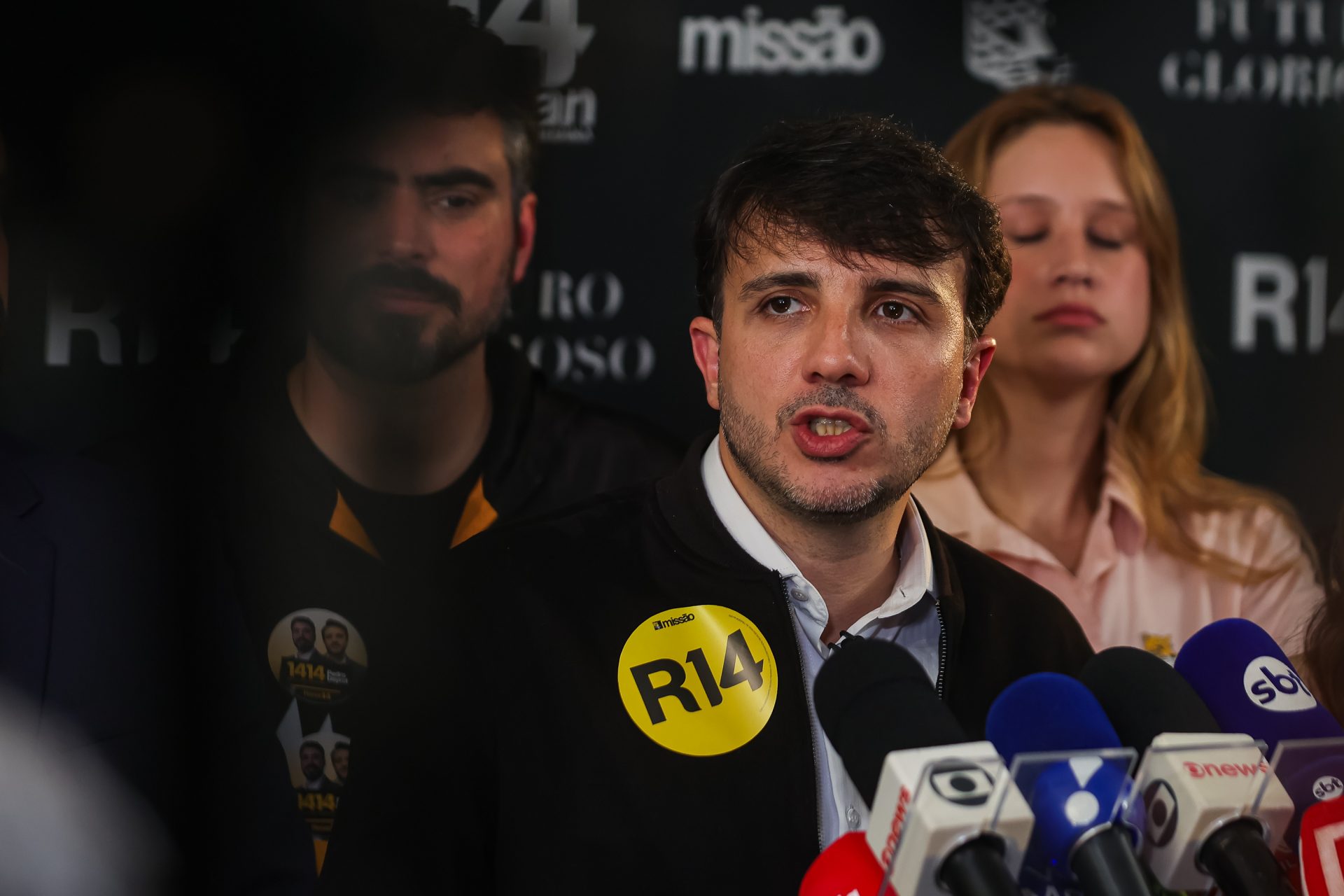
Even if he was knocked out in the first round of the presidential election with 2% of the vote, Renan (politicians are known by their first names in Brazil) had led the field among under-24s with 36% in polling earlier this year. Commentators noted that he possesses a rare commodity in today’s digitalised political landscape: the ability to “break out of the bubble” and reach voters on the other side of the political spectrum. Indeed, the limitations of digital age politics is a core theme: “We have never been so polarised and yet there is so little debate”, he told me in a recent interview. Political alignment has become “automatic” so there is never any need to fight over politics. What he hopes to bring is fresh ideas, and transcend the “asphyxiating” effect of social media — which has done so much to shape the dire character of modern Brazilian politics.
South America is now dominated by conservative governments — all of whom, despite their differences, adopt MAGA-like themes and are friendly to the US president. A slew of new Right-wing politicians are born-online culture-warrior provocateurs: foremost among them is the Bolsonaro-aligned Nikolas Ferreira, who has 23 million social media followers. Renan is scathing of these figures. “The electoral process has become the end in itself, and the mandate is only an instrument for gaining more fame and attention on social media.”
Younger generations in Brazil have grown up under Workers Party governments — 17 of the past 24 years have been under the party of the centre-left — and now increasingly identify as Right-wing. Missão stands apart from its own camp for demonstrating a willingness to rethink Brazil’s role in a post-globalisation world and presenting this in a forcefully ideological and programmatic package.
Renan is a constant critic of the Bolsonaro clan, their submissiveness to the US, their links to organised crime, and their self-serving culture wars. “Voters care more about a hypothetical trans person entering their bathroom than public security or corruption,” he says in one video. He repeatedly calls out Bolsonaro junior as a “miliciano“, or paramilitary gangster, for the senator’s alleged associations with Rio de Janeiro extortion rackets. Indeed, since Renan was knocked out of the election, the Left has been happy to amplify many of his critiques of Bolsonaro.
Missão are often called far-Right or even fascist by opponents, mainly due to their stance on crime. Under the party’s Direito Penal do Inimigo — “enemy criminal law” — members of organised crime gangs would be treated as enemy combatants and lose their status as persons under the law, much as has happened in El Salvador. The party has even pushed the slogan Prendeu, Matou (“arrest ‘em, kill ‘em”), implying a willingness to use extrajudicial killings appealing to a growing punitive strain in Latin America (and, indeed, the US).
Still, without wishing to explain away these provocations, Missão bucks convention today and in many respects resembles bourgeois modernisers, promising a politics of substance. In a recent post, Renan talked up the late Left-wing British philosopher Mark Fisher; and his defence of democracy and sovereignty stand out amid all the Right wing politicians who have tolerated or encouraged Bolsonaro’s coup-mongering as well as the clan’s lobbying the US against Brazilian national interests.
It is these themes that lead Renan to believe Missão can potentially appeal to Left-wing voters. Victor Marques, a philosophy professor and populariser of Mark Fisher who has run for office for Lula’s Workers Party, tells me that Missão are at least “thinking through the global dynamics of the crisis of hegemony” — though he adds that he “disagrees with their entire programme.” The prominent progressive intellectual, Miguel Lago, has also praised their ambition: “Missão’s merit is to have outlined a vision for the country — which others have failed to do,” he argues, welcoming a “Right that thinks”. Still, Lago, who has written extensively about reconstructing Brazil, is at pains to emphasise that not only does he disagree with the content of Missão’s propositions in principle, he also finds many of them impracticable.
Where Renan is novel, at least on the Right, is in his understanding of the end of US hegemony: now the US demands explicit alignment, whereas previously it was presumed to be the only game in town. This imposes choices on Latin American countries. It is in this new world disorder that Missão is now seeking to advance Brazil’s interests.
This much is clear in The Yellow Book, a 500-page manifesto. Instead of focussing on Bolsonarist bugbears, it considers how to maximise the country’s rare earth deposits, clean-energy networks, and its status as the breadbasket of the world, so as to overcome regional inequality and unleash Brazil’s potential.
That starts with redefining what it means to be “Right-wing”. Orlando Lima, the editor of Valete, Missão’s in-house magazine, believes the Brazilian Right is stuck in “an intellectual and creative hole”, too obsessed by ideas of American libertarianism and British conservatism that don’t map on to the unique problems faced by Brazil, while the global Right in general is too fixated on being “anti-Left” on issues such as gender identity or migration.
Yet, Missão’s roots lie in the Free Brazil Movement (MBL), libertarians who were often criticised as Right-wing yuppies. For all their anti-establishment rhetoric, they were a young, business-friendly grouping from upper-middle-class backgrounds — and Missão supporters are still mainly drawn from this milieu. The anti-corruption movement they played a large part in advancing served to delegitimise politics, though Renan disagreed when challenged on this point, defending their record.
Still, today the party is expressly political. On founding Missão in 2023, Renan diluted his economic liberalism — he realised that there were too many problems in Brazil for “less state” to be the solution — and instead focused on remedying deindustrialisation, low productivity growth, a dependence on imports, and a decadent elite.
Missão also marks a distinct contrast to the racism that pervades the radical Right globally in its embrace of Brazilian society as it is. Lima puts it grandly: he hopes to overcome the nation’s issues with a big civilisational project that would prove that a miscegenated tropical country can succeed in the new global order — finally making good on the long-promised (and much-derided) idea of itself being the “country of the future”. The Yellow Book argues that the decline of the US has left a power vacuum in the Global South that Brazil is uniquely positioned to exploit. De-dollarisation would be pursued through the creation of a basket of South American currencies led by the real, while the BRICS+ would be engaged on a pragmatic basis so the country can extract concrete benefits and retain autonomy.
It would also use Brazil’s three “trump cards”: its possession of 23% of the world’s rare earth deposits, the largest behind China; its extraordinarily clean energy matrix; and the major diplomatic strengths of non-aggression and democratic stability. The vision rests largely on two strategic inputs — food and computing. Brazil is already the breadbasket of the world, but producing its own fertiliser would increase its independence. Meanwhile, reversing the brain drain and building data centres would see it become an AI powerhouse.
Rather more controversial is the plan to rid Brazil of its favelas, or informal settlements, in which 8% of Brazilians live (the figure is as high as 25% in Rio de Janeiro and over 50% in the Amazonian capitals). The favela “is more than an urbanistic problem, it is a civilisational plague”, argues the Yellow Book, seeing the remedy as not just a physical but a “spiritual” transformation. There are concerns that the combination of awarding land titles to residents, public service-provision, and housebuilding would cost a lot more than the projected 1.5% of GDP. Moreover, given Brazil’s authoritarian management of its lower classes, it’s not hard to imagine these plans playing out as violent mass expulsions.
Moreover, the much vaunted “War on Crime” has still more alarming implications in a country where the police already kill 18 people per day, over 6,000 per year, according to official figures. Many of Brazil’s Military Police are already implicated in the criminal gangs known as “milicias“, who vie for territory with the drug traffickers. Missão’s plan — ostensibly in pursuit of territorial sovereignty, nation-building, and political control — could just as well end up in the violent chaos of a multisided armed conflict. Meanwhile the horrific implications of the Prendeu, Matou slogan hardly need spelling out. “The fact that Renan always explains it away confirms it is opportunistic and demagogic,” Lago tells me.
How much of a break with the neoliberal Right all this is remains an open question. Its development plans are still weak sauce, even by the standards of Brazil’s own past, while fiscal austerity is item one in their manifesto. “Inequality” hardly features in the Yellow Book, despite Brazil being one of the most unequal societies in the world. Renan meanwhile opposes Lula’s recent (incredibly popular) move to legally guarantee two days off a week as opposed to one — which even Senator Flavio Bolsonaro supported, suggesting the libertarian faith remains strong. In this sense, Missão’s departure from their 2010s neoliberal antecedents is only partial.
Still, whether or not Brazilians agree with the content of Missão ’s programme — and many do not — there can be some small hope that their political seriousness, ambition and vision speaks to the possibilities of the emerging post-hegemonic world. For all the passivity-inducing brainrot of social media today, the current moment is also about the breakup of world order, which should force hard thinking, where previously complacency reigned. In place of imported ideas, there is an emphasis on taking the Brazilian experience seriously as a starting point.
Should Flavio win on Sunday, the defence of Brazilian sovereignty and democracy will be paramount from day one. Renan sees this as more propitious for his camp: the Lulista project will fall apart and there will be a mass of people who are still politically conscious looking for something new. But even if Lula pulls off another miracle, the prospects for progressives look grim. Missão should serve as a reminder to the Left that idealism and political commitment used to be their domain.
Alex Hochuli is a writer based in São Paulo. He hosts the Aufhebunga Bunga podcast and is co-author of The End of the End of History: Politics in the 21st Century.
 Alex__1789