




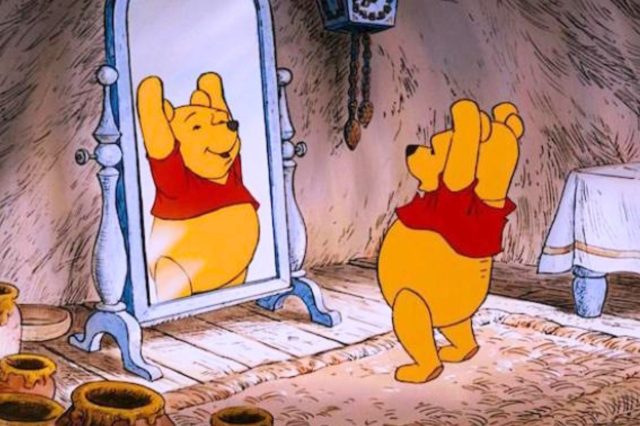
The British have attempted to cover up the nation’s discontent in kindness and synthetic fur. (The Many Adventures of Winnie the Pooh, 1977 / Disney)





If you fancied a really brilliant time in Elizabethan London, you could do worse than visit the Paris Garden in Southwark. There, bears were chained to posts, and made to fight packs of frenzied English bulldogs. This was considered good sport. People were so fond of these bears that they gave them camp, silly nicknames, like fan-favourite “Harry Hunks”. Chief among his tricks was that, if you whipped his shoulders hard enough, they’d soon start to bleed. Apparently, this was funny: a comic interlude between the ordinary blood sports. “The past,” LP Hartley wrote, “is a foreign country: they do things differently there.”
The England of 2026 is impossibly different from that of the Paris Garden, and so is our attitude to bears. Instead of torturing them, we’ve turned them into the cuddly moral arbiters of the modern British state. Nowhere is this clearer than in the case of Paddington, who has become a metonym for the country’s “official” values. “Your actions were the antithesis of everything Paddington stands for,” a magistrate said in 2024, as he sentenced two men for drunkenly vandalising a sculpture of the Peruvian bear. “He represents kindness, tolerance, and promotes integration and acceptance in our society.”
Britain’s arctomania started a century ago, with a different bear: Winnie the Pooh. The first collection of A.A. Milne’s stories, about a “bear of little brain” who potters around the Hundred Acre Wood eating honey, hunting woozles, and playing pooh-sticks with his chums, was published in October 1926. It was an instant success, selling some 150,000 copies before the year was out. Children’s books had always been didactic — as far back as 1475, The Babees Book instructed infants not to pick their noses, bite their nails, or suck their thumbs. But Milne left this behind. Instead, he pioneered a “bossy” turn in children’s letters: his tone was one of adult condescension, an example of which appears on the book’s first page:
‘He’s Winnie-ther-Pooh. Don’t you know what “ther” means?’
‘Ah, yes, now I do,’ I said quickly; and I hope you do too, because it’s all the explanation you are going to get.
And yet, like Paddington’s, Pooh’s moral code is a distinctly adult one. Milne’s stories, as the critic John Bayley wrote, “always seemed to belong more to one’s parents than oneself.” It feels as if he’s constantly reprimanding an idiot child for not quite being child enough. The facetious, italicised tete-a-tetes between the narrator and Christopher Robin evidence that. The sentences are filled with irregular capitalisations (“Silly Old Bear”, “Shortness of Breath”, “Hostile Intent”), which is an attempt to show the childish imagination: how each new thing, encountered fresh, appears singular and so must be rendered as a proper noun. This fails: children’s imaginations are wicked and Gothically capacious, but in the Hundred Acre Wood there is nothing of the sort. Children allow darkness; it’s only adults that must pretend it doesn’t exist.
And these stories were an exercise in adult interference from the very start. Milne pillaged his son Christopher Robin’s imagination and his stock of cuddly toys, only to impose an entirely new meaning onto them — an official and inflexibly grown-up interpretation of what childhood is really about. In Pooh’s world, things can always be explained, and actions have rational consequences: “The only reason for being a bee that I know of,” Pooh says, “is making honey… And the only reason for making honey is so as I can eat it.” It is a far-cry from the illogical transformations of Lewis Carroll or the Grimm Brothers.
This accounts, in part, for Milne’s success. This was how adults wanted childhood to be, how they misremembered it: comfortable and stable, with no horrors lurking out there in the dark. Pooh lulled his adult readers “bump, bump, bump, on the back of the head” into the silly innocence of the Edwardian summer. The Hundred Acre Wood, after all, is a place where the trees haven’t been blasted bare by artillery fire, and the word “Somme” could only be countenanced as a plausibly Poohvian misspelling (“I want Somme hunny”).
Milne retired Pooh in 1928, and turned his hand to “serious” literature. But if his children’s books appealed to adults, his mature works didn’t. The most notable of these was Peace with Honour: a 1934 treatise that implored Hitler and Mussolini to conduct themselves less obstreperously, and the British and French not to rise to their bait. There was no need to fight wars, if we could be kind to one another instead. “It evidently came from the depth of the author’s heart,” wrote a New York Times reviewer. Even when he wrote about geopolitics, he seemed to do so from his study in the House at Pooh Corner.
Following Milne’s death in 1956, Pooh became a global icon — and swapped the King’s English for a gee-wiz Californian in a series of successful Disney films, the first of which, The Many Adventures of Winnie the Pooh, appeared in 1977. He became, like shortbread biscuits and the Queen, a symbol of Britain’s soft power in an age of hard decline. In 2006, his 80th birthday was celebrated by the great and the good of Blairite Britain with a bill in Parliament. It applauded Milne for his influence on “the early development of fine values, honest principles, and decent morals amongst many generations of children worldwide”. John Bercow, Nick Clegg, and even George Galloway signed it. Once upon a time, Britain had exported slaughter and civilisation throughout the world; now it offered a lazy, talking teddy-bear that encouraged children to be kind. In seeking to banish the fusty remnants of an older, imperial Britain, the Blairites had to find a new set of ahistorical values that they could call “British”. And those could be found in the Hundred Acre Wood. Yet cruelty belied the Blairite kitsch: the year of the Pooh bill, 34,000 civilians died in Iraq and the South Yorkshire police ignored Angie Heal’s third report into Rotherham’s grooming gangs.
Twenty years on, even Blairism’s legacy journal, The New World, concedes that the “mordantly twee energy” of Milne’s books has had a disabling effect on British society. Unsurprisingly, injunctions to “be kind” prevent serious political discussion. This is clear from Pooh’s inheritor: Paddington. The Peruvian stowaway had been quietly present in popular culture since Michael Bond published A Bear Called Paddington in 1956, but he assumed his current symbolic role after the release of the 2014 film adaptation. “Kindness”, “tolerance”, “integration”, and “acceptance” all functioned as stifling buzzwords in an era of political turmoil. In the period defined by the Brexit vote, Covid lockdowns, the death of Queen Elizabeth, and mass migration, all the sacred continuities of British society were undone. It fell on Paddington to cheerlead the social cohesion that shared symbols and institutions had once guaranteed.
In his essay “On Toys”, the French philosopher Roland Barthes argued that toys are a means of indoctrinating children into bourgeois life: kids play with postmen and soldiers and police-officers, so that they can assume these roles as adults. Toys are homogenous, factory-made, chemical and plastic, much as their handlers’ adult lives will be. So what would Barthes make of modern Britain’s teddy-bears, with their soft coats and state-approved values: kindness, tolerance and courteousness? Of course, the Elizabethans were wrong to chain bears up and bait them; but at least they knew they were scary beasts that eat people. By turning them into cuddly toys and fictional characters, the British have attempted to remove death’s sting — to cover up the nation’s discontent in kindness and synthetic fur.
Christopher Robin suffered because of his father’s interference in his own enchanted world, and came to resent the Pooh books and even his father. Once he arrived at boarding school, the saccharine lines of the poem “Vespers” (“Hush! Hush! Whisper who dares! / Christopher Robin is saying his prayers!) turned into regular jibes, spat out of bullies’ mouths. It took most of his life before he could recover from what his father had done to him, and this only when writing his own memoir. “It seemed to me,” he wrote, “almost that my father had got to where he was by climbing on my infant shoulders and had left me with the empty fame of being his son.” Milne also left Britain with the emptiness of his creation, which will always be playing “in that enchanted place on top of the forest”.
