




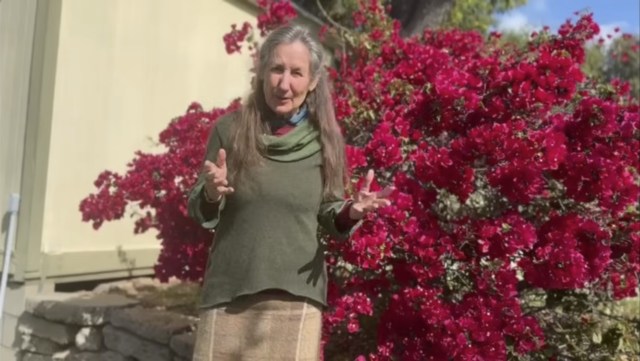
A big bad wolf in disguise? (YouTube)





Barbara O’Neill likes to style herself as “grandmother to the world” — and a grandmother is exactly what she looks like, with long grey hair, a benign smile, and a trim and spritely physical presence (O’Neill is 73). But, as anyone who’s read their fairy stories knows, grandmothers are not to be automatically trusted. Sometimes, they’re big bad wolves in disguise.
In 2019, O’Neill was barred from working in her native Australia after the New South Wales Health Care Complaints Commission (HCCC) concluded that she was “misleading vulnerable people”. Styling herself as a “natural health educator”, she had told cancer sufferers that their disease was a “fungus” and could be treated with bicarbonate of soda, and she had informed new mothers that raw goats milk was a safe substitute for breast milk. Vaccines, as far as O’Neill was concerned, were poisonous.
Her authority for these pronouncements was the two years she had spent as a trainee psychiatric nurse. She never completed her qualification, though she saw that as no impediment to launching a career in health. A member of the Seventh Day Adventists, O’Neill organised most of her lectures through the church for the benefit of her fellow worshippers. Her advice is a disconcerting mixture of familiar homespun misinformation and disconcerting theology; she is a perfect example of the religion of wellness.
That HCCC’s verdict should have been the end of O’Neill’s professional life. No more lectures. No more “consultations”. No more training packages. Unfortunately, quackery has no respect for borders. O’Neill may no longer be able to practice in Australia, but there’s nothing to stop her doing so elsewhere in the world. Including in Britain: this month, O’Neill is embarking on a tour of the UK.
For the low, low price of £700, you can experience five days of O’Neill’s wisdom at an estate hotel in Cheshire. Once attendees have had their fill of lectures, workshops, herbal teas and fruit juice, they get to enjoy a dinner dance — “the perfect way to say goodbye”. For cancer patients who go on to attempt the bicarb cure, they may well be saying goodbye to life itself. A group of doctors has published an open letter addressed to venue management alerting them to the dangers of O’Neill’s misinformation.
Not that this criticism is likely to do O’Neill much damage in the eyes of her admirers, who include the feminist-turned-5G-conspiracist and antivaxxer Naomi Wolf, and the Apprentice-contestant-turned-race-baiter Katie Hopkins. For both, O’Neill is a purveyor of truths that shadowy forces are anxious to suppress. “Big pharma,” tweeted Hopkins, “is more powerful than any government. Has more assets than any military.” Both Wolf and Hopkins seemed to be radicalised by the Covid pandemic, which proved to be a boomtime for health grifters such as O’Neill. In the isolation and confusion of lockdown, O’Neill fostered an avid following on TikTok and Telegram — boosted by the perception of her as a persecuted heretic.
O’Neill herself has leaned hard into this image of herself. On her website, you can purchase a book called (modestly) The Assassination of Barbara O’Neill, written by her husband Michael. The HCCC’s verdict, he thunders, was “an unwarranted smear campaign on a truly humble and caring lady”. Not only that, it was “part of a war on natural health more broadly” being prosecuted by powerful agencies against brave individual dissenters — a “modern-day David and Goliath story”.
The Bible allusion is not inadvertent. O’Neill’s her health claims can generally be traced back to a version of the Seventh Day Adventist theology. Adentism emerged from an apocalyptic cult that was disappointed that the world had failed to end in 1863. Like several religious movements of the Victorian period, the Adventists attempted to reconcile faith with rationalism and social purpose. The faith retains a distinctive focus on health and the body: followers believe that “keeping our bodies and minds healthy and fit are acts of service to God and a visible testimony in this world.”
Once you understand that, it becomes a lot easier to make sense of O’Neill’s health advice. Here, for example, is how she begins a lecture on the digestive system: “I’m very thankful to God that he has given us a liver that is able to detoxify us, and today I’m going to explain how the liver does this, and remember Proverbs 14, verse 6: ‘a scorner seeketh wisdom and findeth it not, but knowledge is easy to him that understands.’”
It feels unlikely that anyone in human history has attempted an exegesis of Proverbs 14:6 based on the liver, but, for O’Neill, faith and health are inseparable. God has granted the human body “inbuilt ability to heal itself”, and when we resort to doctors (she says the “doctor” with the same kind of disgust others might apply to “parking enforcement officer”), we are turning our backs on God himself. You must “listen to the voice of your God in your body”. Much of what the voice of God is allegedly commanding is basic old-wives-tale stuff: a raw onion poultice on the foot to cure a cough, potatoes for inflammation. What goes next to the skin can harm as well as heal; she believes that breast cancer is exacerbated by wearing synthetic fabrics.
Some of her advice is merely eccentric. “What can you do if a child’s got autism?” she wonders in one TikTok clip. “One of the best things is the trampoline. The trampoline rebalances the brain.” Some of it is simply dangerous. Feeding babies raw goat milk will make them sick, if it doesn’t outright poison them (O’Neill later claimed she meant goat milk formula, but that isn’t what she said). Co-sleeping, which she recommends without reservation, is a major risk factor for sudden infant death syndrome. Meanwhile, the O’Neill approach to cancer is harrowingly ineffectual: one patient on the Cook Islands following her advice used a combination of baking soda, lemon juice and boiled water in place of chemotherapy. That man died, of course.
Such apparent setbacks do nothing to impinge on O’Neill’s self-belief. Again, you have to understand her faith to understand her. As she says in one video: “A lot of people are sick. They’re sick because the body will heal itself if you give it the right conditions.” By implication, if you don’t get better, it’s because you didn’t give your body the “right conditions”. You didn’t listen to the voice of God inside you. And if you die, so be it. Not all alternative health influencers are openly religious, but O’Neill’s logic of sin and punishment is a clear echo of the wider movement.
However caring they pretend to be, all “natural health” philosophies, are fundamentally without compassion. Think of the “freebirth movement”, which told women they were failures if they couldn’t go through labour without medical assistance, and callously deserted mothers and babies who were harmed or killed by this approach. Or Andrew Wakefield, whose discredited theories of vaccine-induced autism fed families a toxic mixture of blame and hope: blame for vaccinating their child, and hope that a “normal” child existed underneath the purported injury.
O’Neill’s content is rife with implicit accusations: there is little room for grace. Got cancer? Well, it’s your own fault for wearing petrochemicals. Still got cancer despite the baking soda poultice? That’s down to too much glucose in your diet. Child got autism? You probably caused it by allowing them to be vaccinated (or rather “giving them the V-word”, which is O’Neill’s circumlocution to get around YouTube censorship). You’re also probably making it worse by not giving them enough trampoline time. Every ailment is a morality play.
This should be repugnant. But because it comes masked within O’Neill’s grandmotherly manner, the cruelty can be overlooked. What people hear instead is a heartening message of self-determination. “I am the master of my destiny, I am the one who chooses what goes into my body,” says O’Neill in one of her more rousing moments. It’s a promise that, by living right, you can avoid punishment. It’s an assurance that purity — physical and moral — is within your grasp, if you just try hard.
So much of wellness culture is about, precisely, purification. A horror of contaminants. A belief that you can run your body like a gated community and keep the undesirable elements out, with your liver acting as a kind of security service to clean up any invaders that make their way through the barricades. (It’s never explained why the liver is supposed to be instilled with the will of God when it comes to general “toxins”, but impotent against the forces of nylon.)
This is seductive. Wellness adherents pursue the vision of a perfected self. In the language of health, they articulate a longing to be purged of all their sins, baptised in the holy waters of clean living and moderation. All you have to do, as Proverbs 14:6 says, is believe hard enough: “scorners” will be denied the rewards of both heaven and earth. Only the righteous can be saved, from environmental toxins as much as from damnation. The wages of sin is cancer.
Even when it’s formally secular, wellness carries the imprint of the Christian culture that created it. The yearning for salvation is an understandable reaction to feeling isolated, confused and disempowered — emotions that were rampant during Covid, feeding demand for O’Neill-style influencers. But you don’t need a pandemic to create those conditions. You can also generate them very effectively by exposing someone to social media: that’s why woo-woo thrives in the wilds of the internet.
But though Christianity’s grammar is deeply embedded in our habits and thinking, it also evolves in response to social change. The original Adventists were trying to reinvent their faith for a scientific age. Now O’Neill does the same for the modern world. Her gospel, like our age, is highly individualistic: your duties are to your own body, not to society as a whole. It is a sad, pinched endpoint for the mysteries of faith. It is also a doctrine that seems sure to flourish. Today, wellness spawns cults, but in decades to come there’s every possibility that one of them could become a denomination.
It is hard to save people from their own psychological foibles. Banning O’Neill from shilling in the UK would be the right thing, but it is harder to stem the demand that gives people like her their living than it is to keep one hustler from practising. The fault of logic that O’Neill exploits in her followers is too deeply human to be expunged. We cannot be made pure, in reason any more than in body. Which is why quacks like O’Neill will always prosper.
