




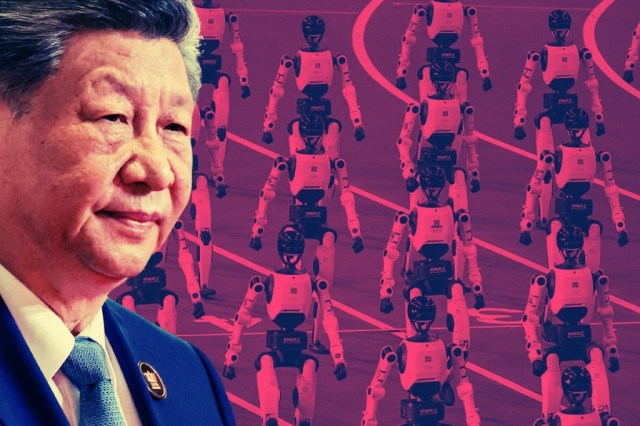
‘It is likely to be China that ultimately better adapts to an AI-enabled world.’





The existential risks of rogue AI, though difficult to judge, are surely worth taking seriously. So are the geopolitical ones associated with US-China competition for, and implementation of, the technology. Both loom large over the meeting between Donald Trump and Xi Jinping, where dialogue on AI competition and safety has been high on the agenda, despite Trump’s dismissal of safety concerns.
But these risks, while worthy of focus in themselves, carry with them a deeper question. AI, like printing and writing before it, is the kind of technology that shapes the evolution of civilisations. In turn, how well societies adapt to those changes depends on the existing cultural landscape, including deep assumptions about human nature, the relationship between mind and body, and how society functions.
Here, concerns with AI safety throw the differences into sharp relief. While Trump dismisses safety concerns, the major AI companies increasingly agree on the need for safety. However, it remains to be seen whether this extends beyond rhetoric to a willingness to curb their own competitiveness. Anthropic CEO Dario Amodei’s concern with ensuring China does not surge ahead may be honest — but it also provides a convenient reason not to follow through on slowing down frontier development. If China will build its own AGI anyway, better that a US firm gets there first. It might bring on the apocalypse, but at least it will be an American apocalypse rather than Armageddon with Chinese Characteristics.
Trump’s dismissiveness towards safety concerns seems to be in tension with the AI companies’ approach of calling for a slowdown that, for game theoretic reasons, they cannot implement just yet. But they both reflect a general modern Western concern with freedom from constraint. In the labs’ case this is often accompanied by messianic visions of AGI just beyond the horizon — a silicon saviour which will achieve miracles ranging from eliminating pestilence to generating limitless material abundance. This is a vision of unbridled progress enabled by free competition and innovation, guided by the utopian visions of individual technologists but directed towards universal benefit.
A different version of this is represented by Trump and the deepening relationship between Big Tech and political power. On one level this is apparent in the entourage of tech leaders who accompanied Trump to China and attended this week’s summit. On another, it is manifest in the visions of technologists like Peter Thiel and Elon Musk, their personal ties (volatile as those can be) with figures in the Trump administration, and, in the case of Thiel, the provision of AI as an instrument of law enforcement and military power. These are far from visions of universal benefit, instead being centred on national supremacy — a will to power channelled through transformative technology. This is the counterpart to utopian liberalism and the contemporary form of the Nietzschean impulse, channelling the drive for self-actualisation into the strongman leader rather than pushing it as a universal objective.
Both visions have a common origin traceable through the Enlightenment and Christianity. This is a faith in the ability of the mind, expressed in the self, to operate independently of the body — and ultimately a desire to free it from physical constraints. Our society is one in which professional and personal existence is increasingly online, in which the work of the mind is elevated over that of the body, in which we express ourselves through self-applied identity labels dislocated from our biology, in which we are beginning to demand the right for our minds to choose when and how to end the existence of our bodies. This is fed by an economic culture of maximal choice — self-actualisation through consumption. It should not come as a surprise that the contemporary West’s vision of AI is one of disembodied agents who reason and communicate solely via language and apparently require nothing else to become superintelligent. Pure, unconstrained digital selves.
Meanwhile, in China, they build robots as well as LLMs. Of course, the Americans do too, but the robots are far fewer. China has become a world leader in the field, giving it a major advantage in pursuing embodied AI — a potential path to AGI made that much more plausible by the fact that a robot-borne programme can interact directly with the physical world. The Chinese government has pursued a systematic AI strategy for a decade and has done so as part of a wider focus on developing “new quality productive forces”, foundational technologies enabling a fourth industrial revolution. This is accompanied by a drive for energy security and electrification as well as comprehensive frameworks for AI governance — that is, the pursuit of policies across economy and society that enable the deployment and diffusion of artificial intelligence. The CCP has emphasised safety since the beginning, and identified early on that the requirements for AI would vary significantly depending on its application to areas as diverse as security and surveillance, manufacturing, infrastructure, law, healthcare, and care for the elderly. It has regulated accordingly, tailoring rules to each sector (including a remarkably robust and not unironic concern for consumer privacy). China’s companies face ruthless domestic competition, but also operate in a society which leapt from industrialisation to digitalisation in decades rather than centuries. They release their models earlier in development than their American counterparts, but do so in a country in which the Party-state is able to enforce and manage safety concerns in a way Washington cannot.
The CCP intends that China leads the world in AI, but does so in a way which maintains domestic and international stability. The promise of leadership, in the CCP’s view, will be realised not by the individual breakthroughs of a genius techno-utopian or the company he runs but by deploying the technology across manufacturing, healthcare, administration, and surveillance. Xi and his colleagues grasp that while LLMs (and other AI models) might appear to us as disembodied minds, key to the control of their development is control of the physical stuff that allows them to exist, right down to the minerals that go into the chips. And they understand that there is an opportunity to lead by providing the rest of the world with open-weight models and the international initiatives and regulatory frameworks to govern their use. It has been China that has offered a Global AI Governance Initiative, hosts the World AI Conference on governance, and engages in extensive AI and data governance agreements across the Global South.
None of this eliminates the potential risks of losing control. But it does mean that China is significantly better placed to mitigate them, and to respond effectively should they occur. None of the above, equally, mean that Chinese AI is inherently more benign. To the contrary, under the watch of the CCP it enhances an already pervasive surveillance machine, enables more efficient repression and pre-emptive action against potential dissenters, and grants the CCP a potent means to control the flow of information through Chinese society and beyond. On the plus side, in a world of Chinese AI we may well be less likely to all die at the hands of MechaHitler.
Just as self-actualisation-through-technology, Nietzschean or utopian, has its conceptual roots in the West’s intellectual heritage, so this alternative vision of AI — an all-of-society enhancement that is context-specific, regulatorily-iterative, embodied, and safely controlled — has its roots in China’s. It is the kind of approach one might expect from a civilisation whose philosophy has emphasised a continuous relationship between the mental and the physical, the mutual influence of society and the wider cosmos, and the complexity of the web of factors that influence individual behaviour. Such principles lie behind ideas ranging from traditional Chinese medicine to Confucian moral self-cultivation, emphasising propensity and interconnectedness over determinism and separation.
As with Western thought, this tradition has optimistic and pessimistic flavours. The countercultural impulse of the Daoist sage to retreat into the mountains and be at one with the way of the cosmos is the sibling of the Legalist statesman’s understanding that his enemies are best destroyed by comprehensively targeting the intricate network of economic, demographic, political, and military factors on which their rule depends. The Confucian conviction that all humans can improve themselves through practising the correct rituals finds its counterpart in the Maoist awareness that those forced to repeat the same behaviours can be “brainwashed”.
So there is much to fret over, regardless of who drives the direction of AI. Ultimately, it is hard to avoid the uncomfortable conclusion that this technology may well spell the end for the societies we in the West consider ideal. For many decades, if not centuries, our societies have seen rapid technological change, but never in that period have we been confronted by a technology with quite so much transformative power over how we receive information, how we communicate, and how we relate to others and ourselves. Writing and the printing press were technologies which, through interaction with economic shifts as profound as the emergence of a merchant class or the newfound sustainability of cities, enabled the thorough and often bloody transformation of political systems. Such technologies define the development of human civilisation for centuries thereafter.
Printing emerged far earlier in China, and did so into a society that had developed many of the trappings of early modern European states centuries beforehand, from bureaucratic government to standing armies. But for us in the West, the arrival of printing caused immense disruption, ushering our societies out of feudalism and into an era of mass literacy that made liberal democracy possible. AI now appears to be a similarly transformative technology, and is swiftly being embedded in the bureaucracy, in the military, and across a corporate sector over which the government has little control. The institutions of Western democracies are ill-equipped to deal with such a radical shift in the creation, control, and distribution of information and the new centres of authority it is creating.
In contrast, China has developed its economy and institutions alongside the emergence and proliferation of digital technologies. It has also done so at a time when advances in science and technology tend towards an emphasis on complexity, messiness, and unpredictability. Contemporary scientific understandings of evolution or the relationship between mind and body, for instance, are entirely at odds with the mind-body dualism of the Enlightenment. A philosophy that worked for a world of steam and printing — discreet manipulable objects and Newtonian physics — is not necessarily up to the messier challenges of silicon and neural networks. A society whose systems of thought are predisposed to understand humanity and the world in a way which complements the science underpinning modern technology is surely likely to adapt to that technology more effectively — and implement it more effectively too. CCP-sponsored AI might very well wish to read the contents of your mind, but a brain-computer interface designed by Xunzi would perhaps be less likely to assume that one can straightforwardly transfer the mind’s contents to a machine with no ill effects than would one designed by Descartes.
For these reasons, it is likely to be China that ultimately better adapts to an AI-enabled world. It is not that China and the West are incommensurably different, nor that they do not face analogous challenges with these new technologies. It is simply that adaptation is an evolutionary process, and in evolution success depends not on perfection but on being marginally better suited to one’s conditions than the competition. China’s approach is much more orientated to the complexity of this technology, and unlike the US, China is building an architecture designed to facilitate the spread of its own vision. America risks failing to anticipate the profound domestic challenges AI is catalysing, while China gains an international reputation as the more responsible AI superpower.
We should take this prospect extremely seriously. Of course, we must worry about US-China strategic competition, from the economic challenge of supply-chain interdependence to the escalation risks posed by two superpowers increasingly reliant on military AI. But we must also think about culture, and what might enable us to better adapt. This is especially pressing for those of us outside America and China. We face two alternatives — the apogee of unconstrained self-actualisation or efficient, holistic security. Or, for the more pessimistic, MechaHitler or MechaMao.
William Matthews is a lecturer in the Defence Studies Department at King’s College London. He writes on China, the changing world order, and the impact of emerging technologies, including on his Substack.
 WMatthewsChina