




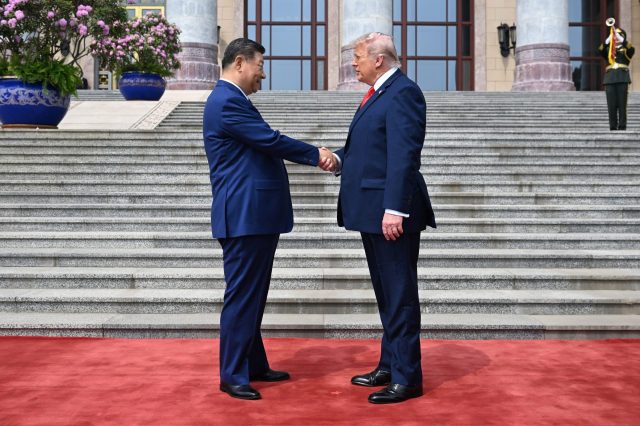
(Kenny Holston/Getty)





In September 2015, Xi Jinping made his first state visit to Washington, DC. During a six-day American itinerary, he made the usual rounds: the summits, the forums, the dinners. Yet during his first speech in the country, Xi also mentioned that he had read some of Walt Whitman’s poetry. This should not surprise us, since Whitman has had a rather strong reception in China. In the Twenties, the avant-gardists of China’s New Culture Movement held him up as an icon, and by knowing some of Whitman’s verse, Xi showed that he’s familiar with a figure who inspired modern China’s literati.
It seems doubtful that the sitting US president will have spent much time with Whitman’s Leaves of Grass. But I feel confident that several of his lines in the “Song of Myself” might still resonate with Donald Trump. “I know perfectly well”, the poet says, “my own egotism”. Whitman is not alone in this self-consciousness. “I chant the chant of dilation or pride”, he goes on, “I show that size is only development”. A line like that could be the motto of any New York property developer. Whitman then asks, bringing a rare end-rhyme to development: “Have you outstripped the rest? are you the President?” Mr Trump could coolly answer: Yes.
With all this in mind, it is worth noting that Whitman penned a fair number of fraternal lines about China. In a poem of delirious cosmopolitanism, “Salut au monde”, he claimed: “I see the four great rivers of China, the Amour, the Yellow River, the Yiang-tse, and the Pearl.” We would now write Whitman’s “Yiang-tse” as Yangtze and his “Amour” as Amur; but what matters is that China’s rivers were flowing in the Brooklyn poet’s mind in the middle of the 19th century.
Whitman even went to Qing-dynasty China, in a poetic transport, to see for himself how the common people lived. “I go among them”, he dreamed. “I mix indiscriminately”. And he found the people of China to be, in the blinding light of his ecstasy, no different from him or from the Americans of his day. “Each of us [is] inevitable”, he thrummed, “Each of us [is] limitless.”
We do not know what it is in Whitman’s ultra-democratic poetry that stirred something in a young Xi Jinping. But as China’s paramount leader returns to the US for another state visit, he surely knows that America has long dreamed of his people.
And it is not only in poetic reveries that the West and China have been friendly. Before the full-bore Industrial Revolution; liberal trade policies (and concomitant trade wars); and the high-watermark of Western imperialism in Whitman’s 19th century, the West and China had several hundred years of largely peaceful cultural, commercial, and intellectual contact. From roughly 1500 to 1800, China and the West rather candidly recognised each other as the world’s most advanced civilisations. Leibniz — a baroque savant and China-watcher avant la lettre — did not hesitate to call them “the two most cultivated parts of the world”.
More recently, and no less importantly, the 21st century’s two great powers were ultimately aligned in all three of the 20th’s great contests: the First World War, Second World War, and the Cold War. This is currently better known in Beijing than it is in Washington, London, and Brussels. And, because we rarely hear it in the West, it’s worth taking each conflict in sequence.
A couple of years before Whitman’s poems began to appear in translation in the pages of the New Culture Movement’s Young China magazine, the Chinese republic declared war on Germany and Austria-Hungary. The casus belli was a lawless German strike, in February 1917, on a French transport ship sailing in international waters. Hundreds of Chinese nationals aboard the vessel had drowned. In March 1917, the Chinese parliament voted to break diplomatic relations with Germany. But this brought no change to Germany’s scandalous U-boat policy. In August 1917, Beijing then joined London and Paris, Petrograd and Washington in their titanic struggle against the Central Powers.
China’s man in Washington at the time was a formidable diplomat with an evocative name: Vi Kyuin Wellington Koo. In a letter printed a month or so later, in The American Journal of International Law, Wellington Koo notified the US Secretary of State of his government’s grave decision: “I have the honor to inform you that China… declares that a state of war exists with Germany and Austria-Hungary.” Notably, Wellington Koo stressed in this letter that his government would “observe all the stipulations of the conventions signed at the International Peace Conferences at The Hague”. The Republic of China, founded in 1912, would uphold the laws of “civilized warfare” that Imperial Germany had relinquished. In other words, Wellington Koo’s Asian republic was more civilised than one of Europe’s great monarchies.
In the Second World War, meanwhile, the Republic of China staked a similar claim, fighting alongside Washington in defence of civilisation. But now, the lawless power China had to resist was Japan: a monarchical Asian ally of a post-monarchical Nazi Germany. On 7 December 1941, Japan struck Pearl Harbor without formally declaring war. This “treacherous” strike was made in violation of the conventional laws of war and later judged to be illegal — which is to say, uncivilised — by a postwar tribunal. The more immediate effect of Pearl Harbor was to forge a momentous link between the US and China.
Why so momentous? Well, on 1 January 1942, a statement titled the “Declaration by United Nations” was drawn up and signed at the Arcadia Conference in Washington, DC. The ur-document of the United Nations, it had four original drafters and signatories: the US, UK, USSR and China. It is no coincidence these four great powers still form the core of the UN Security Council (with France joining later). China belongs to the innermost circle of powers that created the postwar order, and the UN.
Just a couple of days after the Arcadia declaration was signed, Chiang Kai-shek — or “Generalissimo Chiang”, as he was known — accepted the “supreme command over all forces of the United Powers… in the Chinese theater”. The idea for this centralisation of “United Nations” forces in Chiang’s hands came from President Roosevelt himself. And there can be no doubt that FDR had a strategic vision for what he called “the gallant people of China”. By May 1942, he was declaring that “in the future a still unconquerable China will play its proper role in maintaining peace and prosperity, not only in eastern Asia but in the whole world”.
China remained “unconquerable” at the close of the Second World War. But its anticolonial struggle had not decided the issue of a decades-long civil war between Chiang Kai-shek’s nationalists and Mao Zedong’s communists. Of course, Chiang and the Republic of China did not hold the mainland; in the bitter fight for sovereignty, the Maoists prevailed. A successor republic, a “People’s Republic”, was formed in Beijing in October 1949. And with it, a steely party-state was formed which had immense debts to one of America’s other wartime allies: Stalin’s USSR.
The cruelties of China’s civil war and the fantastical complexity of early-Cold War geopolitics cannot be dealt with here. But two brief points can be made. First, China’s postwar settlement in no way cancels out the vast sacrifices made by the “gallant people” of the country during the Second World War. Second, the communist ascendancy in China was not preordained. Indeed, certain actions by the US may have moved the dial in favor of Mao and his Soviet-backed troops. Frank Dikötter has stressed in a recent book that it was FDR’s successor, President Truman, who put an arms embargo in place in 1946: not on Mao and his communist brigades, but on Generalissimo Chiang and his nationalists.
A 1946 New York Times headline tells us why: “Aid to China Hinges on Ending of Strife and Unification of Nation”. Truman confirms this in a personal note he sent to Chiang. In it, the US president made clear that his government’s “generous attitude” towards the Republic of China was highly conditional: Chiang had to demonstrate “genuine progress” towards achieving a “peaceful settlement” with Mao. In hopes of seeing a coalition government formed in Nanjing, Chiang’s capital, Truman leveraged US money and materiel, imposing more than one ceasefire which, in Dikötter’s view, “changed the course of the civil war”.
The early years of the Cold War were therefore treacherous and highly complex. There is much we still do not fully understand. But however we choose to reconstruct that era, it’s clear that a dangerous bloc-formation swiftly formed within the “Big Four” powers that built the UN: the US and UK in the “West”, the USSR and China in the “East”. And no one disputes that China, having aligned with Washington and London in the century’s first two global conflicts, took a hostile posture during the third. This revolutionary, Soviet-backed posture of Mao’s China held up for roughly two decades.
But it is surely worth noting that, for a great power with a 2,000-year history, that’s the blink of an eye. The People’s Republic of China had only been in existence for 22 years when President Nixon touched down in Beijing to make his visionary overtures in February 1972. In the years that followed, Maoist China decided to normalise relations with Washington. And, less than 20 years after that, due in part to the West’s strategic rapprochement with China, the Cold War ended.
This point is especially important. The liberal Nineties narrative of the USSR’s dissolution is highly Eurocentric — but modern China has never been a geopolitical periphery. Any rigorous account of the collapse of the USSR must frankly reckon with the fact that it was not only the Western powers, but the Western powers plus China, which created the conditions that doomed the Soviet system.
Strange to say, the US had a strategic commitment during the Cold War to what we would now call a sort of multipolarity. Cultivating ties with peripheral communist regimes was part of this strategy: Washington’s heavy investment in Tito’s Yugoslavia is a case in point. Nixon’s grand maneuver in 1972 was to invite Mao’s Beijing, a central communist regime, to form a third pole in the bipolar world order of the Seventies. And, indeed, a new pole was formed. “Without abandoning its communist trappings”, as Bruce Mazlish puts it, “China under Deng Xiaoping and his successors has been pursuing its own amalgamation of socialism, Confucianism, and capitalism in a unique blend.” The PRC’s scale is unique, too, and the systemic effects of its late-Cold War opening are often missed in Western discourse.
The triumphalist liberal narrative of the Nineties is also ideologised. Any serious account of China’s reopening to the West must reckon with the fact that it was not instigated or navigated in the early days by Western liberals. Whatever we make of this fact, the breakthrough diplomacy in China was undertaken by Western conservatives: Richard Nixon and Henry Kissinger, with some fine diplomatic play by Margaret Thatcher. Beijing has not forgotten who conceived its Cold War détente with the West. Nixon is highly respected in 21st-century China, as he seems to be among a growing number of young Americans.
But China cannot be reduced to a partisan question in the West. It is too massive, too comprehensive, for that. Our ideologies do not capture it. And it cannot be stressed too heavily that it was Western diplomacy in the Seventies — not politics, not ideology — which drew Beijing back towards Washington, London, and Brussels. It was diplomacy which made “unconquerable China” a stabilising presence in late-20th-century geopolitics.
It’s probably too much to hope for President Xi to be given a first edition of Whitman’s Leaves of Grass during his stay in Washington, DC. But there is, in any case, a pair of words that Whitman brings forward in “Salut au monde” that still speak to the occasion. As he gazes out on the world of the 1850s, Whitman tells us that he sees “barbarisms” and “civilizations”. Not much has changed, perhaps. But this is no time for great-power barbarisms. The stakes are too high.
The task, then, is for China and the West to exemplify their long-related civilisations. Today, we’d be more likely to call them the world’s largest economic zones, and it’s tempting to see these tensions, over AI or rare earths, as insurmountable. But perhaps we shouldn’t be too quick to make the shift to brute economic calculation. For diplomacy is, ultimately, a civilisational legacy. And if diplomacy is what we need in the early 21st century, then surely we can find the strength and calm to engage in it: by returning to the deeper traditions which made several centuries of relatively peaceful trade and intellectual exchange possible between a strong China and a powerful West.
David Lloyd Dusenbury is a philosopher and historian of ideas. His latest book, I Judge No One: A Political Life of Jesus, is out now.
 DusenburyDavid