




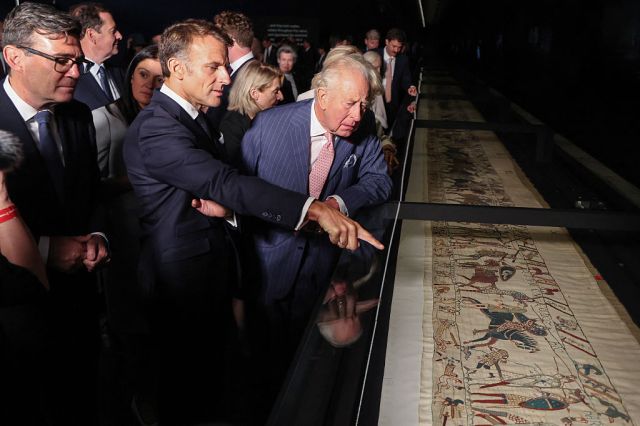
‘Look, it’s your ancestor!’ (Ludovic Marin/Pool/AFP/Getty)





It is remarkable that two of France’s most precious national treasures are not French. The Mona Lisa arrived in France with Leonardo da Vinci in 1516, and has remained there ever since. The Bayeux Tapestry, in reality an embroidery, was almost certainly stitched in England in the 1070s. English embroiderers were at that time considered the best in Europe. Once transported to Bayeux, it never left France again.
Both treasures have played their part in the “soft power” of cultural diplomacy. The Mona Lisa was loaned to the United States in 1963, following a state visit to France by President Kennedy. The story goes that his wife Jackie so charmed de Gaulle’s Minister of Culture, André Malraux, that he agreed to the loan as a goodwill gesture. De Gaulle’s view is not known, but he probably saw this as a harmless sop to the Americans at a time when relations between the two countries were strained.
As for the Bayeux Tapestry, the idea of a loan was first mooted at a summit in 2018 between President Macron and Theresa May, two years after Brexit. Macron, too, was looking for a symbolic gesture of goodwill in troubled times. Knowing that the Bayeux Museum was scheduled to close for renovation, one of his officials, who recounted the story to me, came up with the idea in the small hours of the morning.
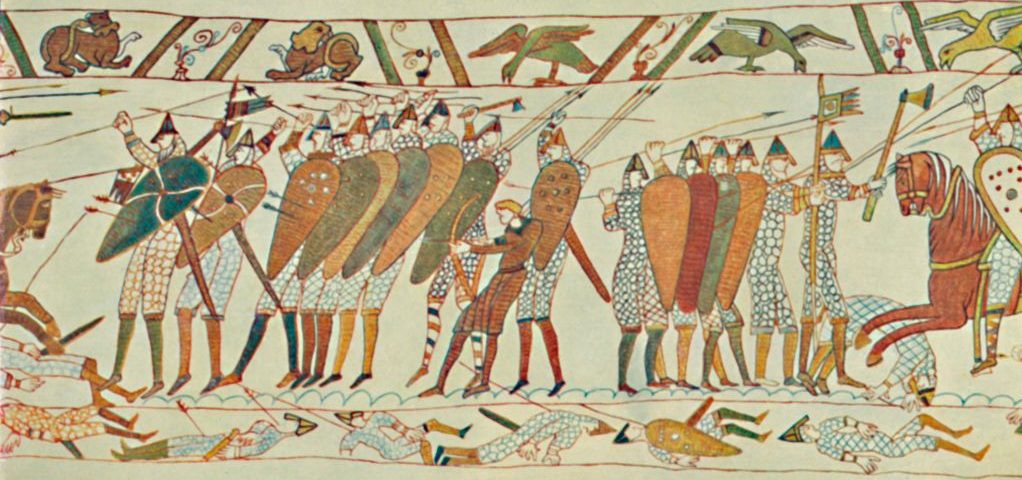
In both cases, there were protests from curators and the public about the risks of moving these precious-but-fragile works. A petition was duly launched against the loan of the Tapestry in July 2025. Macron, like Malraux before him, overruled the objections in the cause of diplomacy. Given the vicissitudes the Tapestry has suffered over the many centuries, it seems likely to survive this one too — and will continue to inform Anglo-French conversations about national identity.
Amazingly little is known about the first four centuries of the Tapestry’s history. It was originally assumed to have been commissioned, and even stitched, by William the Conqueror’s wife Matilda. In France, indeed, it was often referred to as “La Tapisserie de la Reine Mathilde”. That theory is long discredited. It is now believed to have been commissioned by William’s brother-in-law Odo, Bishop of Bayeux, who was also, as Duke of Kent, his main administrator in England. Even so, we still do not know when it ended up in Bayeux. The first record appears in a cathedral inventory in 1476. When the building was ransacked by Protestants in 1562, it survived, perhaps because it was hidden in a chest.
Yet it would be in the 18th century that the Tapestry began to excite wider historical interest, sparking arguments about its “identity” that would rumble on into modern times. In the 1740s, the scholar-monk Bernard de Monfaucon commissioned a draftsman to do a copy, publishing the results in a volume entitled Monuments of the French Monarchy, making the Tapestry known to a wider public. On the far side of the Channel, meanwhile, antiquarian William Stuckley, best known for his work on Stonehenge, claimed the Tapestry was stylistically a British not a French artefact.
Despite all this, the Tapestry remained obscure. It survived two close shaves during the Revolution. The first was in 1792, when fears of an English invasion prompted local patriots to form the Calvados Battalion of volunteers. Searching to cover the weapons and provisions in their wagons, someone suggested the old hanging in the cathedral. Luckily, a local administrator stepped in to prevent this. Two years later, some zealous local citizens had the bright idea of cutting it up to decorate a float for a Republican parade. They were stopped by a member of the Revolution’s newly created Commission for Arts.
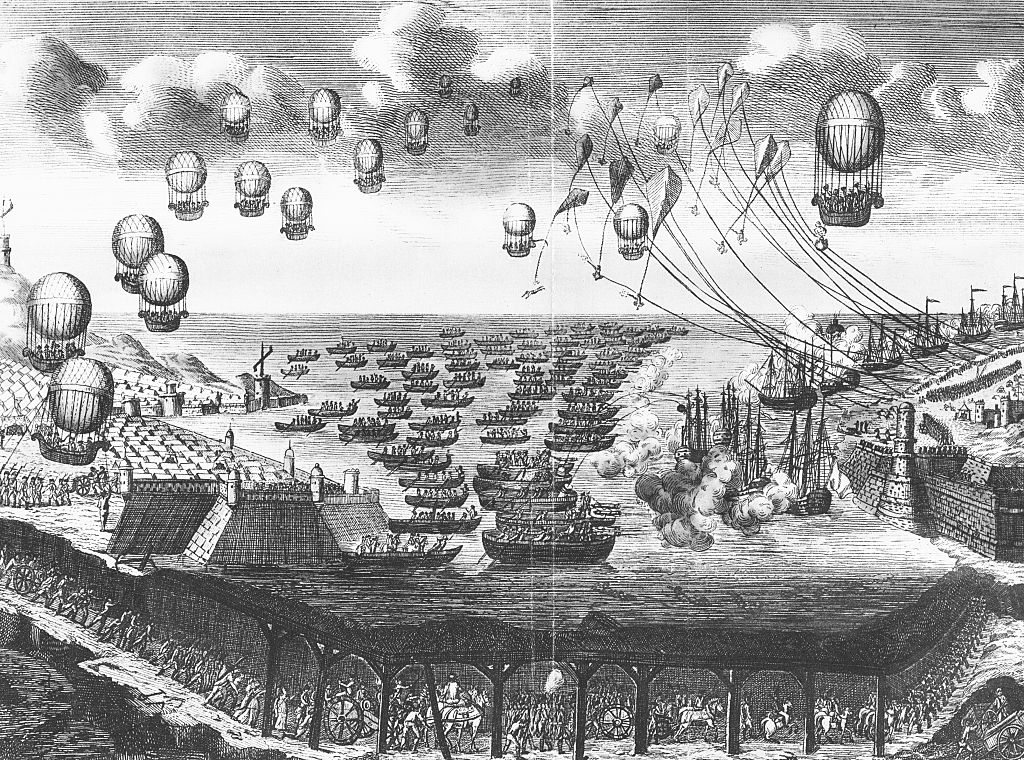
It would, however, be Napoleon who fully embraced the Tapestry as a political symbol for the first time. In 1803, huge numbers of troops assembled at Boulogne for an invasion of the British Isles. To bolster propaganda for the scheme, Napoleon had the Tapestry displayed for two months at the Louvre. An official newspaper reported the next day that, during his visit to see the Tapestry, Napoleon asked a question about the scene with the comet: supposedly predicting King Harold’s doom. In a footnote, the paper also carried the story that a comet had been sighted recently near Dover. Unfortunately for Napoleon, this portended nothing. The invasion was abandoned. The Tapestry returned to Bayeux.
Yet the artwork’s potency would hardly diminish. Over the next decades, after all, the Tapestry moved from being a local relic to a French national treasure. Across the Channel, meanwhile, a member of the British Society of Antiquaries, Charles Stothard, was dispatched to France to make a detailed drawing of the entire work. Years later, after his death, two fragments cut off from the Tapestry were found in his belongings, and his unfortunate widow was accused of the crime. On the upside, his drawings provide the only record of the Tapestry before some 19th-century restorations.
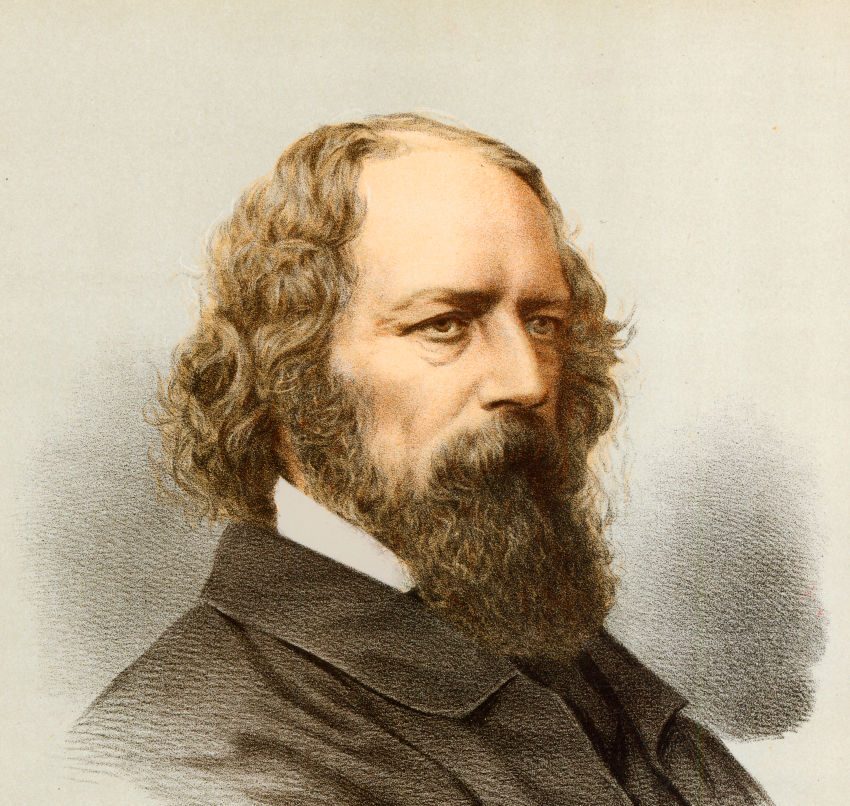
Still, that did not stop Stothard’s drawings from being engraved and published, providing the Tapestry’s first ever full colour reproduction in the 1820s. Especially after railways made Normandy more accessible, it became a major tourist attraction. It was now moved for display from the cathedral to the Hôtel de Ville. The poet Robert Southey complained he had had to queue to see it. Views differed: Constable thought it was “almost as bad a Mexican painting”; Ruskin was hugely admiring; Dickens thought it the work of “feeble amateurs”; Tennyson was inspired by it to write his verse drama Harold in 1876.
All the while, it attracted scholars, who used the Tapestry to debate the impact of the Normans. One example is J.H Round, an Oxford historian who used the work to argue that the Conquest had replaced England’s Anglo-Saxon social structures with feudalism. Tellingly, Tennyson’s Harold is a brave freedom fighter, embracing High Victorianism to rail against the Norman yoke.
Interpretations of the Tapestry took a new turn from the 1870s when, thanks to the display of the hand-coloured photographic reproduction of the Tapestry at the South Kensington Museum — now the V&A — it was reimagined as a proto-feminist work. In her book The Queens of England, popular writer Agnes Strickland celebrated the women who had created the Tapestry. Others retorted that women might have made it, but lacked the imagination to have designed it. As one male academic snootily commented: “I suppose I am not expected to take any serious notice of some amusing remarks made by Miss Agnes Strickland”.
Comments like these did not deter Elizabeth Wardle. A friend of William Morris and a talented embroiderer herself, she conceived the idea of producing a copy of the Tapestry. Setting up an Embroidery School at Leek in Staffordshire, she gathered a team of 37 embroiderers to produce a copy, working from the South Kensington photographs. The replica was unveiled in Leek in 1886 and became celebrated enough to travel the country, as well as to Europe and America. It was even taken to Windsor for a day, though Queen Victoria was not impressed. Finally, the replica was finally bought by Reading Museum. It has been there ever since — despite occasional attempts by Leek to get it back, according to one local, on the grounds that it was the town’s “Elgin Marbles”.
The contested history of the Tapestry took a final and unexpected turn in the Second World War. The more fanatical Nazis were obsessed with the idea of racial purity and the search for the origins of the true Aryan race. Heinrich Himmler, head of the SS, saw his men as new Teutonic Knights, and in 1935 set up Ahnenerbe (“Ancestral Research”) to investigate the origins of the master race. It became interested in the Bayeux Tapestry because, since the Normans were originally descended from Vikings, they could be interpreted as “Nordic”. After Hitler’s conquest of France in 1940, when an invasion of England was planned, the Tapestry was viewed as an example of warlike Aryans defeating effete Saxons (who, of course, could themselves be seen as Nordic).
What saved the Tapestry from Himmler’s designs was that the Nazis were as bureaucratic as they were demented. Occupied France was technically controlled by the Wehrmacht, putting the Tapestry under the authority of the Kunstschutz (“Art Protection Squad”): a body which respected the Hague Convention and protected national works of art. As for Himmler’s pseudo-researchers, they had no rights to the Tapestry unless they could first re-define it as non-French, which would remove it from army protection.
Aware of the dangers posed by the Ahnenerbe, the aristocratic head of the Kunstschutz prepared to move the Tapestry to safe-keeping. But a mole in the unit revealed his plan, and a team of SS “experts” arrived in June 1941 to photograph the Tapestry for research, just another example of the intriguing relationship between physical studies of the masterpiece and the ideological exploitation of it. For the rest of the war, Ahnenerbe “experts” pored over their photographs, preparing a huge volume to prove the Tapestry’s Aryan identity. The work as a celebration of Nordic supremacism was even the subject of a broadcast by Lord Haw Haw.
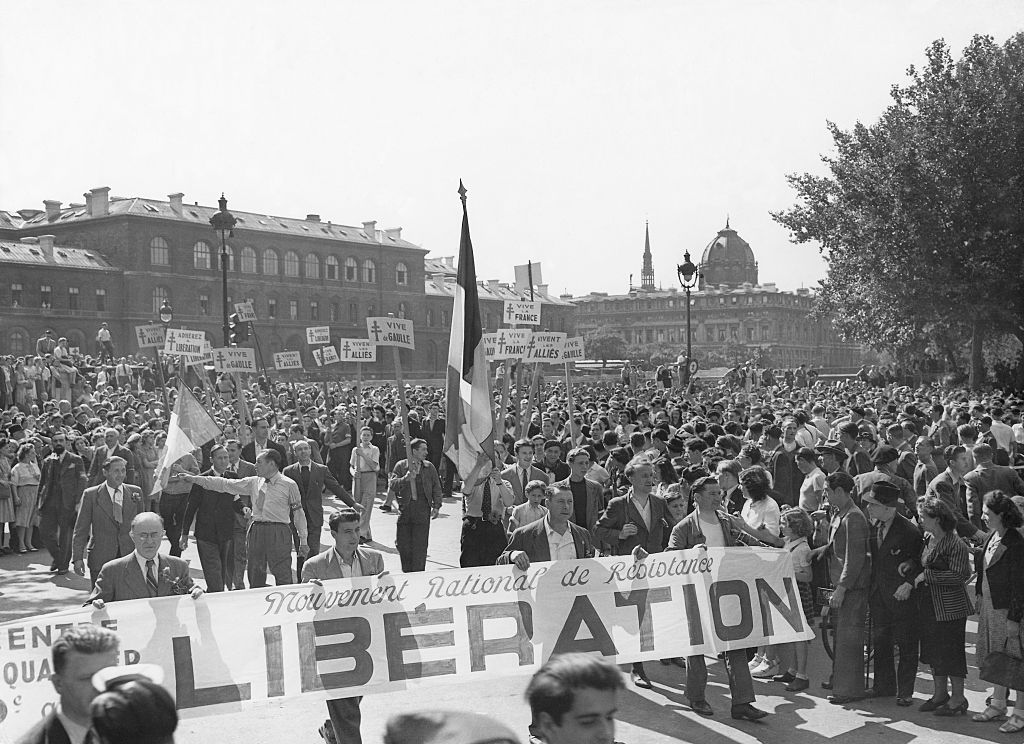
In the end, it wouldn’t matter. After the D-Day landings, Himmler ordered the Tapestry transported back to Germany, but Resistance fighters got there first, capturing the Louvre, where the work had since been transferred from Normandy, a few days before Paris was liberated. In December 1944, for the first time since Napoleon, the Tapestry was displayed at the Louvre. Then it returned to Bayeux, where it has been ever since.
Having survived Huguenot iconoclasts, revolutionary enthusiasts and crazed Nazis, the Tapestry will surely survive this new journey, watched over by its curators. There is no chance that a latter-day Charles Stothard will be able to snip off a few threads. On the other hand, whether the Tapestry will fulfil its role in soft-power diplomacy is another matter. Mona Lisa’s smile was not enough to prevent such a dramatic collapse of Franco-American relations that de Gaulle broke with Nato in 1966. Let us hope the Bayeux Tapestry proves more successful in its mission.