




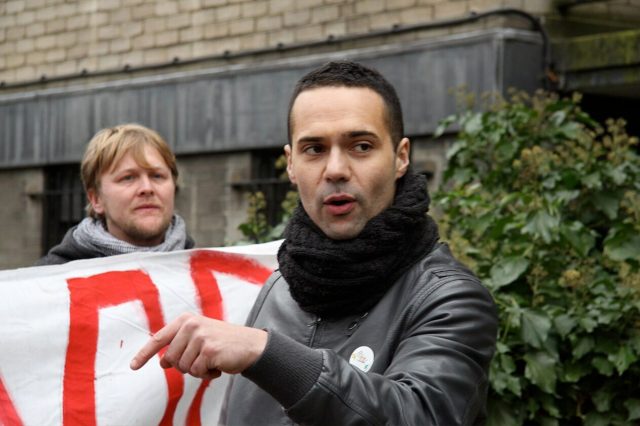
Bastani pictured in his Occupy days. (UCL Occupation/Flickr)





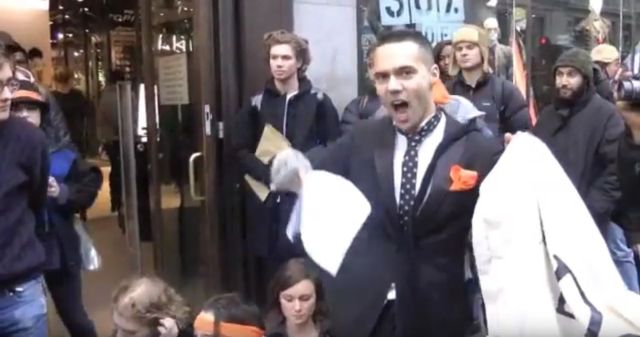
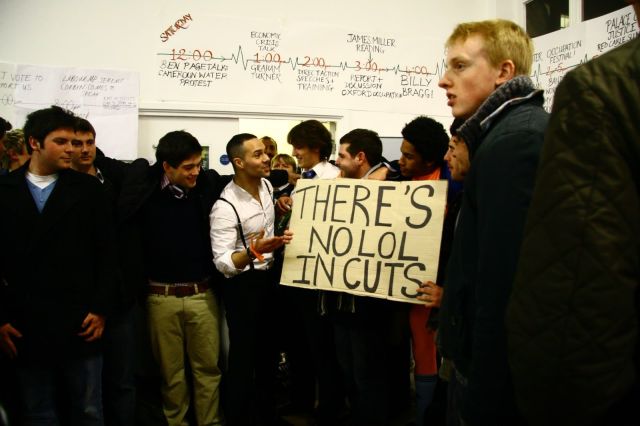
“THIS IS ACTUALLY HAPPENING”. It’s a slogan I spotted countless times after 2010. I saw it scrawled on a wall during the month-long occupation of University College London that winter, and on a placard that November, after a protest at Millbank Tower descended into riot. I witnessed it in action, too, when Topshop’s flagship store was covered in paint the following March, and when students fashioned makeshift shields out of book covers. Whatever you think of them, all these moments sought to defy the inertia of what Mark Fisher memorably termed “capitalist realism” — the sense that, with neoliberalism triumphant, no alternative was possible.
Defying inertia. That, in essence, is what protest means. And 15 years ago — as a wave of student protest morphed into opposition to austerity — I really was certain we were on the cusp of a political revolution. How could I not, when technological change was undermining legacy media, and when Britain was in an economic malaise that clearly couldn’t be resolved by the Coalition government? These truths, I was sure, would invariably smash a political class that, whatever its other internal disagreements, fanatically believed that growth would soon return. Debate over how fast to cut the deficit felt so small by comparison.
That sense of revolution extended beyond these shores. Today marks the 15th anniversary of the Occupy Wall Street [OWS] movement, which began when hundreds of people camped out in New York’s Zuccotti Park, not far from Wall Street. They were forcibly removed a month later, yet Occupy heralded the strange rebirth of Left populism on both sides of the Atlantic. Bernie Sanders, the “Squad”, Zohran Mamdani and Abdul El Sayed — all are downstream from those 2011 protests, casting the “1%” against the rest of us. In Britain, too, Corbynism can be traced back to the same period, as can the more recent rise of the Greens. Today’s talk of a wealth tax feels impossible to separate from the populist rhetoric that entered the national conversation around the time of Occupy.
Those transatlantic similarities are likely a function of the fact that both Brits and Americans were some of the first to exploit the opportunities presented by social media, specifically Facebook and Twitter. All of a sudden, coordinating a decent-sized protest no longer required historic brokers like political parties or trade unions, with the National Union of Students not organising any of 2010’s post-Millbank protests. There was a global element here too, with Western radicals drawing lessons from the Arab Spring. Clearly, we thought, something was shifting on a planetary scale, applying Durkheim’s “collective effervescence” to our global, interconnected age.
It certainly felt effervescent at the time, bringing to mind Wordsworth’s couplet from 1789: “Bliss was it in that dawn to be alive, But to be young was very heaven!” Little wonder, then, that the “March for the Alternative”, which took place on 26 March in 2011, saw half a million people march against austerity in Central London. Some were happy to blow their vuvuzelas and amble serenely to Hyde Park; others smashed up the Ritz or occupied Fortnum & Mason to highlight alleged tax-dodging. I myself was later arrested for pushing a bin through the door of a (closed) HSBC bank, something which looked far more dramatic on camera because we’d breached a magnetic lock. I later pleaded guilty to throwing an empty plastic bottle of water too, and, as a result, spent dozens of hours sweeping leaves in South London and sorting clothes in an East Dulwich charity shop. One consolation was that I got first dibs on discarded Brioni polo shirts, an additional bonus to seeing how destructive outsourcing was for the probation service.
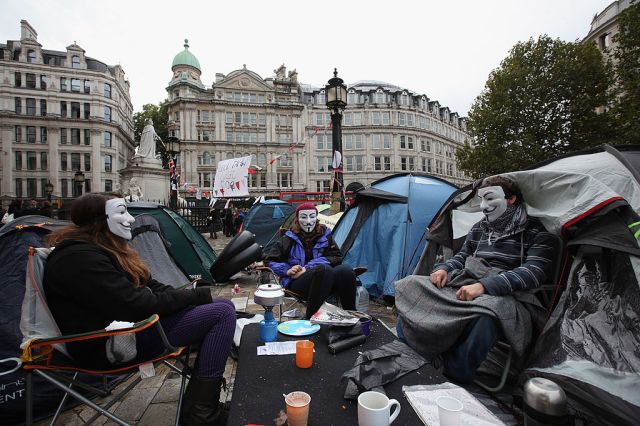
Through it all was a mood of heightened repression. In November, after the Occupy protests had begun in Manhattan, and then been replicated in a pop-up settlement outside St Paul’s Cathedral, a student protest sought to march to the City of London instead of Parliament. Remarkably, the number of police that day matched those demonstrating: I recall calculating around 5,000 on each side. Earlier, in April, on the day Prince William married Catherine Middleton, a large number of arrests were made in central London. They famously included a snatch squad grabbing a guy for singing “We all live in a fascist regime”. When Right-wingers talk about “two-tier policing”, I cast my mind back to that bizarre episode. I’ve not seen anything like it since.
In hindsight, there were other glimpses into the future too — not least in the way we understood, instinctively, that the financial crisis had changed the world forever. This diagnosis had two aspects: economic and political. Economically, the Occupy movement asserted that the growth of what scholars now call the “great moderation” — expanding trade, financialisation, and consumer spending powered in part by rising house prices — would not inevitably return. It’s easy to forget now, but the 2000s were a very different economic time: Vodafone was briefly more valuable than Intel, while RBS was Europe’s largest bank. After 2008, only the radical Left seemed to grasp that the house of cards had fallen for good. And that no non-radical futures were on offer.
From that economic diagnosis came a political recognition: that the West’s challenges were too big to be met by legacy parties, at least in their current form, not least because they found ideas so alien following decades of neoliberal rigmarole. At some point, between the economic challenges and the rise of platforms like Facebook, and the wider network effects they permitted, the two-party system would balkanise. Fast forward to 2026, when the Greens have won a by-election, Plaid Cymru came first in Wales and Reform control dozens of councils and, it’s fair to say our seemingly wild speculations have been vindicated. And while the primary system has meant the big two parties still endure in the US, between MAGA and Mamdani they have changed beyond all recognition. With the Democrats, especially, one suspects that process still has a long way to go.
Those were big bets to get right. So where were Occupy, and the movements accompanying it, wrong? That’s a worthwhile question to ask, not least because Occupy encapsulated many of the ideological assumptions of the moment, and indeed prefigured some of the weaknesses that have come to define the Left ever since.
First was the idea that we should make no demands. In part, this was tactical, with the relative absence of a propositional politics allowing Occupy to retain a broader coalition. But it also reflected an aversion to political leadership, informed by a desire to maintain ideological purity and not engage with what was perceived as a broken system. Here, then, was the politics of “beautiful souls”: the template for the kind of “influencer politics” we see today. This can still work with ad-hoc momentary campaigns — often with extraordinary alacrity — but it also means that long-term political vehicles are harder to build. What the Left lost, in turn, was a repository for collective political memory, and a space where a shared programme could be built over-and-above sectional policy disagreements. In the Corbyn years there was talk of replicating the pre-war German SDP, or the Italian PCI, as an organisation rooted in the associational life of ordinary Britons. The closest we got was the one-day music festival “Labour Live”.
Ironically, given how useful they were, this was partly a function of digital technologies. As Marshall McLuhan vividly put it, the medium is the message. In practice that meant Occupy coalesced around a distrust of large, legacy organisations — precisely because network technologies appeared to make them less relevant. Yet if this allowed protests to spread fast, it also came with downsides. After all, as Martin Gurri wrote in The Revolt of the Public, this bottom-up approach to politics tends to promote a kind of mass nihilism, a corrosive uncertainty about whether any “settled truth” institutions really merit trust, and whether any form of authority can ever be legitimate. We first saw that in Anglophone politics with Occupy. Today, though, it feels more applicable to anti-migrant protests, black-clad road-blockers in Dover and the likes of Danny Tommo in Portsmouth. All those movements — both Left and Right — grew through a blend of digital networks; charismatic leadership; an aversion to legacy actors; and the promise, in many cases, of a world remade. And if, on the Left, this curdled into a strange melange of anarcho-libertarianism combined with budgetary Keynesianism, we might expect something similar to happen on the other side of politics too. Indeed, you already see glimpses of it in calls for a leaderless movement that oversees millions of deportations, and the idea that Britain — the country which arguably gave the world modern secularism — should embrace Christian nationalism.
There are, perhaps, other lessons of Occupy for the Right here too — not least in the way Leftist activists, myself included, failed to really grasp the nature of our coalition. Just as we often thought “graduates” had a shared interest in a wider political transformation, much of the Right now seems to think that billionaires should enjoy lower effective tax rates than provincial headmasters and senior nurses. Indeed, the radical movements of the early 2010s were largely constructed around that emergent figure of the “graduate without a future”. There was much value to the concept: today millennials remain the only generation in Britain to have become more Left-wing over time. But that formulation also missed something important: not all graduates are the same. Some, it turns out, had a future after all.
The typical participant at Zuccotti Park was young and very likely to have a university education, with some 92% having either attended or graduated from college. Yet that didn’t make these people affluent; half of those involved in Occupy Wall Street earned $25,000 or less a year. My personal observations on this side of the Atlantic told a similar story. Whatever cynics might have concluded — often without going to an encampment and actually speaking to protesters — this really was a working-class movement driven by younger adults experiencing economic frustration. Today those concerns are central for millions of millennial voters, the backbone of the workforce in both Britain and the US.
At the time, I thought it was inevitable that this social base of downwardly mobile graduates would sweep politics. After all, without sounding grandiose, “elite overproduction”, as Peter Turchin has since termed it, helped drive the French and Russian Revolutions as well as the English Civil War. What sparked the downfall of the ancien régime, and particularly the rise of Jacobinism, was an alliance of lawyers and the sans-culottes. In the early 2010s, across the West, it seemed like something similar was starting to happen. As the middle class failed to reproduce itself, graduates — the spine of an ever-expanding lumpen-bourgeoisie — would throw their lot in with a class-based politics. The much maligned “laptop class” would be the lawyers this time round, Left-wing millennial stand-ins for Saint-Just, Danton and Desmoulins.
Ultimately, though, something different happened. Because while the downwardly mobile graduates should have recognised that their interests aligned with other workers in the economy — particularly outside major cities — they often allied instead with their wealthier white-collar kin in metropolitan enclaves. Rather than cross-class solidarity, then, these people found themselves enmeshed in political projects which often focused on policing intolerance or defending what were perceived as cosmopolitan values.
These matter, of course, but it also meant issues like the housing crisis, or the collapsing graduate dividend, failed to generate a wider coalition. Here, again, it’s tempting to cast blame on those bewildering new digital technologies. Because mobilising large-scale protest suddenly seemed so easy, this itself became synonymous with change, rather than what it really is: a means to an end. Just as Seneca once wrote how “love of bustle is not industry”, nor do trending hashtags, viral videos and a national wave of protests necessarily constitute a genuine political revolution. Simply put, people failed to build organisations, and were swayed by whatever the latest trending issue was. The likes of the community union Acorn, or the excellent London Renters Union, stand out precisely because they are so unusual in this regard.
The outstanding example of this, of course, became the campaign to stop Brexit via a second referendum. By then, the days of 2011, when students marched through London, and construction workers cheered from scaffolding — not least because students had repeatedly supported Balfour Beatty contractors on strike — had become a distant memory. The default of leaderlessness, and horizontalism, meant hard questions of strategy — “who is our coalition?” — hadn’t been asked for a good few years. In time, that meant a potentially powerful bloc of voters was abandoned in favour of protecting the relative privileges of the professional managerial class and their culture-war peccadilloes. And the worst bit? We didn’t grasp what was happening until the chance had gone.
Today it now seems the Right, as with the Left before them, fail to understand how the digital environment alienates us from what real politics can be. So instead of building institutions, or developing a wider political consciousness, you see infinite online bickering and status games. Worse still — and perhaps because Elon Musk bought Twitter — what claims to be politics is instead an increasingly intricate, obscure sub-culture that, if anything, alienates voters. Those decentralised, diffuse protests look great on Telegram — but, to return to Seneca, bustle is easy to confuse for industry. And on the question of violence: cheering it on goes down like a cup of cold sick, not least with older voters. Farage’s response to the murder of Henry Nowak — that he felt “cold rage”, seeming to align himself with men who had scrapped with the police, was a rare misstep. In my view it was prompted by the fact he placed too much sway on the comparatively extreme online Right.
Geopolitical disorder; accelerating climate change; a seemingly perennial cost-of-living crisis; spiralling inequality; state institutions that struggle to generate consent and legitimacy. The moment demands radical ideas —from the Left, I think. But there’s a great deal of merit in persisting with the political lessons of a century ago: build the party, serve the people. The Left, seduced by the glittering promise of new technologies and the futures they seemed to conjure, forgot how to be good Leninists. And now, with a certain irony, the Right is following the same path.
Aaron Bastani is the co-founder of Novara Media, and the author of Fully Automated Luxury Communism.
 AaronBastani