




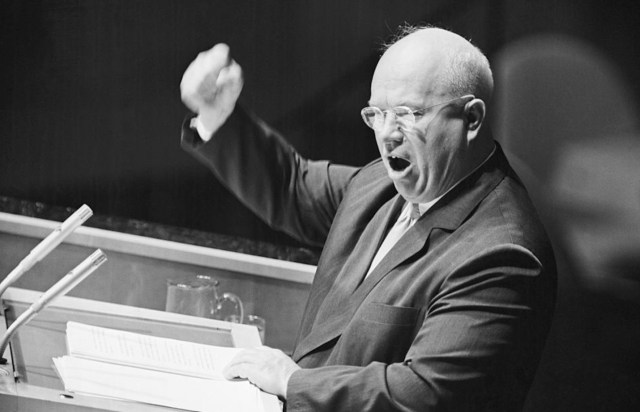
Soviet premier Nikita Khrushchev never actually banged his shoe at the UN General Assembly. Credit: Getty





Another year, another United Nations General Assembly that slows traffic to a crawl for ordinary New Yorkers. They (and many other Americans) ask: what’s the point, beyond global political theater?
For much of the 20th century, the answer was: a glimpse of humanity’s political future. Long before the body’s creation, H. G. Wells imagined the eventual emergence of a world state, arguing that technological interdependence and the destructiveness of modern war would ultimately make the old system of competing sovereign states untenable.
The advent of nuclear weapons made such predictions appear urgent. Albert Einstein became one of the most prominent postwar advocates of world government, warning that “there is no [other] possibility of control of the atomic bomb.” In his 1961 Inaugural Address, delivered a decade and a half after the United Nations was established, JFK described it as “our last best hope.” New Yorkers of a certain vintage will remember the UN flag flying next to Old Glory at their public schools.
The expectations made their way into midcentury popular culture: a powerful United Nations, with its own army, oversees interplanetary colonization in many of sci-fi master Philip K. Dick’s novels of the 1960s and ’70s; Star Trek likewise took it for granted that future politics would belong to a planetary federation.
Whether utopia or nightmare, world government seemed inevitable, and the United Nations looked like its beginning. How things change. Today, the United Nations looks very different from the 20th century’s imagined world state. The annual General Assembly still draws world leaders, but midcentury-style “world government” seems like a distant dream.
But that’s not such a bad thing. When the United Nations tries to reach deep inside how individual sovereign states are governed — what’s implied by true “world government,” as imagined by barmy midcentury visionaries — resistance to its authority waxes, and the real-world outcomes are often disastrous. The better path is for the United Nations to embrace its current, more limited role as a symbolic forum for sovereign states.
The theater, in short, is precisely the point. While many once saw within the UN Charter an opportunity to transcend the nation-state, the body produces its best results when affirming the sovereignty of its member states, not superseding them.
For years, the United Nations has been the subject of critiques from both ends of the political spectrum. On the Left, the core critique is that the organization is nothing more than a veil for American imperialism. As Noam Chomsky says, “the UN is considered favorably to the extent that it follows US orders.” From the Right, the United Nations is disparaged for being either all-powerful or politically impotent. After serving as Ronald Reagan’s UN ambassador, Jeane Kirkpatrick, writing for the Heritage Foundation, claimed that the UN was “too bureaucratic, too remote, and too difficult to hold accountable, too involved in issues unrelated to our interests.”
More recently, a February 2025 executive order from President Trump claimed that UN agencies have been “infiltrated by members of groups long designated … as foreign terrorist organizations,” and that UN employees “were involved in the Oct. 7, 2023, Hamas attack on Israel,” building upon a 2024 Israeli accusation (for which scant evidence has been provided).
So does the organization have a purpose in the year 2026, or should it be sent to join its short-lived predecessor, the League of Nations, in the graveyard of failed international projects?
Like the league, founded in the wake of the Great War, the United Nations was born from the devastation of a world war. The original wartime conception of the United Nations enshrined the four great Allied powers of World War II — Britain, the United States, the Soviet Union, and China — as permanent members of what would become the UN Security Council, with France added postwar. With these five states holding veto power over the council’s resolutions, the United Nations was constrained by the rivalry of the Cold War.
As historian Mark Mazower notes, the United Nations did not emerge “like Aphrodite … from the Second World War, pure and uncontaminated by any significant association with that prewar failure, the League of Nations.” Those responsible for creating the body were not only heavily influenced by the league’s structure and mission, but also carried forward many of its institutional practices. The league’s mandates system, for example, provided an important precedent for the UN trusteeship system, which assumed responsibility for territories transferred from the defeated German and Ottoman empires. Indeed, many of the institutional arrangements through which the league had sought to manage and legitimize empire survived into the United Nations.
These imperial links create an interesting duality around these institutions. The United Nations was initially designed in ways that accommodated, and often protected, the interests of the existing colonial powers. Over the following decades, however, the same institutional machinery became an important vehicle through which anticolonial states challenged imperial rule and advanced the principle of national self-determination. The history of the UN trusteeship system thus illustrates a broader paradox: an organization built in significant part upon the institutional inheritance of empire became, over time, an important instrument in dismantling it.
Particularly striking is that the United Nations’ first armed peacekeeping force was created in an effort to uphold national sovereignty, not undermine it. After Egyptian President Gamal Abdel Nasser nationalized the Suez Canal Company in 1956, Israel invaded Egypt, and Britain and France quickly followed the Jewish state. The British government was the Canal Company’s largest single shareholder, while French investors held most of the remaining shares. Both governments regarded Nasser’s nationalization as a direct challenge to their economic and strategic position in the region. Their objectives went considerably beyond restoring access to the canal: British and French leaders hoped that military intervention would also bring about Nasser’s downfall.
Soviet supreme leader Nikolai Bulganin quickly threatened to join the fray on the side of Egypt, warning that the Soviets were “full of determination to crush the aggressor and re-establish peace in the East by using force,” while also making a pointed comment about Britain’s inability to defend itself from “modern weapons.” The Americans also objected to the invasion. Then-Vice President Richard Nixon later summarized the contradiction facing Washington: “We couldn’t, on one hand, complain about the Soviets intervening in Hungary and, on the other hand, approve of the British and the French picking that particular time to intervene against Nasser.”
London and Paris both vetoed a Security Council resolution demanding that Israel withdraw its military on Oct. 30, then joined the invasion the following day. An emergency session of the General Assembly quickly convened and established the UN Emergency Force, composed of soldiers from countries outside the permanent members of the Security Council, which deployed to the Sinai with Egypt’s consent.
Britain and France agreed to withdraw within weeks, while Israel took longer. The danger that Soviet intervention might transform the crisis into a much wider war was averted, and Egypt’s sovereignty over its territory was restored. When Nasser demanded the departure of UN forces in 1967, they left — as the consent-based character of the mission required. The episode was ultimately consistent with the principle articulated in Article 2 of the UN Charter: that the organization rested upon the “sovereign equality” of its members and that it wasn’t authorized to intervene in matters “essentially within the domestic jurisdiction of any state.”
In the following decades, however, something shifted. Rather than treating state sovereignty simply as a foundational principle of international order to be defended, the United Nations increasingly developed institutions and practices that allowed international authority to reach inside states. Sovereignty became conditional: only states who met the standards of “good government,” as enumerated by the United Nations, could expect territorial exclusivity.
Governments that failed to meet emerging international standards of governance, human rights, or civilian protection could find their domestic authority challenged by international intervention. UN personnel were no longer just establishing ceasefires between states, but also administered elections, supervised police, rewrote institutions, governed territory, and used military force within states’ sovereign bounds. Steadily, the United Nations began to assume those functions that earlier advocates of supranational government had imagined would eventually migrate upward from states to international institutions.
Such interventions have led to a wide range of adverse outcomes, the costs of which have largely been borne by local populations rather than by the United Nations itself. The 1992-1993 UN Transitional Administration in Cambodia, which endowed its high commissioner with the extreme status of “final arbiter of Cambodian law,” has been linked to the spread of HIV in the wartorn country through peacekeepers’ exploitation of Cambodian women and the enormous expansion of the local sex industry that accompanied their arrival. Similarly, the United Nations has admitted its role in the 2010 outbreak of cholera in Haiti, introduced by peacekeepers and ultimately responsible for the deaths of thousands of Haitians and the infection of hundreds of thousands more.
When critics, Left and Right, assail the United Nations, it’s these “global-governance” failures — and many others of the kind — that they have in mind. There is another side of the United Nations, however, that is easy to dismiss because it can look unserious: its role as a stage. This seemingly superficial side is precisely where the institution shines.
Some of the most famous moments in the organization’s history are acts of political theater. Khrushchev banging the desk at the General Assembly and, according to the famous account, brandishing his shoe; Adlai Stevenson confronting Soviet Ambassador Valerian Zorin during the Cuban Missile Crisis; and the like. While such episodes may provoke a chuckle, the spectacle is itself part of diplomacy. The General Assembly and Security Council give states a forum in which to make claims, present evidence, denounce adversaries, rally coalitions, and communicate before a global audience.
Stevenson’s confrontation with Zorin didn’t resolve the Cuban Missile Crisis, but it did give Washington a venue in which to publicly establish its case against the Kremlin, while the actual resolution of the crisis remained a matter of negotiation between sovereign governments. What looks like the United Nations’ weakness — its dependence on argument, rather than enforcement — is also one of the things it was built to provide.
The United Nations is at its best when acting as a forum for states, rather than as a higher authority over them. Some of its most consequential achievements have come not from governing states, but from helping them negotiate rules governing their relations with one another. Nuclear nonproliferation provides an especially important example. The Nuclear Non-Proliferation Treaty created an international framework in which nuclear-weapon states and non-nuclear-weapon states accepted reciprocal obligations concerning proliferation, peaceful nuclear technology, and disarmament. The International Atomic Energy Agency, meanwhile, provided a mechanism through which states could submit to inspections and demonstrate compliance with safeguards. These arrangements didn’t eliminate sovereignty or place nuclear policy under a world government. They instead allowed sovereign states to make bargains that would have been considerably harder to sustain without common rules, monitoring, and institutions.
This more modest role is less dramatic than the world government imagined by Wells or Einstein. However, an institution needn’t govern the world to serve a purpose within it. The United Nations provides states with a place to negotiate, to establish common rules, to monitor agreements, to publicize violations, and to take appeals to the world public. Suez demonstrated what the organization could accomplish when international action reinforced, rather than supplanted, sovereign authority. Arms-control and nonproliferation agreements demonstrate the value of institutions that help states make and monitor bargains without pretending to replace them.
The United Nations may not be the beginning of the world state that Wells and Einstein and Dick imagined. Its more durable achievement may be precisely the opposite: making a world of sovereign states somewhat more capable of living with itself.
Heather Penatzer is a postdoctoral fellow at Perry World House at the University of Pennsylvania and a non-resident fellow at the Carnegie Endowment for International Peace.
 hpenatzer