




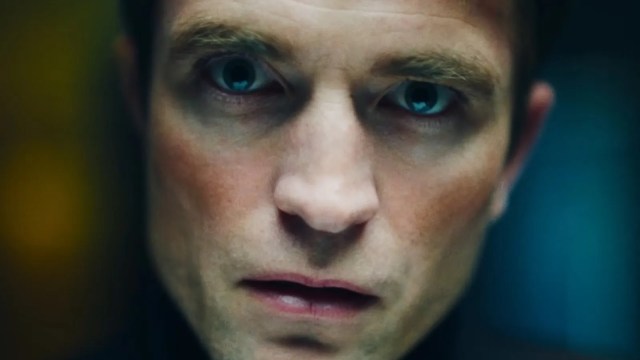
‘Robert Pattinson slips into Hansen’s crisp suit with the A24 film Primetime.’ (A24)





It’s 2006, and a team of paedo-hunters have lured a man to a sting house on the promise of watching a 14-year-old girl molest her cat in an act somehow involving Cool Whip. Their nonce has stripped off naked and run through a room rigged up with cameras where, instead of the kid, he finds Chris Hansen.
This is a classic scene from the NBC magazine show Dateline’s special-report series To Catch a Predator [TCaP], which ran from 2004-7. It was immensely popular, regularly pulling in more than 10 million viewers. Hansen, its lizard-like host, became the entertainment world’s platonic ideal of a respectable reporter, having made his name covering national news stories such as the Columbine High School massacre and the Oklahoma City bombing. With TCaP, NBC had given him a new role: bringer of catharsis, showing viewers their darkest fears embodied in a single paedophile and then bathing him in three-point lighting.
Now the spotlight is being trained on him. The director Lance Oppenheim has slipped Robert Pattinson into Hansen’s crisp suit for his new film Primetime, describing the portrayal of America’s best-loved nonce-buster as “a cross between Jerry Maguire and Dracula”. The film’s screenplay is an adaptation of a 2009 Esquire article headlined “Tonight on Dateline This Man will Die”. The events it described seem, all these years later, remarkable only in that they didn’t happen earlier.
The story runs like this: Bill Conradt, an assistant district attorney from Texas, had been communicating with a decoy posing as a 13-year-old boy. When Bill failed to show up at the arranged house for the sting, police and the NBC crew went to him. After they broke into his home, he shot himself in the head — all of which was captured on film, along with audio of his last words. A lawsuit brought by his sister against the network — settled out of court — alleged that after the gunshot, a police officer turned to a producer and said: “That’ll make good TV.” The county’s district attorney would go on to call this police department “the most incompetent bunch of buffoons you’ve ever seen”; they bungled the raid, he suggested, because they wanted to impress the folks at home watching television.
Rather than simply filming police work, the show’s selling point was that the network would help organise the stings themselves. TCaP used a group called Perverted-Justice to identify and lure suspects; the activist body was founded by Xavier Von Erck, whose initial aim was to post unedited chat-logs between predators and decoys online to turn them into local pariahs. From the start, public humiliation was the motivating factor; the administration of justice merely an awkward add-on.
After Conradt’s death, the series chugged on a little longer before it was cancelled. The decoy actor, Dan Schrack, told a documentary last year that he wouldn’t take “$10 million” to relive the events of that night in Texas in 2006. Hansen, on the other hand, told a reporter two weeks after the suicide that “I sleep well at night”. Sniffier journalists produced condemnatory think-pieces — and the public kept watching in their millions until the show was eventually shelved. When all was said and done, that officer was right: the fiasco had made good TV.
TCaP managed to secure 36 guilty verdicts by early 2007 — though this was only about 15% of the total arrests made by police. Sometimes active investigations were thwarted when suspects caught wind of Perverted-Justice’s ruse and wiped the evidence; sometimes the justice system determined that the men had been entrapped or, as a Columbia Journalism Review column said at the time: “A lot of the men snared aren’t hard-core predators,” and were instead “egged along” by decoys. Many of these same mistakes are still being made by Perverted-Justice’s imitators online today.
For not only has TCaP enjoyed a long afterlife through viral clips on social media, but the show has birthed a mutant genre of vigilante videos which now infest YouTube, Facebook and TikTok. Hometown heroes on both sides of the Atlantic have taken Hansen’s place — working-class men stalking pervs with shaky phone cameras, shouting and swearing at those they’ve honeytrapped on social media. Though less well polished, the grammar of these spit-and-sawdust videos is clearly inspired by Hansen’s show: gathering incriminating messages, arranging a meetup, deploying a decoy and then confronting the predator. It’s all by now grimly familiar.
The urge among some frustrated members of the public to turn the protection of children into moral theatre is ferocious. The status of the paedophile is socially radioactive; almost anything can be justified in the name of his undoing. This is understandable. Unfortunately, the most passionate paedo-hunters often turn out to be the least competent. In 2000, when the justice-as-entertainment format was but a twinkle in Hansen’s eye, vigilantes drove Dr Yvette Cloete out of her home in south Wales when they misunderstood her job title — hospital paediatrician.
Some of the more professional, evidence-led vigilante groups have succeeded in bringing criminals to justice; even in the best cases, though, police find them a nuisance. At their worst, they have actively hampered justice. A Sky News documentary from 2018 shows police officers exasperated by Britain’s vigilante groups, including one band of yelling men in matching red hoodies reading “undercover and expose”. Another troublesome group, which calls itself “Nameless”, uses bad stock photos of faceless hackers and warns “were [sic.] coming for you”. Every so often a nonce on a chatroom reveals they once dabbled in a bit of paedophile hunting themselves. And, just as with Dateline, there are suicides. In 2019, Nigel Sherratt was filmed being told he wasn’t “welcome in the pub… cause you’re a fucking paedophile”. Instead of receiving a fair trial or the appropriate punishment for allegedly arranging to have sex with a 14-year-old girl, he killed himself two days later. His family maintains his innocence.
Today, when nabbing nonces and posting the footage online is a reliable source of income on social media, there is plenty of financial incentive to blunder in. But it’s not just greed that drives this lurid content mill. Mark de Rond, a Cambridge ethnographer who embedded with a group of vigilantes called Cobra (Children Online Battling Real Abuse) from 2018 to 2022, has described such organisations as being motivated by “a narrative akin to the hero’s journey”. To them, being the hunter is a selfless act in service to a community, and in the face of institutional failure: in 2017/18 just 14% of police-recorded child sex-abuse offences in England and Wales resulted in a charge or summons. “Hunters refer to sexual predators as ‘monsters’ and ‘vile beasts’,” he writes; the predator’s monstrosity buffs the hunter’s shine. And yet vigilantes are really serving their own egos: de Rond remarks that they often spend as much time pettily auditing the work of their rivals as they do pursuing paedophiles. And despite the parroted aim of protecting children, “almost all teams value viewing figures and having an audience”.
If Chris Hansen really is the megalomaniacal ratings-chaser that Pattinson portrays, his spiritual successors now slump over keyboards the world over. Primetime depicts him rhapsodising about “cleansing the world of an original evil”, his god complex as poorly concealed as his glee. His mini-mes today also think themselves on the side of good, though their interventions often do more harm.
Since Conradt’s suicide, Hansen has only further burnished his chops for snaring bad guys, working on shows including Hansen vs Predator, Have a Seat with Chris Hansen and Takedown with Chris Hansen. He has questioned “Hollywood’s motive” for making Primetime — though he conceded Pattinson’s impression was “pretty good”, and decided to buy up pre-screening ad slots for his true-crime streaming service TruBlu. This “gollum of network news”, as the New York Post called him, still spies a window for self-promotion.
But perhaps more disturbing is the truth Hansen and his huntsmen reveal about us — we, the viewers, who punch the air or laugh whenever a loser is brought down by a guy in camouflage. Paedo-hunters reassure us of the righteousness of ourselves and our communities: we are the good flock cauterising social ills, annihilating evil, reaffirming our mores. We participate in punishment without getting our hands dirty. It consoles us that the problem is external — even though we know that child sexual abuse is much more likely to be perpetrated by someone known to the victim; even though we know, too, that paedophilia has been normalised in part due to our permissive pornographic culture, one that routinely sexualises youth and taboo. The fantasy of the paedo-hunter is that in humiliating the predator we can fix the society that produced him; in reality, we all live and participate in it every day.
Hansen provided us this relief, this purification, by collapsing the boundaries between journalism and justice; today’s vigilantes collapse those between justice and the mob. And now Primetime is completing the shame circle by turning on the very man who turned child protection into a spectator sport. If the aim of all this were really to protect children, traditional policing would seem the safer bet. The value, if any, of the paedo sting is simply this: it’s one of our culture’s favourite bloodsports.
