




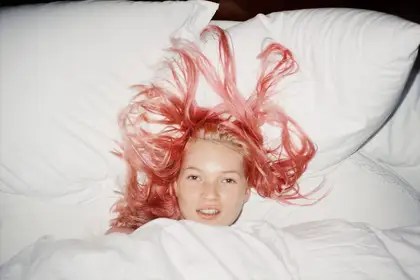
‘One can’t help feeling that it’s feel-good artefacts like this which the paying public will be flocking to see’. (Juergen Teller/Young Pink Kate London 1998/ Juergen Teller, All Rights Reserved)





They say that if you can remember the Sixties, you weren’t there. I’d say that goes for the Nineties too (and in my case, come to think of it, every decade from the late Seventies onwards). Rather like people have observed about the relationship between the Sixties and the Seventies — in which what a few privileged people did in the former trickled down to the masses in the latter — what a few privileged people did in the Eighties went big in the Nineties. Think of cocaine migrating from the Groucho Club to the football terraces.
“The 90s: Art and Fashion”, a new exhibition about the decade, opens next week at the Tate Britain. That it is curated by Edward Enninful may strike one with delight or dismay, depending on one’s opinion of him. There’s no doubt that he knows his onions. He was 18 in 1991, when he became the youngest ever fashion director of i-D magazine. He went on to become the first black, and male, editor of British Vogue, in 2018, and stayed there for six years, during which time he put the preposterous Greta Thunberg on the cover, part of his mission to make the magazine more than a hefty brick composed of photos of expensive frocks and even more expensive advertising.
Yet if Enninful came out with the usual platitudes about how he aimed to bring “diversity” to the institution, it’s a shame that as late as 2018, Vogue didn’t pay its interns, thus seeing to it that only youngsters from wealthy backgrounds and/or with family homes in London could afford to work there. So it is with the awareness of a certain level of virtue-signalling hogwash that one must approach anything “curated” by Edward Enninful.
When we consider the Nineties, most of us immediately think of Cool Britannia, Young British Artists, Brit Pop and Geri Halliwell’s Union Jack mini. It was an unashamedly patriotic time, with the national flag being treated as cool and harmless in a way it hadn’t been since the Sixties; think Harold Wilson’s “I’m Backing Britain” campaign, but featuring pop stars instead of secretaries. But just as every superhero must now have A Dark Side — which seemed kind of interesting the first few times it was done, but now has the heavy hand of Author’s Message with a side-dish of scolding — so must every decade. The Nineties didn’t feel like a dark decade, certainly compared to decades full of foreboding, like the Thirties, or indeed right here, right now.
Yet Enninful’s choices seem determined not to provide simply a fun day out. In the Tate press release accompanying the exhibition, there’s a lot of earnest talk about how Nineties art tackled “agency, identity and class”, and how its artists drew attention “to those excluded largely excluded” from the Cool Britannia zeitgeist. But I’m not sure an exhibition called “Art and Fashion” is a natural prompt for political pondering, let alone reflections on a decade where, supposedly, “hierarchies were dismantled”. Some things are sacred.
The photograph which accompanies most of the advance publicity for the show is Juergen Teller’s 1998 photo of a young Kate Moss lying in bed with only (only!) her face and pink hair showing — and one can’t help feeling that it’s feel-good artefacts like this which the paying public will be flocking to see, rather than Chris Ofili’s Turner Prize-winning tribute to Stephen and Doreen Lawrence.
This, after all, was an optimistic decade, apart from a bit of silly fussing about the Millennium Bug which would make aeroplanes crash from the sky, a fear which seemed to sum up the childish aspect of the Nineties. (This was the decade of the PlayStation console, when grown men with decent degrees from good universities were suddenly quite happy to advertise their addiction to the adventures of Japanese cartoon characters.) There was quite a bit of “joy” about, lots of it chemical — but, despite what the press release claims, there weren’t any “joyful queer club nights”. Back then, “queer” was just an insult which ignorant people threw at gay people, before it became a description which boring people used to make themselves feel interesting.
This was not a self-serious decade, with the ubiquitous “smiley” face gracing the raves where hugging many seemed more pleasant than sex with one. The presence of that consummate performer Tony “Things Can Only Get Better” Blair as prime minister — winning the first of three elections in 1997, bringing an end to 18 years of Tory rule — rubbed this in. This was never clearer than when, at a No. 10 reception for “the talent”, Blair allegedly joked about cocaine with Noel Gallagher. Oasis manager Alan McGee had bunged Labour £50,000, a lot back then, and said, “If I can get a million kids to vote Labour because Noel and Liam have endorsed them then I’ve done my bit”. But things weren’t all lollipops and roses (or cigarettes and booze) for long, with McGee soon grumbling that “if things don’t improve they won’t be getting my money next time”. The fashion designer Wayne Hemingway was equally snarky. “There is a very grave danger,” he said, “that by simply inviting a few (mostly naff) pop stars and comedians to drinkies at No 10, the very people Blair is trying to impress will be turned off.”
It’s never clever, then, to mix the serious with the silly, and that’s what this exhibition seems likely to do. No, the real glory of the Nineties was that there seemed a (now) extraordinary degree of freedom to do and say what one wanted to. State scolding had not become a permanent thing; weather forecasters’ warnings never got more presumptuous than a what-are-you-like snicker of “don’t forget your brolly!” We were not urged to “stay hydrated!” as though the daily commute was a trek across the Sahara, nor taught that a good summer was a harbinger of Armageddon. (The nearest we got to that was Worms Armageddon, a 1999 video game.)
The magazine I co-founded in 1991, The Modern Review (now available to read, mostly for free, on Substack) reflected this; it’s no accident that its editor Toby Young would go on to found the Free Speech Union. Whenever youngsters today are polled about what decade would have been the best to be young in, the Nineties always score high. That’s often associated with freedom from social media, but I think generally also means freedom from thought-policing, even when they’re doing it themselves.
I suppose that even the most self-celebratory of decades looks back in languor at the past and picks out bits and pieces of it. Think of the ultra-modern Beatles, at the height of their Sixties fame, dressed up in their First World War bandsman costumes, or the old-time icons who make up the Lonely Hearts Club Band. But has a young generation ever looked back so hungrily? Jeremy Vine’s daughter got a Smiths lyric tattooed on her arm to celebrate her 18th birthday, with her dad getting the other half: “For there are brighter sides to life/ And I should know because I’ve seen them, but not very often”. Going on to enjoy an excellent solo career in the Nineties — in 1992, he sold out the Hollywood Bowl in 23 minutes, breaking The Beatles’ record — Morrissey is now one of the bold legions of the shunned and cancelled, for saying things that must not be said lest some wet-wipe has the ab-dabs.
I know, of course, that it’s a mistake to say of decades that this was that and that was the other. I remember my fashion friends claiming the Eighties were all about consumerism, while the Nineties were going to be all about thoughtfulness: and that was before the Eighties had even finished. They said this without particular evidence, and for no other reason than that was what they thought should happen when a decade changed. All the same, if I was forced to, I’d say there really was a difference between the Nineties and today. Back then, we were treated as adults yet felt free to behave like children. Now, we are treated like children and feel ground down with the sorrows of adulthood. But there are brighter sides to life — and I should know, because I’ve seen them, and in better places than the walls of an art gallery.
