




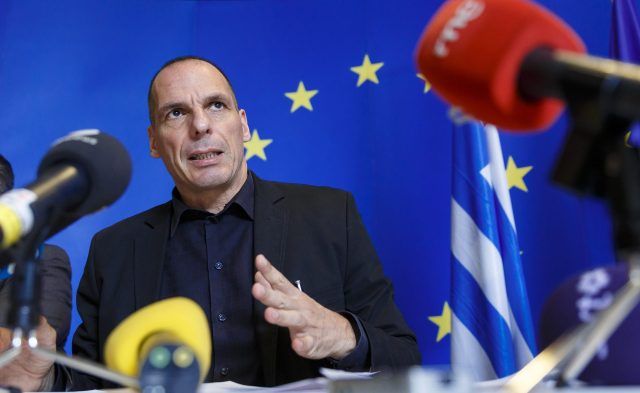
‘Which single compromise would catapult me into the land of the co-opted’ (Thierry Monasse/Getty)





“Only dangerous fanatics refuse to compromise,” my mother used to tell me. And so, several decades later, I entered government ready to compromise; a small price to pay, I thought, for delivering a modicum of relief to the suffering majority who had voted us in. Yet the hardest, and the most pertinent, question kept torturing me: how does one compromise without ending up compromised? Which single compromise would catapult me into the land of the co-opted? For months, I struggled to find the answer, until one revealed itself unexpectedly.
It is an enigma that begets a paradox. On the one hand, trying to pinpoint the pivotal compromise is as futile as trying to seek the single hair that, once lost, admits one into the brotherhood of the bald. On the other hand, just as one glance at me confirms I lack enough hair to count as bald, one glance at Andy Burnham and the vast majority of Europe’s centre-left leaders confirms they are compromised. It is a question that remains pertinent.
But at what point does compromise turn into defection? At what point does practicing the art of conceding judiciously lead one to betray one’s constituency — even to embrace villainy? Indeed, do the villains even know they are villains? Were they aware of a moment when their cascade of compromises finally pushed them beyond the moral pale? I doubt it. The human soul’s capacity for rationalising the vilest of choices is boundless. There is almost no horror perpetrated by one human against another that has not been justified with the principle of the lesser evil.
Interrogate the ghosts of Vidkun Quisling, or his Greek counterpart Georgios Tsolakoglou, and ask them why they agreed to become the Nazis’ puppet premiers in Norway and Greece. They would surely answer that “someone was going to do it”, so it might as well have been them: their complicity was worth the price if it enabled them to shield even a handful of their countrymen from the Nazi menace. That these rationalisations seem laughable in retrospect returns us to the original question: at what point does a sequence of compromises render one compromised?
It was February 2015 when I encountered the sheer banality of Europe’s compromised centre-left leaders. What brought it into sharp focus was the contrast between these hollow men and Wolfgang Schäuble, Germany’s conservative finance minister and Europe’s high priest of stringent austerity. He was ruthless yet cogent; analytically weak yet intellectually honest; coarse yet comfortingly self-assured. He would say outrageous things, such as “elections cannot be allowed to change economic policy in Europe”. But there was a candour in his delivery and the sense that he was describing the world as he truly saw it.
Then came the drudgery of the centre-leftists.
First up was Michel Sapin, France’s finance minister and long-time Socialist Party hack. After embracing me like a brother-in-arms, waxing lyrical about my anti-austerity stance and promising that we would “walk together” to return Europe to the “path of growth”, he led me to the nearby press conference. There, in front of the gathered media, he underwent an instant metamorphosis. Gone was the bonhomie, the common purpose, the condemnation of austerity. Instead, wagging an accusatory finger at me, he out-Schäubled Schäuble with a paean to “discipline” and belt-tightening. Once we were alone, he turned all sweet and comradely again. I stopped him in his tracks, looked him in the eye and demanded to know: “Who are you and what have you done to the Michel I met an hour ago?”
A series of depressingly similar meetings followed only days later, in Berlin. First with Sigmar Gabriel, the leader of the German Social Democratic Party (SPD), then with a delegation of parliamentarians representing the German Greens. The worst part of those meetings was not what was said; it was that it was clear they did not mean a word they uttered. And along with the lack of conviction, their banal musings betrayed a complete absence of intellectual backbone — there was no real proposition to disagree with or argument to logically refute.
Leaving those meetings, I wondered how it had come to this. How had the SPD, a party with a history of transforming Germany into a functioning social democracy, ended up with a leader so banal and vacuous and ready to defer to someone like Schäuble? How had the Greens, who in the Seventies had shaken us out of our complicity with the ongoing ecocide, ended up parroting lines that were as boring as they were toxic?
My theory of the centre-left’s long suicide begins in 1971, when Bretton Woods was killed off by the Nixon shock. Back then, Europe’s and Britain’s social democrats used to play the role of go-betweens. Once in government, they would gather the captains of industry and the trades-union leaders around a table where a deal would be struck: a chunk of industrial profits would fund the welfare state and another would be returned to workers in the form of better wages and conditions. However, when Bretton Woods died, money and power shifted from industry to finance.
By the late Seventies, it was pointless to sit the failing industrialists and the leaders of the dwindling trade unions’ around that table. In a world beholden to bankers and traders, the only meaningful bargain that could be struck was one between ministers and financiers. It was a Faustian bargain. Tony Blair in London, Jacques Delors in Paris and then Brussels, Gerhard Schröder in Berlin… all of them offered the bankers permission to go berserk in exchange for sizeable crumbs from their table with which to fund the welfare state — and, lest we forget, their election campaigns. That’s how social democracy limped on until the crash of 2008.
When, in the autumn of that year, the banks went under, those social democrats in power didn’t know what had hit them. Lacking both the analytical capacity to understand the crash and a moral spine to stand up to the financiers, they bailed out not just the banks but the bankers too. The result was austerity for the masses and “socialism” for the bankers, a collapse in investment and a never-ending slump. From that moment onwards, social democracy was on a slippery slope to electoral, ethical and political oblivion.
I wrote about it all in my 2011 book, The Global Minotaur. But it was one thing to have formulated a theory, and quite another to see it written across the centre-leftists’ faces in 2015: the defeat, the compromise, the banality. I remember the feeling as my aeroplane lifted off from Berlin, carrying me back to Athens and to a parliament in which a Nazi party was the third largest: the result of discontent engendered by years of mindless centrist austerity. And I remember how, suddenly, I thought of Fiona.
My first memory of her was when she heckled me, in 1980, during a boisterous students’ union meeting at Essex University. A graduate anthropology student, she believed that everyone, Left and Right, were at it: coveting unfettered power wherever we could get it. Fiona feared that Leftists, like her and me, folks who could not wield power in the City or in Whitehall, sought it instead in students’ unions, socialist groupings, feminist organisations even. Her intense disapproval of me was systemic, not personal. Which is why we became friends.
About a year after our first encounter, I found myself at one of the countless anti-Thatcher gatherings taking place around that time. By coincidence, Fiona was there too, billed to speak. After enduring two hours of tiresome speakers denouncing Thatcher’s social and industrial vandalism, Fiona rose to speak. She was magnificent:
“While listening to the previous speakers, I was thinking to myself: ‘Give me Maggie Thatcher any time! Unlike you, Maggie gets it. We live in a revolutionary moment. The postwar class-war armistice is over. If we want to defend the weak, we can’t be defensive. We need to advocate as she does: out with the old system, in with a brand new one. Not Maggie’s dystopic system, but a brand new one nevertheless. You lot are bandaging corpses while she is digging graves. If I had to choose between you and her, I would choose her every time. Monstrous as she is, Thatcher can at least be subverted. You wouldn’t recognise subversion if it came at you with a barge pole.”
Her words resounded in my head on that flight in 2015, reminding me why I found my meetings with Schäuble so much more rewarding than encounters with the centre-leftists who were “bandaging corpses” while Schäuble was “digging graves”. Besides the relative joy of conversing with people who mean what they say, there are both short- and long-term reasons why I, as a proud Leftist, prefer self-confident Right-wingers in government to a band of defeated centre-leftists.
Rather than a bunch of compromised pseudo-progressives bandaging some of the walking wounded, I would far prefer to have a Norman Tebbit in power, callously instructing them to “get on your bike”. An unbowed, self-respecting Left would respond by telling the bankers, the spivs and the oligarchs to get on their bike. Alas, the compromised Left does not do this. Instead, it fans a false hope in the hearts of the suffering majority with their empty promises to look after them. That hope is bound to crash on the shoals of reality. And then? Having lost trust in both the centre-right and the centre-left, the electorate has nowhere to turn but the demagogues promising to make them “great again”, to weaponise the border fences, to prepare for war against non-existent enemies, to target the “other”; the Muslim, the Jew, the disabled, the brown people who “pollute” the gene pool.
Andy Burnham’s new government is a case in point. Having ridden into No. 10 on a wave of hopeful vibes, his unwillingness to clash with the fat cats responsible for Britain’s stagnation will deliver another Budget that taxes the overtaxed and punishes the weak. Thus, the road will have been paved for the fascists to further infect the majority’s broken hearts. Whether this will be Reform, Restore or some even more radicalised Tory party, only time will tell.
Naturally, centre-leftists chastise my unwillingness to support them, painting me as a handmaiden of the Right. I would reply that the Left has a duty to remain in opposition until we get our act together; until we have a plan and a mandate for unseating the oligarchy and implementing a workable, progressive agenda. It is better to be in opposition keeping genuine hope alive, while the establishment Right rampages in government, than for the compromised Left to win power on false promises that are bound to extinguish hope and usher in postmodern varieties of fascism.
It was this thinking that led me, six months after being sworn in as Greece’s finance minister, to resign — knowing full well I would be demonised and confined to the margins of the political system. It was a no-brainer. Remember the question that was torturing me from the first day in office? Would I be able to recognise the lethal compromise that led me to the land of the co-opted?
In the end, it was not hard to recognise. It came when I was told I had a choice: my political career in exchange for signing on the dotted line of an application for a huge credit card (from which the Greek state would draw, to pretend it was repaying its debts); a credit card that would be issued on condition of another austerity package condemning 80% of our people to long-term debt-bondage. I did not sign. But most of my colleagues in that Leftist government did. The result? That party, Syriza, no longer exists, the recalcitrant Right is dominant, and the fascist Right is surging.
Ultimately, the compromised Left anesthetises hope, paving the way for reactionaries of the worst kind. Better be an honest opposition to a Rightist government than a compromised Leftist whose policies breed monsters. This is not a resignation from the aspiration to govern. It is simply a clarification of one thought: the only compromise worth making is the willingness to give up power rather than sign away a people’s future.
Yanis Varoufakis is an economist and former Greek Minister of Finance. He is the author of several best-selling books, most recently Raise Your Soul! A personal history of resistance.
 yanisvaroufakis