




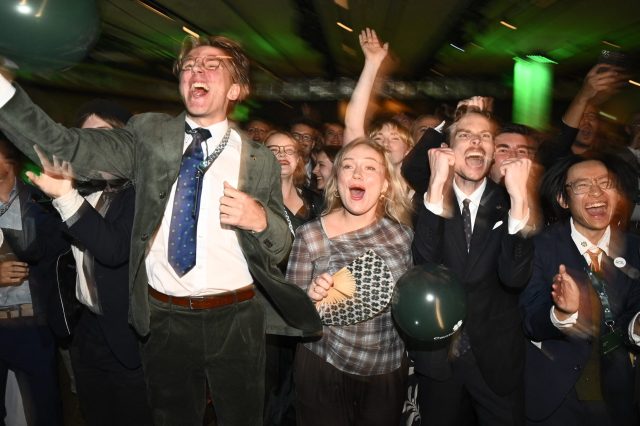
The Centre Party celebrate the exit poll. (Fredrik Sandberg/Getty)





2006. Two decades ago, and the year of the first Swedish election I was eligible to vote in. Yet more than a personal milestone, the vote was to become one of the most monumental elections in the country’s postwar history, as the Moderates defeated the Social Democrats and broke the centre-Left’s nearly uncontested hold on the Swedish state. After 2006, the Social Democrats would never again be the nigh-invincible juggernauts they had once been — the long-time consequence of that election was to make them just another political party.
Compared to the election of 2026, the difference is like night and day. Though 2006 was, in essence, a true watershed election, one that ended an entire political era, the political rhetoric of the day hardly reflected it. Back in those days, the campaign saw genuine debates about the policy differences between the major parties, as the Moderates, restyled the “New Moderates” by their then-leader, angled to make the case that Sweden’s old social-welfare model had become stultified and unresponsive, and that the Social Democrats themselves, so used to automatically gliding into power every election, were unwilling to reform. The most famous Moderate slogan from that election was “Det Nya Arbetarpartiet” — literally branding themselves as Sweden’s new (and only) working-class party.
Today, by contrast, elections in Sweden bear increasing resemblance to the electoral process of the United States, right down to the political rhetoric used by both sides. In 2026, after all, both political blocs were eager to dub this election the most important, most critical, most life-and-death election in history. If the evil Right-wingers won, fascism and darkness would descend on all and sundry, and there wouldn’t even be a Sweden left come 2030. If the crazed leftist Islamo-Marxists won, meanwhile, tens of millions of immigrants would descend on the country; no election would ever be winnable again due to changed demographics; being heterosexual or white would soon be punishable by death; and Sweden would shortly become Europe’s first Islamic emirate.
Of course, the problem here is that the “evil Right-wingers” have been in power for the last four years. Despite some internal drama, the four parties that make up the so-called “Tidö government” — the Moderates, the Liberals, the Christian Democrats and the Sweden Democrats — have ruled the country largely without incident, and certainly not with jackboots sounding in the distance. Some things, like food-price inflation, have certainly got worse, but it’s hard to blame that on any specific policy. Meanwhile, big planks of the 2022 election, like massively expanding Sweden’s fleet of nuclear power plants, have quietly been thrown overboard in the last few years. But, again, there is no reason to think anything would have been different had the so-called “Red-Green coalition” been in power instead.
Certainly, it’s unsurprising that electoral participation actually plummeted this time round. The figures, with turnout in the eighties, would, of course, be impressive in many other countries. But for ultra-democratic Sweden, this is one of the lowest figures since the Second World War. The point, of course, is these figures hit up against the electoral rhetoric. If the future really was at stake, and this really was the last election before migrants or fascists destroyed the state, why did fewer people than ever bother to vote?
The answer is probably structural. In Sweden, just like in America, the louder the pundits’ voices, the less elections actually seem to matter in terms of hard policy. Nobody talked about the looming end of the Swedish democratic system or nation in 2006, but the choices on offer were actually meaningfully different. Today, though, those meaningful differences are becoming rarer and rarer. Consider the American example: as the Trump campaign put it in the lead-up to the 2024 election, a vote for Kamala Harris was a vote for sending America’s sons and daughter to war against Iran, and a vote for ruinous price inflation and unaffordable gas at home. To be fair, that description is probably true as far as politics under a Kamala Harris presidency would have turned out. Unfortunately, the idea that Trump was against these things turned out to be a huge lie. No matter which side you picked, the end result was the same.
This dynamic seems to have spelled the end of the current Tidö government. It came into power with much fanfare, promising a drastic reduction of immigration. Yet critics are today quick to point out that little has changed in terms of migrants granted citizenship. And, indeed, even as a government of the Right looks slated to be replaced by a government of the Left, the chances of anything meaningfully changing in the other direction look very slim as well. The number of granted asylum applications may have diminished, after all, yet other forms of migration — for family reunification or labour — have picked up the slack. Other policy differences between the political blocks, notably attitudes toward Natos, have been retired too. One way or another, business as usual looks set to continue.
One doesn’t need a crystal ball to make that prediction in 2026: the general trend in Europe is that little will change whoever you vote for. Once again, that’s clear on demographics. Boris Johnson promised to cut down on immigration: what he delivered was the “Boriswave”. Giorgia Meloni, the current Italian prime minister, belongs to a party that traces its history back to the Italian fascists. Yet despite these august credentials, Meloni’s tenure in power has seen her quietly increase migration. The structural reasons for this aren’t hard to understand: Italy’s demographics are terrible and the country has long been plagued with financial woes. No matter how much Meloni might rage against immigration rhetorically, her deeds aren’t particularly different from anyone else. Perhaps a figure to Meloni’s Right — such the former army officer Roberto Vannacci — would finally change course if voted into power. But the question one has to ask here is simple: why didn’t Meloni do it?
Perhaps our political classes have simply given up because the problems are too intractable. It wouldn’t exactly be shocking if that was the case, and it would mean that America and Europe are in the same boat. Consider the fact that, less than two years ago, the second Trump presidency promised to fix the deficit, reindustrialise America, and cut huge amounts of waste from the budget. Back then, DOGE was at the top of the news cycle, for good and for ill. Today, that organisation no longer even exists. Americans, after trying to fix the national debt or stop the forever wars in the Middle East, simply gave up. It was too hard to change anything meaningful. The same might be said of the Europeans and migration: trapped by the remorseless logic of globalisation and with native birthrates that simply refuse to go up. Amid these seemingly intractable challenges, why not grant another few thousand visas? Voters are perhaps to blame here too, unwilling to countenance much change, whatever they might claim in vox pops.
Whatever the cause of this malaise, in it we can spot the paradox of European politics in the 21st century. We can all clearly see that monumental, historical changes are happening. Wars and energy shocks rage all around us, deindustrialisation and demographic problems keep getting worse and worse, and yet everyone seems too afraid to do much beyond shouting, with the rhetorical temperature seemingly rising in inverse proportion to actual policy solutions. But as the American economist Herbert Stein put it, things that cannot go on forever simply won’t. If fixing pensions or finding a new geopolitical strategy or addressing the deficits is too hard for anyone to make the attempt, there will eventually come some sort of crisis that forces the change that politicians have been avoiding.
Unlike 2006, the election of 2026 was heralded the most important Swedish election of our lifetimes — if not the most important election ever. Every election these days seems to be the most important election ever, of course, and just as in America or the United Kingdom, the more important an election is, the less anyone expects anything to actually change. But as the Middle East burns and an energy crisis the likes of which we haven’t seen since the Seventies approaches, the age of business as usual may be ending sooner than many people think.