





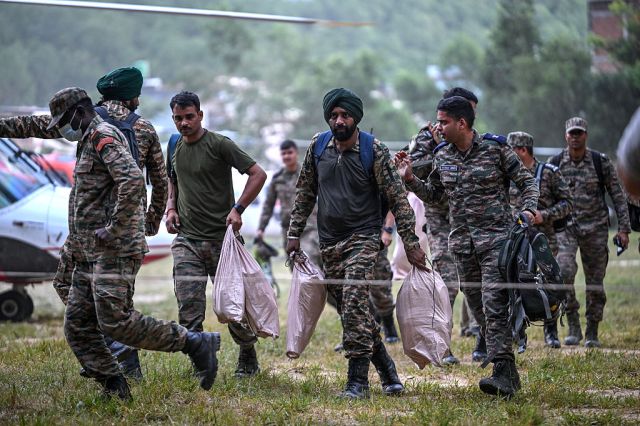
A child rescued from the floods is treated at an army-rescue camp. (Ritesh Shukla/Getty)





It is an article of progressive faith, and I timidly count myself among the faithful, that the green transition is necessary for our survival as a species. On this point, reality has been unusually obliging this summer. Canadian forests burn beneath skies the colour of an Algonquin School sunset, and now Toronto can smell the smoke. Across the Pacific, atoll states from Tuvalu to Kiribati contemplate whether a nation can retain its sovereignty after the ocean has swallowed its territory. Meanwhile, in the Himalayas — where glaciers feed the Indus, Ganges, and Brahmaputra, and thus, indirectly, the hundreds of millions of South Asian souls — ice accumulated since long before the early Mughals crossed the Khyber is disappearing. And in Nepal this week, the Himalayas appeared to come apart. Ice and bedrock tore loose from the high mountains, thundering into the valleys below and turning rivers into moving walls of water.
The fundamentals here are not hard to grasp: the earth is warming at an alarming rate thanks to our prodigious appetite for fossil fuels. What follows, then, is not climate denialism, but a reminder that the green transition has a class system. At its upper reaches everything is agreeably frictionless. From the edgier neighbourhoods of Western chancelleries, its future can look positively convivial: solar panels on the roof, an electric car at the kerb, an oat cortado in hand and a bottle of pét-nat chilling for later. Consumption becomes cleaner, the carbon footprint contracts, and modern life proceeds much as before, only with improved appliances. At Davos, the same transformation is rendered in the more desultory language of targets and taxonomies. Yet it is somewhere farther down the class pyramid that the gigawatts are actually made. There, at the bottom of the pecking order, the lower orders drill tunnels, pour concrete, mine copper, string transmission cables, drive trucks in interminable nocturnal capers, and climb inside power stations when rivers rise.
Decarbonisation appears in prospectuses bedecked in green; but the labour behind it remains blue-collar. Émile Zola, whose coal mining opus Germinal (1885) ends with miners drowning underground, would have instantly recognised the arrangement. Nearly a century and a half since its publication, the fuel has changed and the carbon ledger has improved, but the labourer is still in the tunnel.
In Nepal last week came a grim illustration of this new class divide. On 26 August, near the Tibetan frontier, a sizeable chunk of Himalayan ice detached itself from the mountainside, plunging with such violence that the impact seismically registered on the Richter scale. Rock, ice, water, boulders, and pulverised mountain were funnelled through Nepal and Tibet, where, in scarcely half an hour, the swollen Trishuli River began consuming the valley around it. Roads disappeared, then bridges, and helicopters were obliged to perform duties ordinarily entrusted to highways. An impressive rescue operation managed to save 11,800 people, even as over a thousand perished, with a further 4,500 missing.
Farther down the valley, a rather more hopeless story was unfolding. A dozen hydropower projects were struck, and, at the time of writing, around 900 workers remain unaccounted for. Reports say that 500 of them are still in tunnels, awaiting rescue. Indian specialists have joined Nepali soldiers, while China has sent drones and DNA-testing kits. Meanwhile, some 700 megawatts of generating capacity, roughly a tenth of the national total, has been lost. Nepal has spent two decades transitioning to clean energy, in the main by turning Himalayan water into electricity. It is a bleak irony that the men building this green future have now been buried under it.
For Kathmandu, hydropower was never simply an environmental policy. The dream long pre-dated the climate transition. In 1966, the Nepali engineer Hari Man Shrestha, armed with a Moscow doctorate, calculated that the torrents tumbling off the Himalayas contained some 83,000MW of theoretical generating capacity. Later estimates reckoned roughly half of it commercially exploitable. Here was an intoxicating proposition for a poor, landlocked country with few conventional energy resources and an energy-hungry giant to its south. So it was that in 1992, the government formally opened hydropower to private and foreign capital, explicitly envisaging electricity for export. A power-trade agreement with India duly followed five years later. By the following decade, politicians and developers were talking of Nepal as the “hydropower battery of South Asia.”
As it was, for decades, the battery remained uncharged. As late as last year, Nepal’s installed capacity was roughly 3,400MW, still a fraction of the old 42,000MW dream. Now, however, the dams are going up quickly. India has agreed to buy as much as 10,000MW over a decade, while Nepali electricity already travels through the Indian grid to Bangladesh.
This was no minor achievement for a small nation, wedged between two capricious giants, chronically deficient in merchandise exports, and accustomed to its best workers emigrating to more hospitable economies. Clean energy was a ticket out of poverty and dependency. The rivers promised electricity and reindustrialisation, foreign exchange and domestic jobs. Some of the more utopian Nepalese mandarins even imagined that, after sufficient megawatts, the old hierarchy of landlord and peasant would give way to the more benign modern compact of engineer and technician. In short, the green transition was industrial policy, foreign policy, and class conciliation all rolled into one.
The latter, in particular, was a big deal. Nepal has spent the past generation accomplishing political revolutions rather more efficiently than economic ones. The Maoist insurgency began in 1996 among the impoverished populations of the western hills, where feudalism was still very much a lived reality; by the time the guns fell quiet a decade later, some 17,000 people were dead. The Maoists finally entered government in 2008, abolishing the 240-year-old Shah monarchy and installing their former guerrilla commander Pushpa Kamal Dahal – better known by his revolutionary sobriquet Prachanda, “the Fierce One” – as prime minister.
Republican Nepal had its achievements. Extreme poverty fell precipitously — the share of Nepalis living below the World Bank’s $3-a-day poverty line falling from 22% in 2011 to 3% in 2023. Caste discrimination was outlawed, representation widened and public services improved. Nepal also developed an Italianate — or dare one now say, British — appetite for changing governments. By 2024, there had been fourteen prime ministers in about as many years. Meanwhile, far-Left factions multiplied with a fecundity to rival Marx (father of seven). Maoists joined Marxist-Leninists; Marxist-Leninists embraced their centrist enemies of old, discovering the novel attractions of cabinet office. At one point, the country counted 25 different communist parties — all very People’s Front of Judea versus Judean People’s Front. As the Nepali political scientist Krishna Khanal observed: “Ironically, there are no communists in Nepal even with an abundance of Communist parties.” With the revolution over, the new political caste settled into the more temperate business of coalition arithmetic, familiar enough to any observer of the South Asian scene.
For all these Communists, however, the lower orders remained obstinately lower. Nepal had abolished its king, survived a civil war, and installed former revolutionaries in the Singha Durbar, Kathmandu’s neoclassical seat of power. But what failed to materialise was sufficient productive work for the working classes in whose name all this had taken place. Capitalism here appeared with peculiarly Nepali characteristics: the country’s most dependable export is its own proletariat. After a decade-long People’s War, the people are still obliged to go look further afield for work: at the 2021 census, 2.2 million Nepalis were living abroad, representing around 7.5% of the population. Remittances — money that foreign-based workers send back home — still supply around a quarter of GDP and reach well over half of households. Youth unemployment has hovered above 20%; many find work in the black market. The IMF calls the resulting dispensation a “low-trust, low-investment equilibrium.” Put less decorously, Nepal cannot employ enough of its people, so they leave at a rate of roughly 1,700 per day to earn poverty wages building stadiums in the Gulf and operating factories in Malaysia, which they then send home to their pensionless families. Hydropower was meant to break this cycle. If the Maoists had failed to emancipate Nepal’s proletariat, perhaps the megawatt would.
This is not an appealing social contract and something eventually had to give. It did so last September, when Prime Minister KP Sharma Oli — of the Communist Party of Nepal (Unified Marxist-Leninist) — decided to ban 26 social-media platforms. Nepal’s Gen Z had spent years unemployed or watching friends depart, while the offspring of Communist grandees displayed designer handbags and holiday snaps. On 8 September, security forces opened fire on protestors marching on parliament, killing nineteen in the first crackdown. The people of Kathmandu answered the following day with riots and attacks on politicians’ homes. By the time the upheaval subsided, at least 76 people were dead, and some 2,300 injured. Oli duly resigned. Having successively tried kings and communists, Nepal plumped for a rapper. Balendra “Balen” Shah — engineer, hip-hop artist, independent mayor of Kathmandu, scourge of illegal buildings, and habitual wearer of dark glasses — had spent his musical career rapping about corruption and unemployment. He cannily declined the interim premiership, waited for elections and, in March, demolished the septuagenarian Oli in his Jhapa-5 constituency. His Rastriya Swatantra Party duly swept parliament.
Six months later, the rapper-ruler has inherited a disaster, and, with it, an uncomfortable lesson in political economy. Contrary to liberal assumptions, decarbonisation does not abolish class relations merely by altering the fuel. To be sure, a dam may emit less carbon than a coal-fired power station; yet it still has owners, creditors, contractors, engineers, and labourers, and they do not share its attendant dangers equally. It is Nepal’s hydropower proletariat who drill and blast through unstable Himalayan rock, working underground among explosives and sleeping beside the river systems being harnessed for Indian, Bangladeshi, and Nepalese electricity.
Shah has responded vigorously enough, mobilising the army and hospitals while accepting Sino-Indian assistance. His government has also, understandably, reached for the language of climate justice, seeking compensation from the richer, heavier-emitting powers for the costs of a catastrophe Nepal did vanishingly little to cause. Yet the workers entombed in Nepal’s hydropower tunnels expose a less convenient injustice: the fault line runs through Nepalese society as well as between Nepal and the carbon-rich West.
The green transition promises to transcend carbon. But, as Nepal shows, it cannot quite transcend class. As trillions are poured into dams, grids, batteries, mines, and transmission lines, the old question of who profits, and who is placed in harm’s way, merely acquires new terrains.
The independent producers who now generate roughly two-thirds of Nepal’s hydroelectricity are the toast of the Kathmandu financial press. Their workers understandably occupy the less photogenic end of the boom. At the Tanahun project, a 2025 study found barely two-thirds observing adequate safety practices, amid reports of electric shocks, musculoskeletal disorders, and skin disease. Meanwhile, at Upper Tamakoshi, injuries were significantly more common among men working inside the tunnels than among those above ground. None of this, of course, caused last week’s glacial collapse. Yet once a warming and geologically unstable mountain range becomes a workplace, natural hazard acquires a class dimension: someone must be sent underground; some regulation decides what protections follow him there; and some state authority must possess the machinery to retrieve him when the mountain moves.
Marx, whose ideas have enjoyed a rather eventful afterlife in the Himalayas, would have found 21st century Nepal a familiar place. His account of commodity fetishism turned on the way relations between people come to assume the appearance of relations between things. It followed that the finished commodity confronts us as an object complete in itself, while the social relations, not to mention the labour that produced it, recede from view. Something similar afflicts the modern imagination when it comes to clean energy. We see the turbine, the solar panel, the electric car. Less visible, however, are the Congolese cobalt miner, Chilean copper worker, Chinese solar-factory hand, and Nepali tunneller beneath the Trishuli — until, that is, disaster strikes, making the class relations concealed inside the innocent abstraction of the “green transition” suddenly impossible to miss.
Pratinav Anil is the author of two bleak assessments of 20th-century Indian history. He teaches at St Edmund Hall, Oxford.
 pratinavanil