




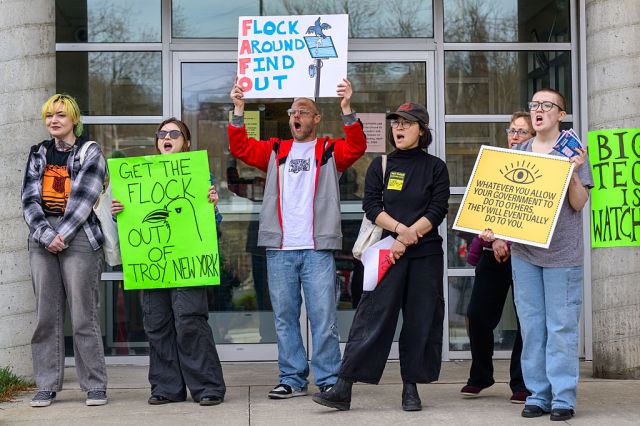
Flock the system. (Jim Franco/Times Union/Getty)





“My understanding is the cameras are only on the highways,” warbles Laurene Weste, the placid silver-haired mayor of Santa Clarita, California. “Noooooo!” erupts the crowded conference room, peopled by weebish Zoomers dressed in red. One brandishes a copy of Nineteen Eighty-Four. “They’re not in front of homes…” she protests. “They are!” yell the groundlings. You’d half expect to see a rotten tomato sailing into frame.
This is one of many now-viral scenes (this particular video has 623,000 views and counting on TikTok) of protests by De-Flock Santa Clarita Valley, a group seeking to force the city to scrap a $120,000 contract with the tech firm Flock Safety. Flock cameras are automatic licence-plate readers (ALPRs), which photograph passing numberplates and use AI to track the movements of cars. These are compiled into a searchable database and made available to police; around 40% of US forces have contracts with Flock, and there are an estimated 130,000 cameras across the country. The firm’s mission is straightforward: to make legible the normally invisible movements of cars to punish and prevent crime; the denser its network of cameras, the more effective the technology.
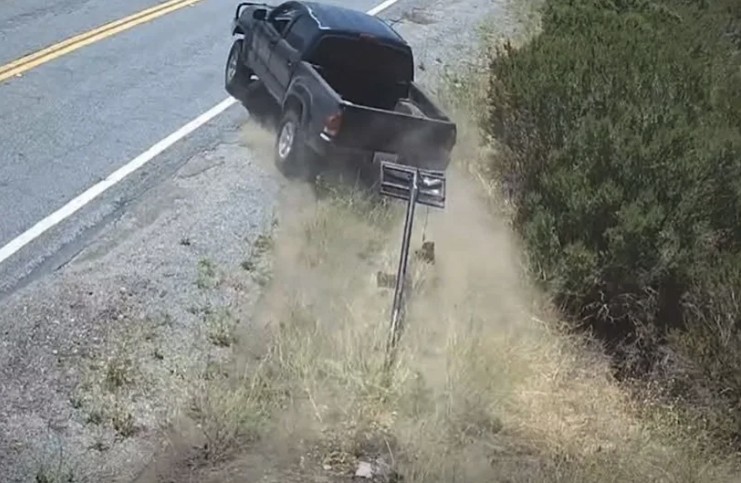
But a pushback is afoot, and not just in Santa Clarita. Cameras have been cut down in Houston, Dallas and on Long Island; Michigan, Connecticut and Oregon have also been targeted. In Englewood, Colorado, the city council unanimously axed its 12 cameras last week over data-privacy objections. Similar votes have taken place in Rhode Island, Santa Cruz and Cambridge, Massachusetts. We’ve also seen apparent anti-Flock vigilantism on TikTok, in the form of videos of masked men with bolt cutters. The commenters are conspiratorial, furtive: they share photographs of “really suspicious cars” parked nearby, or covert advice: “Whatever you do DON’T buy a cheap green laser and point it right at the camera.” If all this sounds a little tinfoil-hatted, it’s worth remembering that the cameras do have the federal government’s backing: with characteristic flippancy, President Trump says “I sort of like ‘em”; “they catch a lot of criminals”.
It makes sense that Trump would embrace the technology. Though Flock does not overtly partner with ICE, it seems the immigration agency can access the data simply by asking police to search on their behalf, according to investigations by 404 media. The same website also found that Texas police had searched Flock cameras for the whereabouts of a woman suspected of having self-administered an abortion (made illegal in 2022). The tech suggests we have nothing to fear if we have nothing to hide; naturally, this doesn’t wash. Being so closely tracked without public consent feels like a violation to an American public which is otherwise constantly told to protect its “digital hygiene” — changing passwords, updating software, using multi-factor authentication in an endless battle against shadowy hackers. Flock asks us to relinquish control over the focus of this hypervigilance: our own data.
It doesn’t help that Flock is eerily ubiquitous and highly visible. All over the country, black poles with solar panels and slick black cameras are springing up like weeds, thousands of Eyes of Sauron surveilling the American heartlands. Most of Big Tech’s innovations — AI, or the iCloud — are not anchored in visual symbols and “happen” on our screens. Flock, by necessity, elbows its way into the physical world.
Last month, Flock Safety’s chief executive Garrett Langley appeared on Fox News to defend his firm amid mass vandalism of its cameras; when weighing up privacy and safety, he argued, people were “prioritising the wrong thing”. In revenge, X users began posting what they claimed was Langley’s private home address; at one point, pictures of his supposed front yard popped up on Reddit. It was alleged that his house was blurred on public maps — a courtesy which I’m sure many normal Americans envy. Privacy, they say, has become another elite asset.
The revolt against Flock resembles the anti-low-traffic neighbourhood (LTN) camera vandalism in the UK. During Covid, councils cack-handedly tried to create walkable streets and tackle air pollution by pushing traffic onto main roads. The policy was met with fury from mainly working-class professionals — taxi drivers, white-van men — who were regularly caught out by what they deemed council “camera traps”, retaliating with midnight raids on numberplate cameras. Their case was that the initiative was a money-making ruse for councils who only seemed to want to beautify the “nicer” streets, leaving cars to clog up poorer main roads. There, as here, the LTN debate became a culture war about ordinary people losing faith in local governments; as with Flock, the story goes that the “little guy” is a freedom fighter oppressed by a bumbling, venal council with a pompous agenda and ulterior motives. The same tale is playing out with the rebellion against AI data centres; on one July day this year, 142 protests were held across 42 states. The activist group Data Center Watch says opposition has stopped or delayed $64 billion worth of projects so far. It does seem there’s something in the water.
These movements often produce their stars; the heroes of the Flock fightback are clearly the Santa Clarita kids. Brouhaha in the council chamber has caused many a recess as Mayor Weste, who’s held the top job since 1998, tries to control a new and unusually spirited crowd of furious teenaged constituents. One member of the protest group in particular has found huge support on TikTok: Charlotte Brown, a high-school kid, is one of De-Flock SCV’s leading lights. She uses the meetings as a soapbox, clinching viral moments by gentle-parenting the “big feelings” of the council’s adult leaders. At one point, she describes how, “ever since I was a little girl, I’ve dreamed of having unlimited access to surveillance technology to keep tabs on my ex-boyfriends”. She was referring, with precocious satirical chops, to Coty Wayne Hall, a policeman from the ironically named Niceville, Florida, who inappropriately searched the Flock database 192 times, including to stalk his ex-girlfriend. In North Carolina, Elizabeth Snowman, another police officer, is accused of using the technology to stalk her boyfriend’s ex-wife amid 31 inappropriate searches.
Brown may be an incorrigible theatre kid, but her zippy floor speeches have successfully drawn the David and Goliath battlelines. In one corner, a band of hip, liberal tech-native Zoomers with funky haircuts, flat caps and bisexual-flag earrings; in the other, fogeyish old-schoolers who don’t seem to understand the implications of what they are unleashing on their voters. To the protesters, Flock’s problems seem obvious, even comically so: in one viral TikTok from last week, a teenaged boy ragebaits council members by proposing a pop quiz called “Flock or fiction”, asking the panel to guess which character has deployed supervillain-esque mass-surveillance tactics. Is it Jigsaw, the villain of the Saw franchise? Is it Emperor Palpatine from Star Wars? The presiding official does not play along. Social media loves these class clowns; local officials don’t get them at all. These kids are motley misfits worthy of Stranger Things; for them, no doubt, Flock is a unifying evil comparable to Vecna.
Outside of City Hall, in the real halls of power, the dividing lines of the Flock debate are muddy. The tech firm’s top haters make for exceptionally strange bedfellows. One minute you have Bernie Sanders posting that “Flock is always watching”; the next you have a bill to stop federal agencies purchasing Flock’s data being brought forward by a Tennessee Republican, the pro-gun, anti-abortion Tim Burchett, who railed: “We gotta ban these dadgum things.” One imagines the pounding of a fist and the ding of a spitoon.
But for tech futurists, Flock is a dream come true; its biggest backers will not squander its potential. In Silicon Valley, the venture-capital firm Andreessen Horowitz, or a16z, has invested in Flock three times, leading its $275 million funding round last year. The firm is celebrated for its “American dynamism” philosophy — deploying tech in the national interest, bolstering the American Dream by overhauling civic infrastructure unencumbered by pesky government bureaucracy. Flock is the quintessential a16z tool: unsentimentally tough on crime, fanatical on public safety, viciously comprehensive. Incidentally, the crown jewel in a16z’s “American dynamism” portfolio is Anduril, which manufactures autonomous military tech. In Big Tech’s vision of the future, all arms of the state will move fast and break things.
Among the little people, opinions are divided. A Reuters poll on Friday showed Republicans were 54% in favour; Democrats were 54% against. Across all parties there is a stark generational split: a majority of 55s-and-up support Flock, while the most disapproving group is the youngest, 18 to 34 (21% in favour). Zoomers instinctively understand the integration of tech into law and order to be high-risk; they know to be suspicious of surveillance technology because they were the first cohort to have a permanent digital footprint of their lives. It’s not that their elders are stupid or sinister; it’s that they come from the analogue world of public infrastructure — a world Flock is dismantling at speed.
The kids of Santa Clarita might seem like standard-issue plucky liberals, then, but there’s more going on here. They know better than anyone that data can be misused, manipulated, sold, weaponised. Zoomers understand surveillance as an ambient condition of being online: your location visible on SnapMaps, your face cropping up in tags, your passwords being routinely caught up in leaks. They’ve seen data used against peers socially: doxxing, leaked DMs, revenge porn, screenshots. They know how innocuous information — your route to work, or where you sleep at night — can become consequential in the wrong hands. And they are used to the goalposts constantly shifting; companies selling off their data, or changing their privacy policies, or leveraging Facebook data for political profiling. Zoomers have grown up being told that the internet never forgets; now, neither does the state.
Flock might be a tipping point in a broader anti-tech movement; if anybody’s going to kick up a fuss, it’s teens. Remember, this age group is having social media snatched from them all over the world; now it’s their turn to do the finger-wagging. They know exactly which buttons to press, digitally or otherwise. The Santa Clarita kids are tech-literate, earnest and single-minded as all teenagers are; they are alighting on these strange black poles with generational fury, using Flock as a metonym for all the ways tech has made their lives more bleak, cynical or difficult. The Boomer balance of priorities — privacy caving in to security — is alien to a cohort who’ve grown up on social media, for whom the online world is the world. Their grandparents might see a mildly irritating numberplate camera; they see a hidden network, a database, a nefarious hooded hacker and an ill-intentioned official. Zoomer activists may look wet behind the ears, but in the battle against Big Tech it’s their elders who seem the most naive.
