




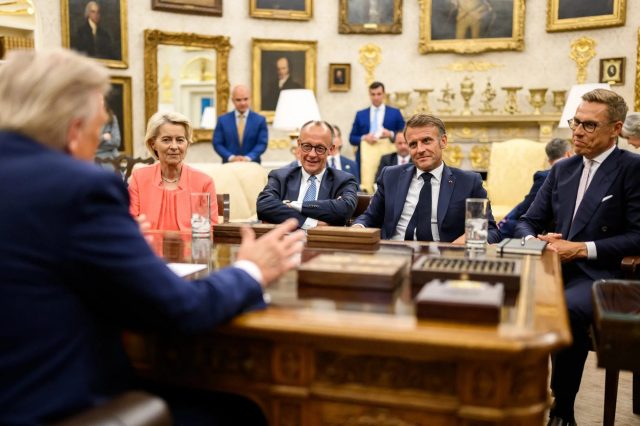
In 2025, Trump lined up European leaders like schoolchildren. (White House)





Donald Trump has always got a kick out of humiliating people who suck up to him. That was the entire premise of The Apprentice, and a running theme in his two non-consecutive terms as president. His career is littered with the hunched skeletons of discarded lackeys. His current lackeys know this, of course: it is a risk they knowingly incur, and a small price to pay for power.
Trump is such a natural at this, though, that he can have a similar effect on Europe’s elite. There’s the spectacle of Emmanuel Macron massaging his ego and Mark Rutte calling him “daddy” — but however unedifying this may be, it is just diplomacy. Stranger still is the way they often seem to cede to him, unforced, a kind of moral authority. Trump brings out their masochistic streak; they become eager participants in his hobby of Europe-bashing. What pathetic little leeches we are, they cry out, when the President attacks them for being defence freeloaders, exploiting American goodwill: he has us bang to rights.
They do not take this line on other aspects of the White House’s critique of European policy. They do not say that Trump has them bang to rights on free speech or trade or energy or immigration — to say this would be to admit the defeat of an entire moral worldview. But on the specific subject of defence their usual reflexes are suspended. All of a sudden they turn MAGA. We have been free-riding for decades, they say; Trump is “simply right” that Europe should spend more. It was only a matter of time, one can almost hear Mark Rutte suggest, before somebody intelligent and manful enough would catch on.
This is not the posture of MAGA’s European outriders. Europe’s insurgent Right-wing parties tend to take a more hard-headed view of American objectives. The nationalist Right in France, Italy, and Germany has a long tradition of anti-Atlanticism: they never subscribed to the view that American support for European defence was an act of supreme, selfless benevolence. Indeed, they increasingly appear to recognise that MAGA is an albatross around their necks. Giorgia Meloni recently had a public falling-out with Trump; she knows, in a country where only 8% have a favourable opinion of the President, that some distance from the White House can only be a good thing. Beatrix von Storch of the AfD may have a “Make America Great Again” cap on her desk in the Bundestag; but, at the same time, her party and its base tends to look at Trump’s America with a certain coolness.
They are well aware that Trump is extremely unpopular in Europe. His reckless statements and interventions, and his encroachments on the sovereignty of other countries, can be a major liability for Right-wing politics internationally — as the cautionary tale of Pierre Poilievre in Canada goes to show. One wonders sometimes whether MAGA understands the toxic effect it can have on “sovereigntist” Right-wing parties in the rest of the world, and even exploits this in order to keep the establishment parties in charge.
For Europe’s establishment parties are the real marks for Trump’s rhetoric on defence. They are the lackeys whose humiliation Trump craves and enjoys. They are used to taking their orders from Washington, and defence spending is an easy concession for them to make to Trump, in word if not in action — easier, anyway, than accepting his counsel on immigration, energy, or other areas of policy that he is wont to berate them about. So somehow, in this single instance, the Trumpian line has become a piece of European elite consensus. Sanna Marin, the former prime minister of Finland and now a strategic counsellor for the Tony Blair Institute for Global Change, wrote for the Economist last year commending the American taxpayer for having aroused from his slumber to question “why they should shoulder more of the cost of European security than Europe itself”. Alex Younger, the late chief of MI6, said similarly: “We have been infantilised and it hasn’t been healthy… we should be extraordinarily grateful to America for its generosity.” He likened Europe to a spoilt child on a “trust fund”, a spoilt child which now has to toughen up, get wise, and make its own way in the world. A belligerent Russia, the argument runs, is Europe’s problem, not America’s — and so it’s high time that Europeans take matters into their own hands.
That Europe should spend more on defence, and on containing Russian aggression, is a fair proposition, and one which many previous American presidents have supported. “Nato 3.0”, where Europe assumes principal responsibility for its own defence, could indeed be a good thing for Europe — and, perhaps especially, for Ukraine. This is a message which Britain badly needs to hear, especially now that John Healey has conveniently forgotten the national security imperatives that caused him to resign as Defence Secretary less than three months ago. None of this means, however, that Europe’s leaders should accept the framing that American support for European defence was motivated by “generosity”, which Europeans have been greedily exploiting and for which we should now be “extraordinarily grateful”. If Europe has been “infantilised”, then that is something that the Americans deliberately engineered, over the course of many decades. Trump is not meting out “tough love”; he is not Matron making the medicine go down, or a wealthy father cutting off his pampered, profligate children “for their own good”. The “trust fund” was always an investment, and quite a profitable one at that.
The Americans realised, after being drawn into two world wars, that isolationism was a risky and unworkable strategy. They had an interest in preventing future war in Europe. They were anxious to prevent nuclear proliferation, and to stop countries like France and Italy from falling into Communist hands. The end of the Second World War left them in a fortuitous position in Western Europe, and one they were in no hurry to relinquish. They got — and still enjoy — a military foothold in Europe, which can come in handy when, say, they want to direct logistics and communications from somewhere within striking distance of Iran.
It was a good arrangement, while it lasted. America got fat off Pax Americana. We in Europe got a lot out of it too: a “holiday from history”, the luxury to spaff billions on welfare; billions which, in a previous age, would have been spent on dreadnoughts and munitions. Not that we Europeans were totally useless on military matters: we tended to accept that our obligations were a two-way street. If the Americans were footing the bill, then it was only fair for them to expect what little military assistance we could offer during their moments of need. That guided the decision made by many European countries to join the American-led coalition in Afghanistan and Iraq. One reason Trump’s Greenland gambit earlier this year left such a bitter taste in many European mouths is that Denmark was one of America’s more devoted European allies. Denmark had the third-highest per-capita casualty rate among Nato nations in Iraq and Afghanistan, behind America and Britain. Trump’s obsession with gratitude could easily be turned on its head. The Americans could say thank you for our help in the War of Terror; the Americans could say thank you for Ramstein, Lakenheath, and Fairford.
The European country which has come closest to implementing Trump’s advice is of course France. France clears its Nato target of 2% of GDP on defence, and seems to spend it more effectively than other countries do, including Britain. Earlier this year this caused Britain some embarrassment when French warships, rather than British ones, sailed to Cyprus after the RAF base at Akrotiri was hit in an Iranian drone strike. France pulls its weight. And France, to the chagrin of George W. Bush’s White House, did not join the war in Iraq. Nor does it host US bases on its soil: General de Gaulle chased all of them out in the Sixties. Because France has tended to pull its weight, it has also enjoyed more strategic independence from America in foreign policy. The two go hand-in-hand.
Suppose, now, that the rest of Europe were to follow Trump’s admonition to the letter. Suppose that the rest of Europe were to become truly “sovereigntist”, perhaps under the aegis of MAGA’s sister movements on the populist Right, and to figure out what the French figured out long ago. Is that an outcome that Trump and his coterie would actually want to come about? Recall Trump’s fury earlier this year when the Kingdom of Denmark moved a few dozen troops to another part of the Kingdom of Denmark; or his rage that European countries did not fall immediately into line when he embarked on his Iran adventure. Those countries would be a lot less pliable than they currently are if they really did get their defence spending in order. Nor is it the case that Trump is that invested, in general, in the sovereignty of his European allies. He routinely makes demands about how they should direct policy on fossil fuels and immigration, and with whom they should and should not trade.
Europe’s leaders should, as ever, be careful not to take Trump’s words at face value. But even if they do, they are unlikely to put them into action: as John Healey’s recent U-turn reveals, welfare spending must always come first. Their hope is that Trump is succeeded in the White House by someone with a less capricious attitude towards their allies, someone who understands the upsides of the postwar arrangement, and thinks that it is still worth paying for. The alternative — slashing welfare to fund defence — is somewhat more conceivable under parties on the nationalist Right; but the practical consequences of that, a Europe composed of sovereign states capable of pursuing their own interests as they define them, would not be to Trump’s liking. Trump claims to want Europe to stand on its own two feet, but he does not want Europe to be strategically independent. He should, perhaps, be careful what he wishes for.
