




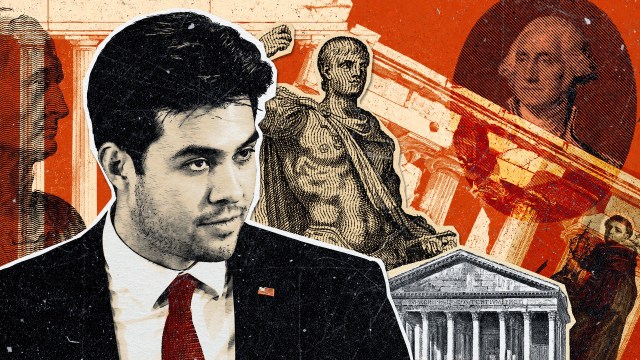





“Rights are not something that are created by governments. Natural rights belong to all human beings on account of their nature as human beings, they’re unchanging, and they can’t be reserved to particular groups or identities of people.”
So says Samuel Samson, a 27-year-old deputy assistant secretary in the US State Department’s Bureau of Democracy, Human Rights, and Labor, or DRL. As used in this sense, the term “natural rights” derives from the early-modern age, when thinkers like Hobbes and Locke radically reprogrammed Western political philosophy. Where ancient and medieval thought had viewed the human subject as naturally social — naturally inclined to cooperate for the good — the moderns framed him as naturally turbulent and self-seeking, and forced into a social contract in order to protect his life and property from his equally violent, turbulent neighbors. Life and property were his natural rights, in this telling, and government’s job was to protect them. This new conception formed what the philosopher Leo Strauss called the “low but solid ground” of modernity — and came to shape the American founding.
Samson says natural rights are a cornerstone of his mission at DRL — a directional change that he describes as “anthropological.” This, even as he wants to link natural rights back to the much older account of natural law, developed first by the ancient Greeks and then absorbed by historic Christianity. Heady stuff, now at work (sort of) at the heart of Trumpian soft power and diplomacy.
His branch of the State Department, the DRL, was established in 1977 under a slightly different name, with the mandate of promoting democracy and American values around the world amid the Cold War. Back then, with Soviet Communism still standing as a universalist rival vying for hegemony, American values mostly meant modern liberalism. But now, under Secretary of State Marco Rubio, Samson’s boss, it is charged with implementing the Trump administration’s ideological pivot towards “tradition” in American foreign policy.
In the abstract, this has meant embracing the principles of Western civilization and the ideals of the nation’s founders — as if the two were perfectly in accord, with each other and with Trumpism — on topics such as nationhood, immigration control, free speech, and democracy.
In practical terms, Samson’s work has heralded a change in what kind of causes the US government funds abroad, as well as a shift in emphasis from the developing world to the mostly European countries that Rubio designated America’s “civilizational allies” in remarks at the Munich Security Conference in February 2026.
Not surprisingly, Samson has become something of a lightning rod for the administration’s new philosophy. A Catholic from Houston, the son of a Filipino mother and an American father of European ancestry, he arrived in Washington in 2021 and soon accrued a formidable Right-wing intellectual pedigree: a master’s degree in government from Hillsdale College, the evangelical-ish college that declines government funding in order to preserve its cultural and academic integrity, and a fellowship at the Thomistic Institute at the Dominican House of Studies in DC, with plans for a doctorate to follow. “I thought I was going to be a professor,” he says.
However, “there were exciting things happening in the conservative intellectual space,” and he was drawn to the NGO sector and was eventually offered a role in government. An acquaintanceship with Vice President JD Vance probably didn’t hurt. “Some have tried to spin me as having some particular or personal connection” with Vance, he says. The reality is that Samson has met the vice president a few times, and that he’s a young idealist, enthusiastic to work on causes he considers “critical issues at this critical moment in our country’s history.”
If Trumpian foreign policy’s “civilizationalist” tilt — viewing the world as divided between large civilizational blocs, with Washington obliged to favor the West — has an architect, Samson has a good claim to being it. A blog post he published on the State Department’s website under the headline “The Need for Civilizational Allies in Europe” came a full year before Rubio’s remarks in Munich, in which the secretary of state said that post-Cold War the West had succumbed to the “dangerous delusion … that every nation would now be a liberal democracy … and that we would now live in a world without borders where everyone became a citizen of the world.” Rubio announced an American return to national autonomy and expressed the wish that Europeans, with whom “we are connected spiritually and we are connected culturally,” join us in being “unapologetic in our heritage” and proud of our “common inheritance.”
In a sense, Samson’s rejiggering of DRL has saved it from the administration’s penchant for slashing government agencies that the Trumpians view, not unjustly, as ideological jobs programs for credentialed progressives. DRL, like the former USAID, is an American governmental channel for ideological advocacy abroad, dispensing about $190 million in funding every year, for the promotion of causes that have come to fall under the rubric of human rights but which Samson describes as “progressive social engineering or Leftist conditioning around the world.” DRL, he says, “was using its mandate as a skin suit to promote ideological Leftism that often ran contrary to the defense of democracy and human rights, and beyond that, just at a practical level, would often get involved in foreign-policy issues in ways that would actually undermine the national interest.”
These efforts included, he says, “conditioning populations to adopt particular Leftist premises about promoting LGBT; normalizing things like transgenderism and gender surgery, including for children; promoting abortion around the world as if it’s some sort of settled moral question; and facilitating mass migration and elevating mass migration as a humanitarian obligation that developed countries have.” He adds: “All of these things are deeply radical.” In his time at DRL, it has shut down 80% of existing grants, and is currently offering money for causes more aligned with the Western tradition or Trumpian politics, depending on whom you ask.
On that latter point: the observer would be forgiven for viewing most of its initiatives as narrowly political. In Britain and Europe, for example, Samson’s work has raised grumbles for favoring one side in the continent’s partisan battles, and the fact that some recipients of DRL largesse tend to go silent when it comes to criticizing the Trumpians’ own encroachments on free speech and other rights. Accordingly, Samson has been roundly vilified in the media. The Global Project Against Hate and Extremism has published a feature on him. The New York Times in April said he’s “the 27-year-old diplomat waging Trump’s cultural war with Europe” and referred pointedly to his Catholic religion in a hit-piece on him. The progressive-leaning investigative site ProPublica criticized his championing of the State Department’s program to protect white Afrikaners under the rubric “the end of aid.”
Samson, however, refers to the agenda as one that prioritizes natural rights, and proffers a return to a conservative view of humanity and its purpose. He originally tried to change the bureau’s name to reflect the new orientation but settled for setting up an Office of Natural Rights instead, which he describes as intended to “defend America’s national interest and security by defending the unalienable rights and dignity of American citizens, and championing those same rights around the world.”
The natural-rights theory of the Enlightenment came as a shock to the upholders of the West’s old order, not least Samson’s Catholic Church. Enlightenment philosophy, and the 18th-century revolutions that sought to bring it to life, shifted the end goal of politics, away from the common good of the whole — as the likes of Aristotle, Augustine, and Aquinas had had it — and toward individual autonomy. In the classical frame, moreover, the happiness of the individual and the community had an objective content. But under the new dispensation, this was much more contested, with modern political orders leaving it up to each person to determine for herself what it meant to pursue happiness.
“Nature” was the common denominator of both natural law (the old view) and natural right (the new one). Yet the substantive content of human nature shifted dramatically in the transition between the premodern world and the modern, concurrent with the collapse of feudal orders and the rise of early market societies.
Natural law, the older vision, first appeared in ancient Greece. Heraclitus, a forerunner of Plato, held that “man’s nature as well as his ethical goal consists in the subordination or conformity of individual and social life to the general law of the universe,” as explained by the German lawyer and theorist Heinrich A. Rommen in his authoritative survey The Natural Law, first published in 1936. (Rest assured, Rommen opposed the Nazis and eventually immigrated to the United States to escape their clutches.)
The premise was then developed by Aristotle, and later by the medieval Christian Scholastics, and might broadly be described as the proposition that right and wrong, good and evil exist as unchanging ontological truths in the same manner as what we observe in the natural world. A tree exists to fulfill a certain end or range of ends: to grow and bear fruit. Just so, our purpose as human beings is to strive towards the “good and the true,” as Samson puts it. And our laws and social institutions are good or bad, legitimate or not, in so far as they promote these ends.
If human beings are made to strive toward certain kinds of goods, it follows that they have certain rights, also ontologically determined, that will promote this quest. These rights “belong to all people by our nature as human beings — that is what makes them natural,” Samson says. As he puts it, “perhaps in the Aristotelian sense, [man’s nature is that he is] a rational, social being made in the image of God. Some of the foremost natural rights that come from that nature are the rights to life, sovereignty (and security), speech, religion, and life in the polis.”
He goes on: “Natural rights are a much older, more profound conception of human rights — one espoused by America’s founders, and certainly in our founding documents.” Samson argues that his office’s focus on nationhood, immigration control, free speech, and democracy “tend back to those core tenets of human nature and are necessary for human flourishing.”
What Samson is doing here is subtly blending the older, natural-law or Aristotelian worldview into the early-modern, Enlightenment-derived one enshrined in America’s founding documents, now with a dash of 21st-century populism. For the premoderns, for example, there was no general right to free speech as such, except insofar as speaking freely corresponded with a particular citizen’s duties and stature. Freedom of religion was rare, to put it gently; “error has no rights,” the Catholic Church long taught, and often used the business end of the secular state to make sure things stayed that way. And the classical and medieval world that nurtured this tradition was, by and large, dominated by large, multinational empires. Nationalism and nation-states with borders and immigration laws that the Trumpians wish to harden — all these came much later: in the 18th and 19th centuries, right about when the modern vision took hold.
Yet if the attempt to discern an Aristotle or Aquinas in the figure of Locke or Jefferson is theoretically tenuous, Samson is far from the first to attempt it. The project has a serious lineage and worthwhile aspirations. Plus, it may just work in practice. While we must be thankful for the more capacious rights theorized by the modern thinkers and secured by the American founders, there are ways in which the older, natural-law account can help us today: by elevating our rights discourse, and reminding us what rights are for.
It sounds good, but the Trump administration’s attempts to promote Western civilization so far have failed to escape accusations of bad faith, and haven’t been taken seriously outside of the most credulous elements of the MAGA base.
Anyone trying to seize the moral high ground and promote the good and the true will have a difficult time explaining many elements of Trump administration policy, from the brutalities of ICE to the betrayal of the America First base represented by a unilateral war with Iran. And Western civilization-focused executive orders, such as one decreeing that all federal buildings should be constructed in a classical style of architecture, are performative and flimsy. You can order a certain style, but intelligent observers understand that it won’t make the buildings resemble the architecture of the classical period unless they’re also designed and constructed beautifully — which is unlikely, given the aesthetics of the Trump administration. In the same vein, you can withhold federal funding for schools teaching racial “indoctrination” and promote “a patriotic” curriculum, but only if you have a plan for how to replace the old ideas with better ones, organically, within the American academic culture — without bowdlerization or hiding the country’s dark side in a mirror image of the woke who hid the noble side.
The State Department’s activities also leave it open to accusations of being more politically motivated than virtuous, even when the cause of virtue is being served. Samson declined to comment on new grants actively under consideration, however ProPublica has reported that they include one to the Free Speech Union, a British organization founded in 2020, which references the “spirit of the Enlightenment” in its statement of values, and defends people “who get into trouble for exercising their right to lawful free speech, whether in the workplace, at university or on social media.” Others are a reported $40 million slated for the Victims of Communism Memorial Foundation; and a reported $7 million for “878” — a new, Washington, DC-based British think tank, whose focus areas include “renewing our Judeo-Christian culture” and “ending mass immigration and deporting illegal immigrants” (as if the two obviously go hand-in-hand).
These are popular causes on the Right, but how are they being executed? Free speech in Europe has been a marquee initiative. The State Department has declared an erosion of European civil rights, due to limitations on free speech imposed by Britain’s 2023 Online Safety Act; and by the European Union’s Digital Services Act, which, among other powers, can fine companies for violation of its standards for up to 6% of global revenue, and which recently went after Elon Musk’s X on transparently thin grounds.
Both pieces of legislation contain language that can be — and occasionally is — used to suppress conservative speech. In a recent case in Britain, the comedian Graham Linehan was arrested for X posts critical of transgenderism. Defenders, however, claim the laws are necessary to prevent sexual abuse, threats of violence, and actual sexual harassment — forms of speech that are proscribed even under the US Constitution and its First Amendment. In Britain, supporters of the law contend that political arrests are usually a result of bungling execution and affect only a tiny minority of cases. The Free Speech Union itself cites only 300 people arrested under the UK’s law since 2023, and is vague about how many of those arrests were political.
“At the end of the day, a lot of this is going to be prudential judgment,” Samson says. “No one actually believes in an anarchistic free-speech utopia, right? There is such a thing as harmful content, but we want to defer to the side of speech as much as we can.” (It’s worth noting, again, that you will find no defense for such an expansive libertarian view in Aristotle or Aquinas — or even in the early American tradition, which tolerated blasphemy laws as compatible with the First Amendment.)
Presented with the perception of American hypocrisy, regarding the United States’ own suppression of pro-Palestinian speech on campuses, he says that “we have a substantial legal tradition and also practical tradition that says that incitement to violence is a problem. There’s a categorical difference between grandmas praying outside of an abortion clinic, and violent Leftist groups that are calling for the extermination of our civilization.” Many of those facing such restrictions from the Trumpians did no such thing, however, and the courts are increasingly casting a skeptical eye on the administration’s pinched view of speech rights, especially when it comes to visitors and noncitizen migrants.
The disputes about the scope of speech are telling. They arise under both supposedly censorious Eurocrats and an American administration that tub-thumps loudly for speech. If everyone agrees that some limitations on speech are necessary, perhaps our civilizational allies in Europe are going about it in their own way, and how they do so may or may not be the appropriately ordered top concern of the American government. It does, however, play to an American base.
The issues are real. However, the noise surrounding them drowns out a genuine and important shift. If the MAGA coalition was anything, it was the decisive majority of more-or-less normal Americans seeking a return to the kind of values they feel normal people, broadly, believe in, and that they feel progressive governance has abandoned. This has been branded by the spokesmen of progressivism as uneducated and dim: what, exactly, are the “normal” values? Who determines what’s “good”? Obviously there’s no ultimate authority, or real answer to these questions.
Here, the natural-law tradition can be especially instructive. By the natural-law formulation, humans are designed to know the good, and thus the vague feeling that certain things are beyond the pale is telling us something. Our reason may be clouded, our will may be weak, our university education may be confusing us, but each human conscience is endowed with a sense of the true and right, and a longing for it. If there’s a MAGA future that could be pro-something, instead of merely anti-woke, it springs from this inchoate sense of a proper human virtue.
Liberal secular morality and progressive governance have been characterized by the opposite, holding that truth is whatever the individual says it is; and that “the good” is what the people think is good for them, or perhaps what their betters think. That way led to the open border and the pediatric gender clinic, and a broad coalition of Americans has come out against it.
It is astonishingly radical, actually, both in its metaphysical claims and its practical ones, that in 2026 the American government is even trying to deliver an authoritative stance on the good. To stand for any fixed truth — such as a defense of Western civilization, even if messily put together from discordant elements — is to oppose the ideology of the postwar order. That ideology elevated diversity as the highest good, and was allergic to suggesting that any populations or societies have any characteristics at all. Defense of a civilization requires certain claims: that we believe Western civilization is a good and meaningful category; that it has certain essential characteristics that are proper to it; that we aim to promote those characteristics and discourage others.
This isn’t diverse, but nor is it antithetical to the diverse society we currently have — because of Western Civilization’s very insistence that rights are universal, Samson says. The Catholic popes were among the first to champion the rights of indigenous peoples, on natural-law grounds, moral counsel that European conquerors honored only in the breach. Samson is thus clearly right when he says that “the tolerance and acceptance that this country has shown to immigrants is itself a product of the Western ethos…. There are non-Western people who live in America, but that’s distinct from the particular heritage that this country belongs to.”
He references his own experience as the son of an immigrant from the Philippines, and his experiences in spending summers in the Philippines growing up, which were formative for his Christian faith. “If the prevailing international narrative was true, they would say, ‘Oh, well, the Spanish came and colonized your ancestors, and they were terrible to them.’ And of course, there are historic atrocities that you can’t ignore. But at the same time, I have the faith that I have, because of them. It was the Spanish who first came and taught [my ancestors] about the good and the true. I’m very grateful for that.”
The devil, of course, is in the details. If there are actually correct values and goals that will promote human flourishing, the interpretation of what those values and goals are is a crucial art. An art that sits uneasily next to a president, Trump, who too often resembles the kind of petty, impulse-control-challenged figure the Greco-Roman sages of the natural law had in mind when they warned about the absence of virtue in a leader. Still, one cannot blame Samuel Samson for trying. One key question for the conservative movement, as it leaves the Trump era behind, is whether the intellectual depth and seriousness of purpose Samson exemplifies can be extracted from the wreckage.
