




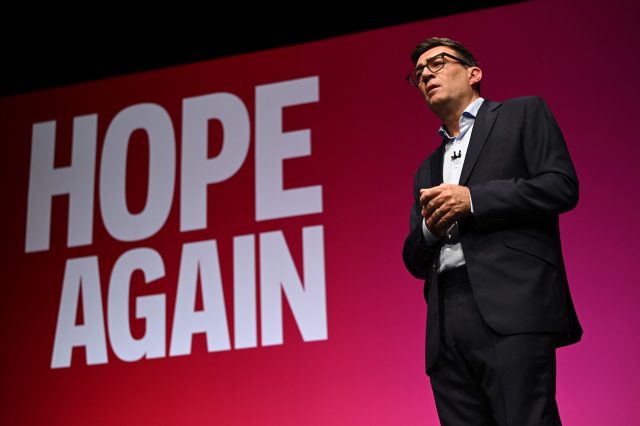
Andy needs a bridge too far.(Leon Neal/Getty)





It’s Andy Burnham’s victory parade. Hope and a sense of secular evangelism are in the air — and they’re to be had in the city of his birth. That feels wholly appropriate, for from the riverside entrance of Exhibition Centre Liverpool, where Burnham and his party faithful just met, you can see the history of modern labourism in stone and glass and steel. The dock system, nostalgically invoked by the Prime Minister in his leader’s speech, was an engineering marvel, almost eight miles long, and where Burnham’s granddad “drove a lorry for Tate & Lyle”. Much of it fell to ruin in the twilight years of the last millennium, only to be tentatively resuscitated by culture-led regeneration, European subsidies and Blairite regional development bungs.
Today, opposite the inebriated Labour spads and staffers jabbing furiously at their phones, Cammell Laird shipyard hosts Royal Navy frigates for repairs. One of only four remaining British oil refineries is visible in the distance to the south-east. And, out to the west, in the Irish Sea, a host of wind turbines turn limply in the sunshine. This, then, is the sweep of Labour Britain in microcosm: the one built by industrial labourers, and shaped by the trends of progressive interventionism. And you can see it all from within a sealed, airport-style security cordon full of lobbyists, millennial PR professionals from London, hacks-on-tour, wonks and assorted politicos. They all agree: “The vibe is very different from last year, isn’t it?”
In truth, of course, it’s the same conference bubble strangeness that we are subjected to every year. Each party has its own neuroses. Labour’s principal one is that it’s a party of progressive liberal graduates — but nonetheless clings to its original roots as a manifestation of genuine working-class ascendancy. And here it is encamped as a foreign object in an airless architectural carbuncle on the banks of the river, among the red-brick warehouses and shipyards and the very places that gave the labour movement so much of its original form. Its relationship with working-class Britain is akin to that of the adulterous husband, begging his wife for one more chance. One civil servant-turned-comms girl, here at Conference for the first time, has a slightly different observation. “There’s quite a lot of gimps, isn’t there?” But here, the gimps are king. This is their safe space, the place to indulge in all manner of comforting delusions.
During an extended visit in 1965, Allen Ginsberg called Liverpool “the centre of consciousness of the human universe”. Brian Patten, Ginsberg’s weary host, later remarked that “I think Allen believed the centre of human consciousness to be wherever he was at the time”. You could say something similar about most Labour types. They consistently engage in what the philosopher John Gray calls “the fatal conceit of the progressive mind”, namely “an invincible faith in its superior rationality”. In this world, if only everyone was party to the facts, nobody would vote Reform; if only more right-on types had their hands on the levers of power, then all would be well. With a straight face, one think tanker told me that the rise of populism could be put down largely to a lack of “up-skilling opportunities” in the left-behind English regions.
Wherever “the centre of consciousness of the human universe” is today, it’s not located in the Conference Fringe Guide. Instead, we have “How Can Employer Partnerships Create Genuine Pathways into Work For Young People?”, and “Closing the Sports Gender Gap with Sky and Lucy Powell”. The slogan of the conference, “Hope Again”, is deliberately broad and absolutely banal. It adorns screens and billboards. For now, drunk on warm wine and good vibes, most attendees are prepared to believe.
But these dreams will inevitably meet contact with difficult realities: tightening fiscal constraints as a result of geopolitical crises beyond our control; those pesky gilt yields; the recalcitrant PLP, who will meet with hostility any attempt at constraining current spending. The cost of government borrowing is now at a 20-year high. And, 20 years ago, the national debt stood at around 30% of GDP, not today’s 95%. We’re spending three times more on debt interest than we are on infrastructure, almost twice as much as we spend on defence.
But the problems are for later: this is Burnham’s time to shine. A year ago, he was shunned for what was billed as a premature attack on Keir Starmer and the bond markets. Today, he is dominant within a party that has identified him as its last electoral hope. The PM seemed to have a slogan of his own for a speech that rang as hollow as Hope Again: “All together now”. But, for his part, the speech was a success, a classic of mawkish, progressive soft-Left Labourist eulogising. There were perorations on 1945, tears for his father in an open display of Men’s Mental Health, odes to his “gran”, and the beloved, abstractly conceived working class: who in actuality have abandoned the party in droves.
Burnham is an infinitely superior speaker to Keir Starmer, and he knows what the Labour faithful want to hear. He has the self-confidence of Tony Blair, and a coherent narrative of how Britain found itself in its current woeful predicament. “Homes, water, energy, transport, care, were broken up and sold off”, he told the gathered activists. “The British Right talk about taking back control”, he added, “but it was them who gave it away.”
The Prime Minister, in short, is a man who deals in an anti-Thatcherite, progressive social democratic nostalgia — one he hopes can reunite progressive Britain’s warring tribes. He makes Labour people feel good about themselves, which is more than can be said for Starmer. Some in the conference hall wept openly, perhaps in a show of what they like to call “solidarity”. Perhaps they’ve been waiting to hear such a bold assertion of their Labour values since the days of John Smith. There were moments of whooping and shouting reminiscent of a Pentecostal church on Sunday, the congregation all filled with the spirit of Andeh, the spirit of ’45. He is good at this, delivering a broad-tent vision of a liberal Britain that seemed pitched towards uniting left-of-centre voters against what he called “division” (which we can translate as still-burgeoning national-populist insurgency).
And the delegates lapped it up. It was as clear a signal as we have yet heard of the kind of coalition he wishes to build come the next general election: the modern Labour bloc of liberal professionals, public sector workers, young renters, ethnic minorities, students and sections of the old working-class who haven’t been lost to Farageism (particularly in the North). In other words, it’s time for the Green, Liberal and soft-Reform defectors to come home. It may even be enough to win the next election, at least as the largest party in coalition with Liberals and Celtic nationalists, pointing us towards a future of proportional representation, an elected senate, and smug Euro-style consensual technocracy.
Aware that, as time goes on, the popularity of virtually all political leaders fades, No. 10 would be foolish not to consider the possibility that waiting until 2029 for an election heightens the risk of a Conservative rebound and a Reform-Tory coalition. Certainly, the need to raise taxes to pay for a National Care Service could be the substantive excuse to U-turn on early denials and to go to the polls seeking a fresh mandate.
Yet if all this makes sense politically, nothing Labour has proposed so far will break the doom loop, nor alter the fundamentals of Britain’s decline. As ever, the yawning gap between the diagnosis and the prescription is the most fundamental contradiction in the Burnhamite project. Though it offers a story of systemic rupture, a “circuit breaker” on “40 years of neoliberalism”, it’s all told to justify a handful of discrete, piecemeal, modest interventions: a revamped help-to-buy scheme by another name; £2 bus fares; VAT off electricity bills; a commission on electoral reform; a slightly modified triple-lock to pay for enhanced social care. Elsewhere at the conference, Shabana Mahmood has agreed to make her migration reforms more palatable to Labour’s metropolitan liberal castes: Blue Labour’s lodestar has gone full woke with safe and legal routes for Gazans and Afghan women.
This, then, is a shopping list of policies adding to much less than the sum of a “post-neoliberal order”. It didn’t even reveal a new strategy for growth, simply for more fairness within the current ailing model. It was a paean to safe soft Leftism, not an extrapolation of what would really constitute post-neoliberalism: the hard, social-democratic radical reforms that would rebuild state capacity; put us on a pathway towards a more cohesive national economy; and usher in genuine industrial revival and investment-led national renewal.
Whatever else neoliberalism meant, after all, it really did entail a radical reorientation of the ship of state. It pursued a steady, deliberate retreat of the demos, the public, from ownership and direction over productive assets. It disciplined organised labour, outsourced services, and began to allow markets to allocate capital — in a way that used to be debated politically and enforced via industrial strategy, capital controls, trade barriers and incomes policies. The productive state, that engaged directly in investment and capital formation, became a regulatory state that taxed and tweaked with cash transfers from a financialised, privatised growth model. Nothing on Burnham’s wishlist approaches a reversal of this at anything like the necessary scale.
Back on the Mersey, the tide is on the turn. Every political economy leaves its monuments here. The refineries and shipyards stand for industrial Britain; the regenerated docks for tourism, services and creative capital; and the turbines out in the Irish Sea for the net-zero revolution. Each epoch wasn’t built by tweaking the old ones. If Burnham truly wants a post-neoliberal order, he will have to build one, and that means large-scale investment in physical things meant to last generations: not regulatory fiddles while Britain smoulders. Burnham’s problem, then, is a twofold gap: the first between a diagnosis of systemic rupture and a weak prescription of cheap bus fares and VAT cuts; the second between the hope in the hall and the grim arithmetic waiting beyond the security cordon. Even the grandest of speeches can’t bridge chasms that large.
Jonny Ball is a Contributing Editor at UnHerd. He formerly wrote under the name Despotic Inroad.
 DespoticInroad