




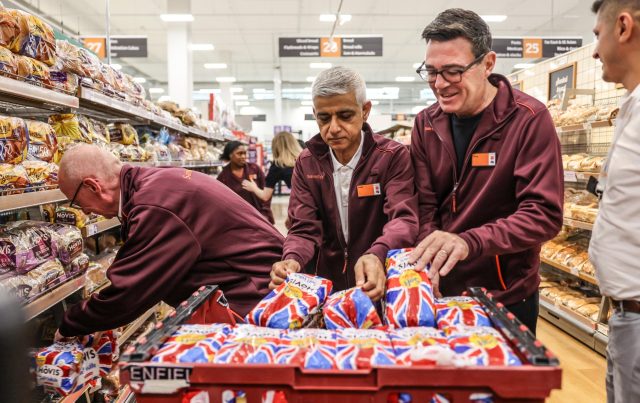
‘We’re running out of bread.’ (WPA/Pool/Getty)





In the Seventies, a phrase emerged in Left-wing circles: “actually-existing socialism.” It had been used by Leonid Brezhnev and Erich Honecker, the communist leaders of the Soviet Union and East Germany, to describe the political and economic model in the Soviet countries. They meant it positively, but it implied a sad discrepancy between the utopian, radical ideals of the Left, and the reality of their grand designs east of the Elbe.
Like the comrade-citizens of the Eastern Bloc — taught all the ways of brotherhood and abundance, but used to sclerotic central planning — we’re about to find out what “actually-existing Burnhamism” looks like. The recess is over, and so is the honeymoon. Making his prime ministerial debut in the Commons yesterday, Andy Burnham experienced something of a baptism of fire. He’s already faced a global sovereign debt fire-sale, with Britain looking predictably exposed, as well as a grilling by Kemi Badenoch. And, more awkwardly, Burnham now faces a by-election in Holborn and St Pancras, courtesy of an ever-helpful former leader. The North London contest will turn into a Labour-versus-Greens showdown. Though Makerfield proved that Burnham could turn Northern heads away from an insurgent Faragism, facing off Zack Polanski in a liberal metropolitan stronghold is a different task entirely.
Over the summer, Burnham had the opportunity to prove that he’s at least superficially different to his robotic predecessor: he played The Smiths to Ukrainian squaddies, and masterminded an impeccable TikTok game. Plus, he announced a set of nice, small-scale retail policies focused on the cost of living.
Now he bemoans Margaret Thatcher’s legacy in the Commons, linking privatisation to the rise in water and energy bills, and deregulation on the decline of bus travel outside of London. It’s all cogent Left-populist diagnostics: Tory spivs sold England by the pound; austerity in local government compounded the misery; and Brexit cut us adrift in a harsh geopolitical climate. We already know what is on Burnham’s big to-do list: a reversal of “40 years” of neoliberalism, public ownership of the core utilities, investment in regional infrastructure, devolution, constitutional reform. But what will this all look like in practice, in a country that is currently spending more than the annual education budget on debt interest? How will Burnham finance his grand plans with an incapacitated, outsourcing state that few trust to deliver on the most basic services?
Disappointment lingers on the horizon. Signs were there over the holidays: “Our Andy” was forced to watch his beloved Everton play Crystal Palace last weekend from the safety of the director’s box — rather than his usual seat on the terraces. And so the man of the people became the man of the prawn sandwiches. The idea of Burnhamism is all about normie populist swagger: his easy charm says “one of us”. But now he’s no longer one of us. He’s Prime Minister of the United Kingdom of Great Britain and Northern Ireland. And, in the land of actually-existing Burnhamism, the security arrangements for a prime minister at a football game present a considerable headache — as does much else besides.
In the doctrinal version of Burnham Thought — “Manchesterism”, as it is sometimes known — we might expect to see some municipally owned water and energy companies, even a “gas-and-water socialism” revival in the tradition of Joseph Chamberlain’s Birmingham. In actually-existing Burnhamism, however, the Government has been advised that bringing an ailing Thames Water onto the public books would add another few billion to the debt pile and make the state vulnerable to legal action.
Burnham has long been a champion of big capital projects: full-fat HS2, Northern Powerhouse Rail and more tramlines, to name but a few. All of them could conceivably facilitate higher regional productivity, job creation and private investment for decades to come. But in actually-existing Burnhamism, any signs that a cool hundred billion might be expended on concrete and steel could be met with a gilt rout by twitchy hedge funds holding mountains of British debt. Yes, the Manchesterism schtick plays ably on a boomer-coded social-democratic nostalgia: remember proper bin men and pork scratchings? Except that under actually-existing Burnhamism, Ofgem has just raised the price cap again, and we’re still paying our bills to a hodgepodge of competing private outfits.
Defence poses similar questions. When John Healey, the Chancellor of the Exchequer, first hitched his wagon to Team Andy after resigning as Keir Starmer’s defence secretary, he presumably thought Burnham would be sympathetic to his plea for higher defence spending. After all, Burnham, unlike his predecessor, had decried the limiting effects of fiscal rules and being “in hock” to the bond markets. But, again, in actually-existing Burnhamism, the bond markets do exist. Healey is already facing accusations of hypocrisy for not immediately setting out the route to 3% defence budgets. And, in order to pay the triple lock to the wealthiest generation in human history, to fund PIP payments to anxious twenty-somethings, and to ensure ambulances turn up, the Government must issue gilts and remain in the bond markets’ favour. This is, of course, a situation entirely of our own making — reflecting a national desire for Scandinavian services without the taxes to match, along with a public purse that splurges billions on shoddy procurement deals.
In this context, change is likely to be incremental rather than wholesale. Transferring whole industries onto the public books would require an enormous amount of trust from our creditors. It would likely necessitate an ample demonstration that, while large-scale public investment in assets and infrastructure was the new growth model, day-to-day government spending could readily be balanced through a combination of cuts and higher taxes. That would mean either confronting Labour MPs with hard truths that they would be unlikely to countenance, or potentially stymying growth with more financial burdens on employers and high earners.
A third, more radical, option exists, discussed in hushed tones on the outer fringes of Labour circles. Some within call themselves the “Based Left”, only semi-ironically, and they speak of a “politics of production” and “national preference”. The offer involves going to war with the Bank of England over quantitative tightening and rate hikes, infringing upon central bank independence to facilitate a programme of stimulus spending and de-privatisation. That is beyond the realms of probability today. After all, it would mean pursuing a kind of Left-nationalist siege economy replete with capital and exchange controls, postwar-style price commissions, incomes policy, and fiscal-monetary co-ordination.
Rather than reversing the Eighties legacy as promised, with a genuine return to a properly social-democratic political economy, something more akin to gradual reform is likely — think less Tony Benn, more Roy Jenkins. We could see the train routes gradually come under the purview of Great British Rail, perhaps an expansion of GB Energy, and some more public, regional or municipal options explored for water. Since Burnham is hemmed in by the 2024 manifesto commitments on tax, an early election will be required to really be the “circuit breaker” leader he promises. But, for now, this is Burnhamism in essence: the adoption of fiery Left-wing rhetoric on economics accompanied by a slight Leftward pivot on fiscal policy in actuality, plus better vibes.
And yet if the vibes have undoubtedly shifted from a lacklustre Starmerism to a more dynamic Burnhamism, the latter has inherited the former’s central contradiction: the speeches extolling the end of globalisation on the one hand, and a relatively limp policy offer to remedy it on the other. Though Starmer was said to have been captured by the Labour Right, he tried in vain to tell a national story not unlike Burnham’s: one of investment, the return of state ownership in energy and transport, and the failure of “trickle-down economics”. The problem was the story was told so inconsistently, insincerely, and with such a lack of gusto, that it was hardly noticed at all.
Burnham will be a better storyteller. But in the coming weeks, the unstoppable force of his grand projects will meet the immovable object of a recalcitrant Treasury and an economy on the ropes. Britain’s problems are still structural, requiring fewer technocratic tweaks and InstaReels from No. 10 North — and more of a systemic overhaul. We are experiencing a deep-rooted, overlapping polycrisis. The nation has experienced zero productivity or real wage growth since 2008. It still produces less than it consumes, and it remains dependent on inward foreign investment and the kindness of strangers in a world now beset by the end of liberal globalisation.
So when an increasingly confident Kemi Badenoch walks into PMQs today, she’ll be armed with plenty of ammunition: one-in-one-out prisons, spiking gilt yields, expected tax rises in a putative “Red October” Budget. What, then, does a Big State man do when times are tough? We are about to find out what existing Burnhamism can actually deliver.
Jonny Ball is a Contributing Editor at UnHerd. He formerly wrote under the name Despotic Inroad.
 DespoticInroad