




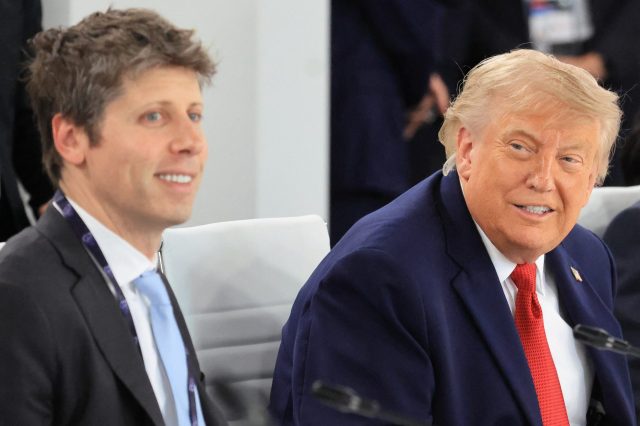
Sam Altman and Donald Trump at the G7 summit. (Ludovic Marin/Getty)





What is science? This used to be a test question at school, but it is now a test question for society. Today, we are in the midst of a historic collision between scientific discovery and scientific dogma. In July, just as the White House issued “Science: A New Golden Age”, its sweeping new scientific roadmap, Congress was raking Dr Anthony Fauci over the coals. As America’s most visible scientific authority thanks to his role in the COVID pandemic, he became the personification of a troubling reality that, until recently, was heresy. Not only is traditional science alarmingly fallible, but it seems that some in the scientific establishment are willing to be deceptive rather than lose control of consensus, cash flows and power. As a New York Times headline put it: “We were badly misled.”
This has attracted the attention of President Trump and his Chief Scientific Advisor, Michael Kratsios, who comes from a private-sector background. They see an opportunity to wrest control of science from the bureaucracy — or perhaps even what MAGA loyalists might describe as the “priesthood” of experts who protect the science community at the expense of public well-being.
The travails of Dr Fauci, therefore, are part of a wider struggle. There is a broader, civilization-level conflict going on, one that was best articulated by Claude Lévi-Strauss in 1964 when he said: “The scientist is not a person who gives the right answers; he’s one who asks the right questions.”
Not long ago, anyone who said there was water on the moon was deemed a nutcase. Thanks to data gathered via India’s Chandrayaan-1 mission of 2008, and Nasa’s LCROSS mission of 2009, we know that there are some 600 billion kg of water ice in the moon’s polar regions — a discovery that bodes well for both manned and unmanned missions. In 2020, Nasa’s Stratospheric Observatory for Infrared Astronomy (SOFIA) confirmed the existence of water molecules in the sunlit regions as well.
The heretical discoveries range from space to the mundane matters of daily life. For instance, we used to think that ulcers were caused by spicy food and stress. Then, in 1979, Dr Robin Warren and Dr Barry Marshall, both Australian scientists, showed evidence that ulcers were caused by bacteria. The idea was heavily ridiculed, because almost every other scientist had accepted the dogma that no microorganism could possibly survive in human stomach acid. The opposition was so fierce that, for the sake of humanity, Marshall offered himself up as a rat lab by drinking broth made from a patient’s gastritis. First, he became violently ill from the H. pylori bacteria it contained, as he knew he would; then, he cured himself with antibiotics, proving that a peptic ulcer was the product of the bacterium. This discovery has saved millions from unnecessary surgeries and lifelong peptic ulcer disease. Today we know that the condition of the microbiome, the gut, is fundamental to our overall flourishing, and that our bodies are host to countless microorganisms capable of both inflicting profound illness and sustaining our happiness and health.
Science, in other words, is full of orthodoxies waiting to be overturned — which is exactly what Trump and Kratsios are aiming to do. The White House science strategy is a ruthless overhaul, upending traditional funding models and clearing out the legacy leadership that has long governed the scientific community: not only government bodies, but also institutions, such as universities, that are funded by the government. Naturally, many in the scientific establishment are horrified, given their animus for Trump and their hostility toward government meddling in science. But others are thrilled, because the new strategy released by the Office of Science and Technology Policy (OSTP) is the most radical overhaul of the US federal research enterprise since the Second World War. It breaks the old guard’s control over who gets funding, what gets funded, and how science “should” progress.
Instead, it calls for funding individuals rather than institutions such as universities, no matter how garlanded. In other words, scientific investigators no longer need to be blessed by the scientific bureaucracy to qualify for funding. Marshall would have been funded a lot sooner had this approach been in place.
The OSTP is also gunning for the peer review system, via which scientific work is slowly and ceremoniously reviewed by other scientists. This approach is often inimical to radical new thinkers, but it has been maintained by universities for decades. Now individual agency reviewers can unilaterally advance unconventional and high-risk, high-reward proposals that traditional academic panels, mindful of existing scientific consensus, would probably reject. Federal money will now flow to “Focused Research Organizations”, which address well-defined problems over a deliberately short lifespan. (Note the contrast with the ancient and bloated university sector.) The roadmap will also enable faster delivery of grant money and, when appropriate, longer timeframes for researchers to get on with their work without having to apply for further funding. How much discovery has been blocked, even unconsciously, by an old guard whose livelihood and parent institutions benefited from scientific stasis?
But the government is not the only source of scientific funding. In fact, the private sector funds a significant proportion of university science. The question remains: how much of the science community has ignored ideas because of ego, or because their cash flows from sponsors would have been adversely affected by the new discovery? Peer reviewers are unlikely to admit that a new idea is right if it proves that their own life’s work is wrong. Some say the peer-review system is independent, but in the case of Fauci, who led the National Institutes of Health’s massive grant-giving process for 38 years, it seems scientists everywhere believed that publishing anything that ran counter to his views might well cause their funding to dry up.
Kratsios is also coming for the academic journals, another form of gatekeeper. From 1951, Robert Maxwell transformed the old peer-review system, which had been quaint and collaborative, into a multibillion-dollar commercial industry, starting with Pergamon Press. This forced journals and libraries to pay subscription fees to remain up to date. The academics, who had been doing this work for free, were now paid. Peer review prestige thus became commodified and monopolised, and the research itself became expensive to access. Kratsios, in response, is trying to cut the flow of taxpayer dollars to these journals.
As for Trump, he wants the credit for being the president who tore down those gates and the gatekeepers, and for enabling a new era of scientific discovery, one that will be led by free thinkers rather than bureaucrats. The OSTP is therefore pushing many scientists out of the National Science Foundation, the Food and Drug Administration, and the Centers for Disease Control. It is also limiting federal funds to the old academic institutions.
Central to the new strategy is the “Genesis Mission”, which is commonly described as the Manhattan Project of our generation. Just as the US, in the Second World War, sought to gain control of the atom and the atom bomb through the Manhattan Project, today the White House seeks to enable artificial intelligence to solve the greatest problems facing humanity, from health to energy. The core of the Genesis Mission is the “American Science and Security Platform”, which aims to consolidate the government’s massive supercomputing resources and its diverse research and experimental facilities. These facilities include the seventeen national labs, like Los Alamos National Laboratory and the Princeton Plasma Physics Laboratory. These labs house immense bodies of work that their scientists have quietly accumulated over many decades.
We must remember that much of the research has been so highly classified that scientists could not share data within some of these labs, or across them, let alone with private researchers. The White House says this work is a public good paid for with taxpayer money and that all qualified scientists should be able to access it, especially since the old guard have either been wrong or are holding back innovations that would benefit the public.
The White House is also implying that the old-guard scientists have been using the “Classified” label as a “Keep Out” sign for too long. The Genesis Mission calls for all this data to be digitised, standardised, and made AI-ready so it can be shared and studied by both government and private scientists. By feeding many decades of extraordinarily valuable data to AI, the thinking goes, researchers can break open scientific silos and connect the dots between complex biological, chemical, and physical interactions.
In other words, the White House is saying America will go “open-source” in a controlled environment. The US won’t share everything with the world, but it will share it amongst a much broader pool of scientists. This modern Manhattan Project is designed to create an explosion in collaboration.
The most ambitious aspect of the strategy is to allow AI to run labs directly, testing new hypotheses, generating predictive models, and designing and executing new experiments. Science will thus no longer depend on the views or whims of individual scientists or gatekeepers. Science will become autonomous, self-driving, and continuously iterating, operating at a speed that it is impossible for human researchers to replicate.
The era of scientists pipetting chemicals or adjusting lasers or working directly with lab rats, then, is over. AI and robotics will automate both the decision-making and the physical actions. All this takes energy — and the US has some catching-up to do. A new nuclear power plant for example, used to require $30bn and thirty years of regulatory approvals. In May 2025, the White House gave small American nuclear firms the deadline of 4 July, 2026, America’s 250th anniversary, to “go critical” with small modular reactors using new technologies. Four firms made it. The US is now scaling up the nuclear energy needed to power the data centers and AI essential to the project of a Golden Age. Even now, AI is solving mathematical equations that were hitherto unsolvable — which will make for faster scientific progress. For example, nuclear fusion used to be perennially “50 years away”. It is advancing quickly now that AI and supercomputing are reshaping the boundaries of math and physics. The AlphaFold team won the Nobel prize in Chemistry for unlocking a decades-old puzzle of folding proteins, revolutionizing how scientists approach disease and drug discovery. Today the same AI-led transformation is happening across science.
The White House also seems determined to demonstrate that Dr Fauci was not the only scientist who prioritised cash flow and business interests over health outcomes. Back in April 2025, Kratsios made an intriguing claim while addressing a gathering of technologists. He said: “We are capable of so much more. Our technologies permit us to manipulate time and space. They leave distance annihilated, cause things to grow, and improve productivity.” It turns out that he was quoting President William McKinley in 1901. That was the era of electricity. What does “annihilating distance and manipulating time“ mean today? What clandestine research, observers wondered, was Kratsios referring to? It doesn’t seem to be a coincidence that, at the same time as the administration aggressively declassifies so much material across various agencies, it has also decided to nullify many government non-disclosure agreements — ensuring whistleblowers can come forward without risking their status, pensions, and possibly more.
We need to be prepared for what scientists call “ontological shocks”. These are the profound psychological or cognitive disturbances that can occur when a person or a society encounters new information that breaks their fundamental understanding of reality. All the talk in the AI community is that AI is about to revolutionise both maths and physics. This needn’t be scary: humanity’s worldview has collapsed many times before — be that in the Copernican Revolution, or when Darwin revealed his Theory of Evolution. And each of these collapses has been to our benefit. Of course, it will be different, more difficult this time: humanity has never had to contend with an intelligence that is so much greater than its own. No one knows what AI will optimise for. After all, we’ve programmed it for efficiency and profitability, but not for human connection. It’s been trained on the internet, a place that doesn’t represent the best of human intent or human thinking. Are we ready for the consequences of AI and the new approach to science that it will bring? It took three generations for humanity to adjust to Galileo’s worldview. Can we be sure to adjust any faster? Indeed, should we? Will new truths be more reliable than the old ones?
The White House, however, says humanity is entering a new “Golden Age”. Science is making extraordinary new discoveries almost daily, rendering old dogma obsolete. Many in the scientific establishment fear obsolescence. Sensing the barbarians at the gate, they fear a scientific dark age brought on by government intervention. But the old order had to end, as it always does — and given the advent of AI, superfast computation, and potentially explosive declassification, its destruction might not take long.
Dr. Pippa Malmgren was an economic advisor to President George W. Bush. She is the founder and CEO of the Geopolitica Institute.
 DrPippaM