




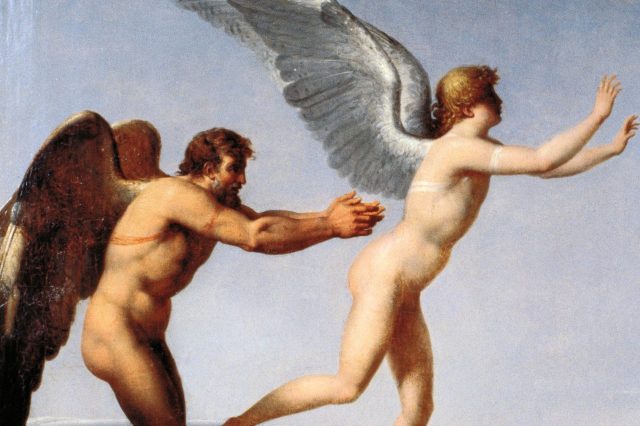
Daedalus pushing Icarus. (Heritage Images/Getty)





The King has had a word with the giants of the AI industry, so one assumes that all is now well and the Apocalypse has been called off for lack of support. Surely these CEOs wouldn’t turn a deaf ear to a bit of good old English common sense. They have flown back to the States in their private jets with the slogan “technology in the service of humanity” engraved on their hearts, and the rest of us, giddy with relief, can resume our search for a villa in Portugal for our twilight years.
Or maybe not. Perhaps capitalism will continue to act antisocially if it’s profitable for it to do so. A respect for humanity doesn’t seem to have restrained it much so far. It’s not a question of changing the minds of its leaders, as our deluded monarch seems to imagine. A few moral platitudes from Charles won’t prove enough to avert Doomsday. The economic system we have is as geared to promote profit over people as a tiger is geared to sink its teeth into your neck. If we’re all going to perish together, a plausible answer to why it might happen is organised greed. It’s unlikely that such unseemly words passed the monarch’s lips.
The word “Doomsday” suggests a punctual event, whereas one of the problems with alerting the public to the urgency of climate change is that it’s a gradual process. And we don’t tend to think of catastrophes as gradual. AI, however, is a different affair. There may come a world-shaking moment when a squad of terrifyingly brainy robots actually takes over, swarming our garden paths and emitting lethal rays, just as there may come a point in time when weapons of mass destruction are unleashed. Well, actually slightly more than a moment. It’s been estimated that such warfare could wipe out humanity in 17 minutes, time enough to try on a number of tweed suits, take the dog for a disappointingly brief walk or tell the boss what a contemptible little creep he is. The Apocalypse has traditionally been thought of as a dramatic event, an irruption of the timeless into time; in fact, some years ago, an American evangelical TV station drew up plans to broadcast Christ’s Second Coming, with cameras placed strategically at the poles and the Equator. It’s hard to know who would have taken out ads.
What the literature of Apocalypse never really took account of, however, was that we ourselves might be responsible for winding up our own history — that the disaster might constitute mass suicide rather than an outrage inflicted upon us by the Antichrist, an exasperated Almighty or a bunch of well-aimed asteroids. Diffident creatures that we are, it never struck us that we might pull off the end of the world all by ourselves, without a helping hand from the powers of darkness or a deity at the end of his tether. In accumulating the power to destroy itself altogether, humanity has finally come of age. There’s something grimly amusing about the idea of an animal that is scuppered by its own sovereignty — one which is wiped from the evolutionary record by its own eminently civilised achievements. Power becomes weakness, and progress a stealthy self-unmaking. As Freud was aware, the very forces that make life are secretly in love with death.
Like Sophocles’s Oedipus, and with just the same stiff-necked self-blindness, we bring our fate down on our own heads while priding ourselves on our sovereignty and intelligence. It never occurred to either Oedipus or us that intelligence was not just part of the answer but a major part of the problem. Our reason is unbinding itself from our bodies and confronting us as an autonomous, potentially hostile force. This is one reason why reason alone won’t save us. For a thinker like Thomas Aquinas, reason ultimately involves a kind of love — an intensely focused attention to the object we want to understand which is open to its peculiar form of being. One doesn’t hear such talk in the boardroom of Anthropic.
There have been many calls in history for humanity to unite, or to see itself as a unified whole. Such appeals are no longer necessary. We become one species the moment we reach the point where we’re capable of mass self-extinction, a point which arrived long before AI. What we share most deeply is our common killability. Not everyone has the ability to play Mozart’s clarinet concerto, but the most inconspicuous citizen has the capacity to be annihilated. We can find solidarity in death, the greatest form of democracy yet discovered, if in little else.
It’s hard to strangle someone with your bare hands. The mechanisms which inhibit intra-specific killing would probably kick in and we would simply be violently sick. Being violently sick is unpleasant, but it’s preferable to being strangled. Because we’re linguistic creatures, however, which is to say conceptual ones, we can invent ways of killing each other at long range which circumvent these bodily inhibitions. You can put up with torturing someone as long as you don’t have to listen to the screams. Language allows us to abstract ourselves from our bodies, but also to create the kind of technology to which our bodies are vulnerable. Spiders don’t have this problem, and neither would cherubs, but the human animal, being capable of complex labour through the power of concepts, is contradiction incarnate, caught on the hop between body and mind. Creatures like this, who are made up of mutually contradictory elements, were known to the ancient world as monsters. The Sphinx in Oedipus Rex is an example.
The whole of civilisation is an elaborate extension of our bodies, but these prostheses constantly threaten to slip from the control of our senses and lead a life of their own. They don’t just waltz off, however, but return to plague us. The more power we invest in them, the more our flesh and blood come under their tyrannical sway. In the economic sphere, this is what Marx calls the fetishism of commodities, in which the fruits of our labour detach themselves from our flesh and blood and come to conduct an existence of their own. We become the creatures of our own products. The relations they set up among themselves determine the material conditions of human life. It’s the market which decides who shall grow sleek and who shall starve. In this sense, superintelligence is nothing new. Bankers and stockbrokers deal with it every day. We inhabit an economy which lies within nobody’s control but which determines whether we flourish or fail. The market has a mind of its own, and like AI its intentions are by no means always admirable. It would be rash to assume that either set-up is spontaneously on our side.
There’s a long history of myths and fables which concern servants or apprentices rebelling against their masters, taking advantage of their absence in order to sport, riot and smash the dinner plates. The Shakespearian Fool wants to do this but can’t, so he contents himself with creating verbal havoc instead, running linguistic rings around the monarch and his courtiers. Ariel in The Tempest is always just about to get out of hand but just reined in by his irascible master.
We can’t, however, root out our power to manufacture cruise missiles without at the same time eradicating our capacity to feed the hungry and heal the sick, which also require complex extensions of our bodies like aid agencies, hospitals and so on. And this is our tragedy, one of which spiders and cherubs are blithely unaware. For the ancient Greeks, it was tragedy in the most literal of senses, one represented on a stage. One of the most common causes of ruin in Greek tragic art is hubris — the process by which we aspire, overreach ourselves and bring ourselves to nothing. Humankind is its own most perilous adversary. It’s in danger of evolving too fast, breeding new tools and capabilities before it has time to work out how to regulate their most negative effects. Before history began, evolution did this for us, implanting certain instincts and constraints in our bodies. Moral prohibitions can be strong, but they aren’t always as strong as the impulse to be violently sick. Now we can override these instincts, we live in constant danger, which means that our lives are more exciting than those of slugs but a lot more precarious too.
In this sense, the current alarm about AI is symptomatic of a much deeper dilemma. “To be able to overpower the monstrous progeny of our own intelligence,” writes the philosopher Malcolm Bull, “has always been the condition of human survival.” Our problem lies in being potentially infinite in creativity yet finite and fragile in our bodies. For the mind to shake itself free of the senses is a form of madness, as Shakespeare and Jonathan Swift both understood. King Lear begins by thinking his powers to be infinite and ends up acknowledging that he is not “ague-proof”. He must see and think “feelingly”, and part of what he learns to feel in his bones is the anguish of others, not least of the poor and homeless. The play contains a magnificent passage in favour of communism. To live well for Shakespeare, one must live within the sensuous confines of the body; the only problem, as he appreciates, is that we are so built as to transgress those confines all the time, and if we didn’t we couldn’t have fire engines and penicillin along with patriarchy and poisonous gas.
There’s a popular mistake that Frankenstein is the name of the monster, not the scientist who created it. The error is a significant one. Monsters are always other people. It’s a way of avoiding the fact that as Oedipus discovers, the real monster isn’t the Sphinx but his incestuous self, and in him humanity as a whole.