




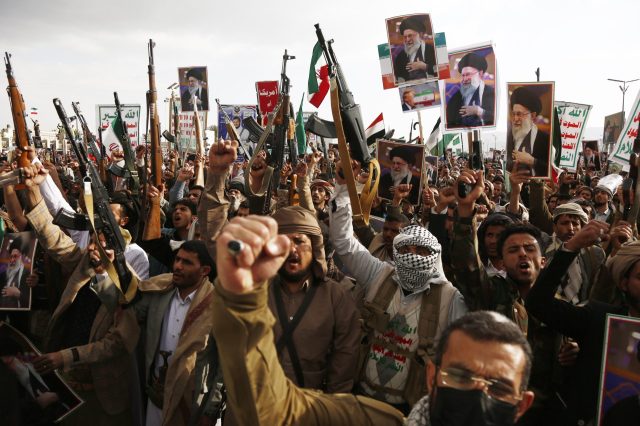
Pro-Iran protesters brandish billboards depicting the late Ayatollah Khamenei in Sana’a, Yemen. (Mohammed Hamoud/Getty)





We know the playbook by now. Donald Trump intermittently bombs Iran, albeit less intensely than when the US and Israel began their war in February. Meanwhile, his threats escalate along with his claims that the Iranians are actually begging for a deal. Never mind that this narrative is broken by leaks from the Pentagon and blatant Iranian contempt. On the President goes, hoping this latest round of threats will finally break the deadlock.
But for how long can his reverie last? After all, rumours of diminishing stockpiles only confirm what a lot of folks, though perhaps not the President, have known for weeks: the US will shortly run out of crucial missiles, drastically impairing its offensive and defensive capacities. The senior brass in the Pentagon have made it clear through leaks that they want an “off-ramp” from this conflict. As for Iran, and despite the considerable damage done to its missile and drone capabilities, it seems able to keep Hormuz effectively closed and its Arab neighbours burning for however long is needed.
Little wonder, then, that an ever-more-mocking regime insists there will be no deal that doesn’t recognise its right to levy tolls on ships passing through the Strait. To highlight its belligerence yet further, it now also wants to deny passage of any US warship into the Persian Gulf. Tehran further claims it’s negotiating directly with Oman to establish new rules of navigation, cutting Washington out. That last part probably isn’t literally true. Oman has exuberantly played both sides: working with Washington, sometimes sincerely and secretly, to hurt the clerical regime, even as it helps Iran evade American sanctions. Given the way the wind is blowing, however, the Sultanate will now surely listen more attentively to what the Islamic Republic wants.
All the while, Tehran is gleefully making it impossible for the White House to withdraw from this war — barring a flat-out surrender in the Persian Gulf, which would also inevitably weaken, if not flat-out demolish, the US sanctions regime. Certainly, Iran’s leaders believe they’ve got both the military high-ground and sufficient economic resilience to outlast the American blockade.
That matters: for it’s the blockade and sanctions, not more US bombing, that worries them most. The fact is that Islamic Republic is an economic basket-case. The regime is well aware that its abysmal management of the country’s statist economy, to say nothing of rampant corruption, has sparked small protests that can quickly accelerate into big ones. Now add war damage. If Tehran actually envisions the blockade lasting, then it’s certainly in its interest to goad Trump into a more intense conflict now. This could well create the pressure needed — from missile shortages; the Gulf Arab states; and, perhaps most consequentially, from Secretary of the Treasury Scott Bessent, who thinks a lot about financing the US debt and bond markets — for Trump to give up. Iran closely follows American commentary on the war, and knows all about how it’s making the President, and the Republicans, less popular by the day.
If Trump wants out of this duel — if he has neither the intention of waging a battle for the Strait of Hormuz, nor the stamina for a protracted blockade of the Persian Gulf — then he will have to find a means to give Tehran its tolls. In practice, that might mean a few more bombs before letting the Gulf Arabs, the Iranians, and everyone else who lives off Gulf oil and gas to figure it out among themselves.
Trump says now he’s putting his chips on the blockade, which could last until the clerical regime cracks, or until a Democratic Congress or market forces dictate otherwise. Certainly, if Bessent believes that important energy factors are enough to keep energy markets and inflation relatively stable, then Iran’s assessment of Trump’s economic patience may prove incorrect. There are reasons for American optimism here, from an increase in US natural-gas exports, which lessen the damage done elsewhere, to the fact that upwards of eight million barrels of oil are still coming through the Strait each day.
Not that America’s Middle Eastern destiny is really its own to decide. It’s increasingly clear that the Gulfies, despite Saudi Arabia’s new defence pact with Pakistan and Turkey, and for all the chatter about a revitalised Sunni Gulf Arab alliance, are prepared to pay Iran to stop the war. To Trump’s great dismay, Riyadh even prevented the use of its bases and air space when Trump last seriously tried to open the Strait in May. This highlighted what had been clear about Crown Prince Muhammad bin Salman since 2019, when Trump failed to respond to an Iranian attack on Saudi oil facilities: he no longer views the President as a reliable guarantor of his kingdom’s security. MBS, then, has become like the cautious Saudis of yesteryear. In 1996, after the Iranians blew up Americans at the Khobar Towers housing complex, they initially hid the intelligence from Washington for fear that even the détente-seeking Bill Clinton might bomb Iran in reprisal — and Saudi Arabia would suffer the blowback.
A protracted blockade can only work if Washington can keep Iran and its Houthi allies from launching damaging missile and drone barrages against Gulf energy infrastructure, including pipelines, and oil tankers in the Red Sea, which Saudi Arabia is using to offset the decline in shipments through Hormuz. The more the blockade squeezes the regime, the more inclined it will be to escalate into missiles and drones against the Gulf Arabs.
Much to Iran’s displeasure, however, tribute-paying Arabs might not shred American sanctions. After all, the Gulfies are unlikely to completely dump Washington. Facing Iran with no US backup is likely still scarier than facing the Islamic Republic with a humiliated, retrenching superpower behind them. Old habits die hard, and so too does the hope that America might somehow recover. Like Oman, the other Gulfies might well be discreet: paying Iran through opaque credit mechanisms and barter via trans-Gulf shipping. In this scenario, Tehran would let oil or LNG tankers pass in exchange for much-needed civilian and military supplies. A wounded sanctions-regime that significantly increases Iranian business costs might still linger on.
That still leaves the perplexing, insufficiently highlighted nuclear problem. The Israelis have emphasised their worries about Iran’s deeply buried nuclear facility beneath Pickaxe Mountain south of Tehran. Trump has mentioned the site, and threatened to bomb it. What’s in no doubt is that examining what’s happened at the mountain recently calls into question Israel-American narratives about damage to Iran’s nuclear-weapons programme.
Somehow, the Iranians installed thousands of centrifuges, either assembled or in parts, after the 12-Day War last June. No one in the White House or Israel has yet publicly explained how this could have happened. Did the CIA or Mossad know that the regime was transporting thousands of centrifuges into Pickaxe? Trump has said this site was being watched around the clock. Israel, too, has its own surveillance. So if Washington and Jerusalem only learnt about these activities after the fact, they have an alarming intelligence gap.
Whatever the truth, all these centrifuges must have come from somewhere, suggesting the Iranians might have thousands more hidden away. For that matter, they might also have the parts to quickly rebuild a plant for making uranium metal from uranium hexafluoride gas. To make a bomb from there, all they’d need to do is build a sphere and a trigger, something we know they had workable plans for as far back as 2003.
Among the many deficiencies of Barack Obama’s nuclear deal was that we had no accounting of Iran’s hidden stockpiles, which we nonetheless knew existed. A wide array of paperwork, normally given to the UN nuclear watchdog, the International Atomic Energy Agency, was never turned over. Critical interviews of key personnel, again normal for the IAEA, weren’t done either. Pickaxe may anyway mean that the 12-Day War didn’t actually set Iran’s nuclear programme back very far. Besides, if the regime really did get thousands of centrifuges into a closely surveilled mountain undisturbed, how can Washington possibly know that it also didn’t get generators down there to power them? Certainly, closed-door hearings of Congressional intelligence oversight committees are surely urgently in order.
When the Soviet Union collapsed, Bernard Lewis, the great Anglo-American historian of the Muslim world, started speculating what the Middle East would look like if Western powers withdrew and only Israel remained as an outpost. Lewis thought the past would probably repeat itself: Iran and Turkey, the two heavyweights of the “gunpowder age” of Islamic history, would likely hold sway once again. In the early Nineties, Turkey was already rediscovering its Ottoman Muslim identity, reanimating its Middle-Eastern appetites. Iran as the Islamic Republic hadn’t yet exhausted its revolutionary potential, despite the horrors of the Iran-Iraq War and the death of Ayatollah Khomeini. As for the Arabs, Lewis thought they were unlikely to coalesce into a competitive military force, leaving them to align themselves with either Turkey or Iran, as they had once chosen the US or the Soviet Union.
Thirty-five years on, this seems like a decent prognostication. Neither Turkey nor Iran has the power to dominate the Middle East as they once did. But they can fill a vacuum. And more than Turkey under Recep Tayyip Erdoğan, whose grand Islamist-cum-nationalist ambitions may not have a successor, the Islamic Republic has shown it has staying power and a lot of young men willing to kill thousands of their own people, as well as foreigners, to keep the dream of a new Islamic Middle East alive. It’s a blessing for the region that the Iranian regime’s internal resources don’t match its foreign ambitions. But Tehran may well have what it takes to humble the Arab side of the Persian Gulf. If it can do that, and gain the revenues that will flow from these tributaries, then a lot of other things will become possible, especially if the United States won’t be there to stop it.
Reuel Marc Gerecht is a Resident Scholar at the Foundation for Defense of Democracies and a former Iranian-targets officer in the Central Intelligence Agency.
 ReuelMGerecht