




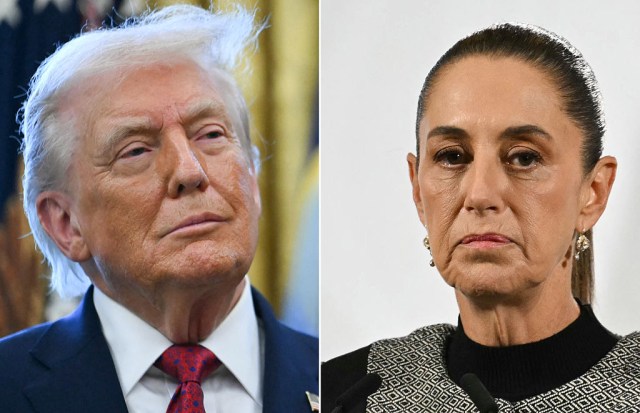
Donald Trump has turned on Mexican President Claudia Sheinbaum, despite her crackdown on cartels. Credit: Getty





Last week, the State Department revoked the visa of “Andy” López Beltrán, son of former Mexican president Andrés Manuel López Obrador (AMLO). The move is the latest escalation between the Trump White House and the Mexican government of President Claudia Sheinbaum of the Left-wing Morena party.
We’ve seen other signs of stealth-conflict: a car crash killing two CIA agents in Mexico — who may have been involved in an alleged CIA assassination campaign against cartel operatives; the indictment by US authorities of Sinaloa Gov. Rubén Rocha Moya, a member of Sheinbaum’s Morena party, over alleged drug ties. Finally, the State Department revoked visas in June for Morena Govs. Alfonso Durazo and Américo Villarreal, stating that both were under investigation.
All of this has come amid conflicting statements from Trump officials. Last month, Drug Enforcement Administration (DEA) head, Terry Cole, claimed that the Mexican government and cartel networks were “one and the same”. Days later, the US ambassador to Mexico, Ronald Johnson, credited Mexican President Claudia Sheinbaum for an ongoing crackdown against the cartels, including a nearly 70% reduction in fentanyl flows to the US. Washington and Mexico City now exhibit a two-track relationship: one in which the two countries cooperate closely over security and another in which the White House appears hellbent on weakening the Mexican government. In the new paradigm of Trump II’s bellicose foreign policy, the latter is an ominous sign that Mexico could be the next target of US military intervention.
Narco-corruption in Mexico is endemic and particularly rampant in failed states like Sinaloa and Tamaulipas. Sinaloa Gov. Rocha Moya, recently indicted by the US, was an alleged ally of the Chapitos faction of the Sinaloa Cartel — so named after loyalists to former kingpin Joaquín “El Chapo” Guzmán. In the lead-up to the 2021 gubernatorial election, the cartel kidnapped Rocha Moya’s electoral opponents. In return, the governor has allegedly given the Chapitos forewarning of anti-narcotics operations. He resigned in May following his indictment by US authorities, though the Mexican government seems unlikely to extradite him.
But it is hard to make a case that the Morena party is uniquely tainted. For one thing, virtually all of Sinaloa’s governors in recent decades have had alleged links with the state’s eponymous cartel; in the Eighties, Institutional Revolutionary Party Gov. Antonio Toledo Corro reportedly harbored Guadalajara kingpin Miguel Ángel Félix Gallardo in his home after the latter ordered the killing of DEA agent Enrique Camarena.
Yet the fact that US authorities have selectively and exclusively targeted Morena politicians suggests that the Trump administration’s chief concern is neither good governance nor the drug trade. In May, the investigative think tank InSight Crime compiled a list of the most notorious Mexican officials accused of organised crime. Of the 10 officials listed, six were associated with the opposition Institutional Revolutionary Party (PRI), two with the opposition National Action Party (PAN), and only two — including Rocha Moya — with Morena.
Sheinbaum, moreover, has rightly noted that Washington has denied all 269 of Mexico’s extradition requests since 2018, including former Tamaulipas governor Francisco Cabeza de Vaca. A dual citizen, Cabeza de Vaca is currently at large in Texas, despite embezzling roughly $300 million in concert with the Gulf Cartel. His affiliation with the Right-wing PAN has led many in Morena to accuse the Trump administration of condoning organised crime by perceived allies.
Indeed, since 2025, the White House has pardoned or granted clemency to dozens of friendly fraudsters and convicted traffickers, including Chicago’s Gangster Disciples kingpin Larry Hoover and former Honduran president Juan Orlando Hernandez. And the irony is that the first Trump administration arguably viewed AMLO, Sheinbaum’s mentor and predecessor, as a strategic ally. Officials such as former Organization of American States ambassador Carlos Trujillo lauded Mexican cooperation over trade and immigration, stressing shared interests and ideological pragmatism between both countries.
Trump I shockingly condoned record-low drug seizures under AMLO, following the dissolution and replacement of Mexico’s Federal Police with the military National Guard in 2019. In his first term, the US president similarly heeded López Obrador’s counsel against designating Mexican cartels as terrorist organisations and dropped trafficking charges against Mexican Gen. Salvador Cienfuegos. And while Trump I also denied all of AMLO’s extradition requests, it nonetheless prosecuted former opposition party PRI and PAN officials such as former Security Minister Genaro García Luna and Nayarit Attorney General Edgar Veytia.
In contrast, it’s clear that the more interventionist — and Miami-influenced — Trump II no longer regards Mexico as an ally; in June, López Obrador went as far as to pen an open letter to his erstwhile friend, writing: “For the good of all, bring back the old Trump.” Even as Sheinbaum has deepened cooperation with Washington on immigration and security, much of the GOP is now virulently hostile to the Leftist president and her party. Many Republicans sincerely believe that Sheinbaum was “installed” by the cartels. Others, such as Miami neocon Carlos Gimenez, believe that Mexico is a “narcocommunist dictatorship” — a view shared by parts of the Mexican opposition.
Trump and MAGA hardliners have repeatedly called for strikes inside Mexico — a prospect that Sheinbaum has rebuffed. In one of many occasions in which Trump has referred to strikes, he gloated: “That [sounds] like a war. Would I do it? I’d be proud to.” And the White House strategy of punishing Leftists and elevating conservatives, deployed in other Latin American countries, appears to now include Mexico as well. Last year, Trump sanctioned and tariffed Brazil over its Supreme Court trial of former Right-wing president Jair Bolsonaro. In May, the State Department revoked visas for five board members of Costa Rican newspaper La Nación over its criticisms of the Trump-aligned government.
Of course, unlike other Latin American countries, Mexico shares a border with the US and is the country’s largest trade partner. In the event of military action, the Mexican government could simultaneously close the border to roughly $1 trillion in trade and flood it with migrants by removing visa requirements on Cubans and Venezuelans. Given ongoing catastrophes in both countries, it is likely that millions of migrants would subsequently undo Trump’s signature accomplishment of slashing illegal crossings. Never mind the likely Mexican refugees fleeing US ordnance.
Unlike the unpopular Trump, moreover, Sheinbaum has her country’s support: her approval rating has hovered around 70%, giving her a better chance of weathering a protracted standoff with Washington. Viewed in this light, US lawfare against Morena politicians can be read as an effort to weaken the Mexican government ahead of an eventual conflict, diplomatic or military or both.
In the case of Sinaloa, the White House’s actions have tragically worsened security — a key reason why previous administrations avoided indicting incumbent governors. Following the arrests of Sinaloa kingpins Ovidio Guzmán, Joaquín Guzmán and Ismael “El Mayo” Zambada, the cartel has split between Guzmán and Mayo loyalists. With the Chapitos-and-Guzmán-allied Rocha Moya out, the Mayos have exploited the power vacuum to settle scores. Local journalist Luis Armando Becerra, a native of Culiacán in Sinaloa, told me that while he found the US indictments to be credible, officials “failed to consider its effects on local security”.
The Trump administration now appears to be taking a subtler approach toward Morena officials. Despite having their visas revoked, Govs. Durazo of Sonora and Villarreal of Tamaulipas, as well as Gov. Marina del Pilar of Baja California, whose visa was revoked in 2025, have traveled to the US under a parole program reserved for informants. In July, a leaked phone call between Del Pilar and a purported FBI intermediary showed the governor offering to cooperate with US authorities.
It’s unclear whether US officials plan on indicting any of the aforementioned governors. Del Pilar is known to have associated with traffickers through her ex-husband; while plausible, Durazo and Villarreal’s alleged links to organised crime have yet to be substantiated. More likely is that the Trump administration aims to gather testimony for a bigger indictment; another possibility is that it is trying to co-opt governors it views as politically or geographically strategic.
Much of the Mexican opposition believes that Washington aims to indict López Obrador, arguing that his son’s lavish lifestyle is a sign of drug money; the State Department has yet to give a motive for revoking the younger López’s visa. The DEA, however, has long attempted to substantiate alleged links between AMLO and the cartels — to no avail. In 2024, ProPublica revealed that the agency investigated claims that traffickers funnelled $2 million into López Obrador’s 2006 presidential campaign, but couldn’t prove whether the former president “sanctioned or even knew of the traffickers’ reported donations”. Subsequent attempts to incriminate AMLO based on testimony from kingpins have failed to bear fruit.
Alternatively, the Trump administration has shown a keen geographic interest in the US-Mexico border; Morena Govs. Del Pilar, Durazo and Villarreal control states neighbouring Texas, Arizona, and California. The remaining border states of Nuevo León, Coahuila and Chihuahua are run by opposition governors, whom the White House likely sees as allies. Unlike Del Pilar, Nuevo León governor Samuel García has yet to face scrutiny from Washington despite comparable familial ties to traffickers.
Indeed, the April deaths of two CIA officers were in the PAN-governed border state of Chihuahua. The two officers were found to have entered Mexico illegally with the blessing of embattled Chihuahua Gov. Maru Campos. Despite being nearly suspended from office over the incident, Campos subsequently authorised a joint surveillance hub with US agencies in Ciudad Juárez. US lawfare against Morena governors may ultimately be aimed at safeguarding CIA operations along the border — including its alleged assassinations of cartel members.
And yet, Sheinbaum’s government is arguably the most cooperative and competent Mexican partner that Washington has ever dealt with on security. The president and her security minister Omar García Harfuch have overseen a remarkable crackdown against organised crime, prioritising mid-level cartel members in tandem with kingpins in addition to a policy of mass incarceration.
Outside of Sinaloa, Sheinbaum’s strategy has managed to limit infighting within and between cartels following decapitations of kingpins such as Cartel Jalisco Nueva Generación (CJNG) head Nemesio “El Mencho” Oseguera. Authorities quashed subsequent retaliations throughout the country within 72 hours. Just days after DEA head Cole’s comments regarding the Mexican government, Security Minister Harfuch thanked the DEA for its help arresting fugitive Janero Van Demario Garrett for cocaine trafficking.
Fentanyl seizures south of the border have risen to record highs while seizures north of the border have plummeted to record lows. Mexico has also illegally extradited nearly 200 kingpins to the US. Government figures point to a record 50% reduction in homicides across the country, with independent analyses putting the figure closer to a nonetheless historic 20%. Sheinbaum and Harfuch have even prosecuted more than 60 local officials with ties to organised crime, including from Morena. The charitable reading of White House pressure is that it has given the president cover to make difficult but welcome changes; last year, Sheinbaum reportedly forced the resignation of Mexico’s spectacularly corrupt attorney general, Alejandro Gertz.
Yet the sad reality is that neither Trump nor MAGA care about concrete results on security. And so long as millions of Americans remain addicted to illicit drugs, no amount of bombs will make a difference to the logic of the drug trade. Instead, the Trump administration would do well to continue aiding Mexican efforts at incarcerating violent criminals; it could also explore a program of mandatory institutionalisation and rehabilitation for public drug abuse at home.
However, if success is selling televised, performative “wins” to supporters, the picture changes. In Mexico’s case, that could mean dropping missiles on alleged “narcoterrorists,” never mind the roughly 25 million Americans who visit Mexico each year, the 1.6 million US citizens who call the country home, and the likelihood of setting off a costly and indefinite endeavour with untold blowback for civilians in both countries.
The hallmark of a forever war entails a nebulous objective against an irregular actor on an open-ended timeline. In every way, the MAGA pipe dream of cartel wars in Mexico fits this description — and the groundwork is being laid.
